




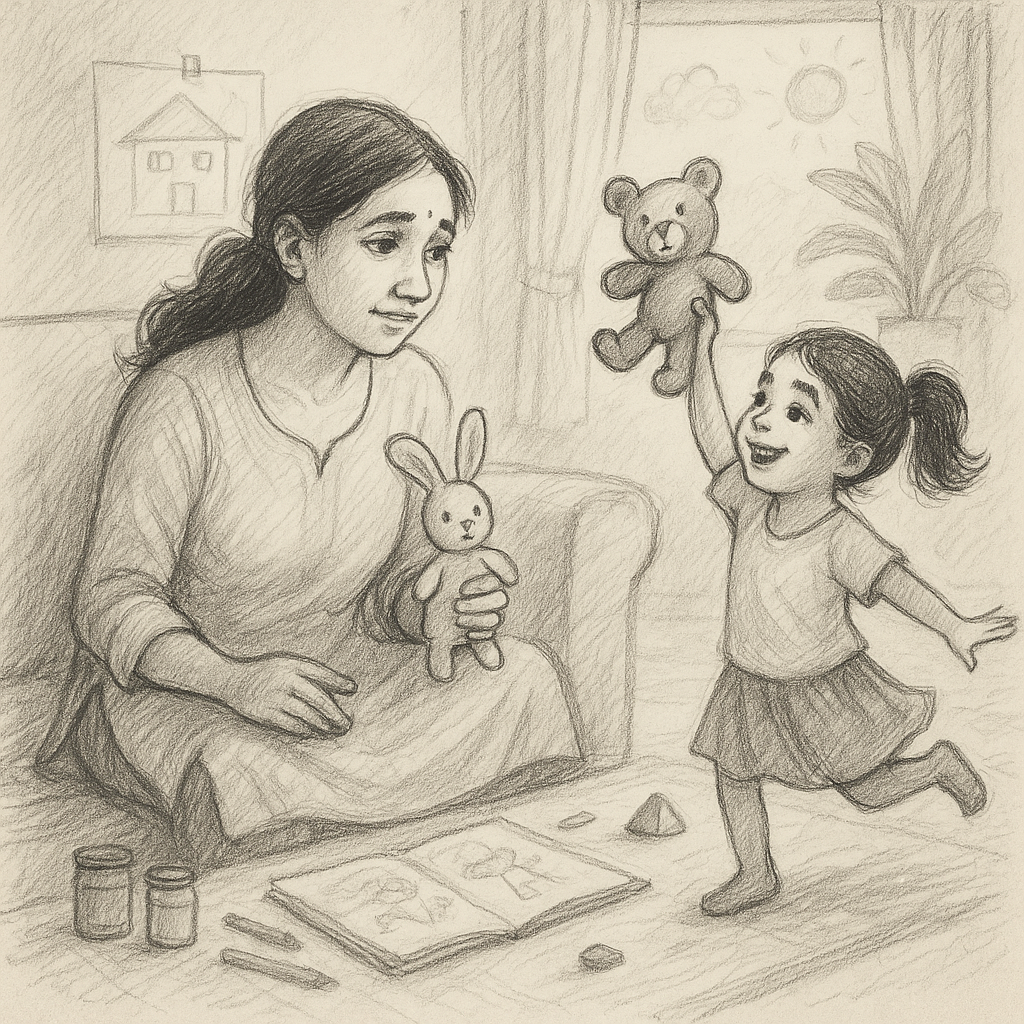
Over the past few months, we have been in conversation with caregivers across India—parents, grandparents, childcare workers, and community members who hold children’s everyday worlds together. This two-part series Thriving Caregivers Enable Thriving Childhoods captures some of what we saw and heard along the way.
In the first part, Rethinking Parental Well-being, we share why supporting caregiver well-being is not a side issue but the foundation for thriving childhoods.
In the second part, Resilient Parenting, we reflect on how resilience showed up in the day-to-day practices of parents—through small choices, quiet strengths, and the slow work of building steadiness over time.
This is not a set of instructions or advice. It is a weaving together of what resilience looked like, on the ground, in real lives.
___________________________________________________________________________
In the conversations we’ve been having with parents and caregivers across different settings, one thread kept surfacing: Resilience wasn’t about having all the answers. It wasn’t about perfection, elaborate plans, or following every piece of advice.
It showed up quietly—in the small, steady ways families made space for uncertainty, for growth, and for learning to live with what they could not always control.
Here’s what stood out to us about resilient parenting on the ground.
Struggle Wasn’t Seen as Failure
The parents we saw practicing resilience didn’t rush to smooth over every difficulty. When their children stumbled—whether struggling to eat independently, feeling left out by friends, or facing everyday frustrations—they didn’t immediately intervene to fix it.
Instead, they stayed close. They let the struggle happen, offering support without taking over. They seemed to carry an unspoken message: It’s okay. You are strong enough to work through this. And I am here if you need me.
It wasn’t about being distant or hands-off. It was about trusting that learning happens inside the struggle, not after it’s been removed.
Boundaries Were Actively Protected
Another thing we noticed: resilient parents were selective about what they let in.
Many spoke about the pressure to sign their children up for endless activities, to chase milestones, or to follow rigid schooling timelines. But they had learned to filter the noise.
- Some kept weekends free for unstructured play.
- Some chose slower-paced schools even when others questioned them.
- Some simply gave their child—and themselves—permission to move at a different rhythm.
Setting boundaries wasn’t always easy, but it helped families protect what mattered most: space, rest, joy, and presence. And in doing so, it also showed children that it is possible—and important—to say no to things that don’t serve you.
Community Made It Possible
Almost every resilient parent we spoke to had found some form of community, even if it looked different from what they had imagined.
Sometimes it was another parent from school, a neighbour, a cousin, a friend. Sometimes it was a WhatsApp group where people could vent or share small victories. Sometimes it was two families informally taking turns watching each other’s kids when one needed a break.
Resilience didn’t grow in isolation. It grew because people allowed themselves to ask for help—and gave it freely when they could.
The families who seemed most grounded weren’t the ones who “managed it all” on their own. They were the ones who built small webs of trust around them, quietly and steadily.
Resilience Was a Practice, Not a Trait
Most of all, what stood out was this: Resilience didn’t look shiny or extraordinary.
It was a practice—something parents returned to again and again, often without fanfare. It lived in the willingness to repair after a bad day. In the choice to slow down even when it felt easier to rush. In the patience to let a child feel their feelings, instead of pushing them away.
Resilient parenting wasn’t about being unshakeable. It was about being willing to keep showing up—with softness, with sturdiness, and with the belief that both the parent and the child could grow through uncertainty, not despite it.







 )
)