

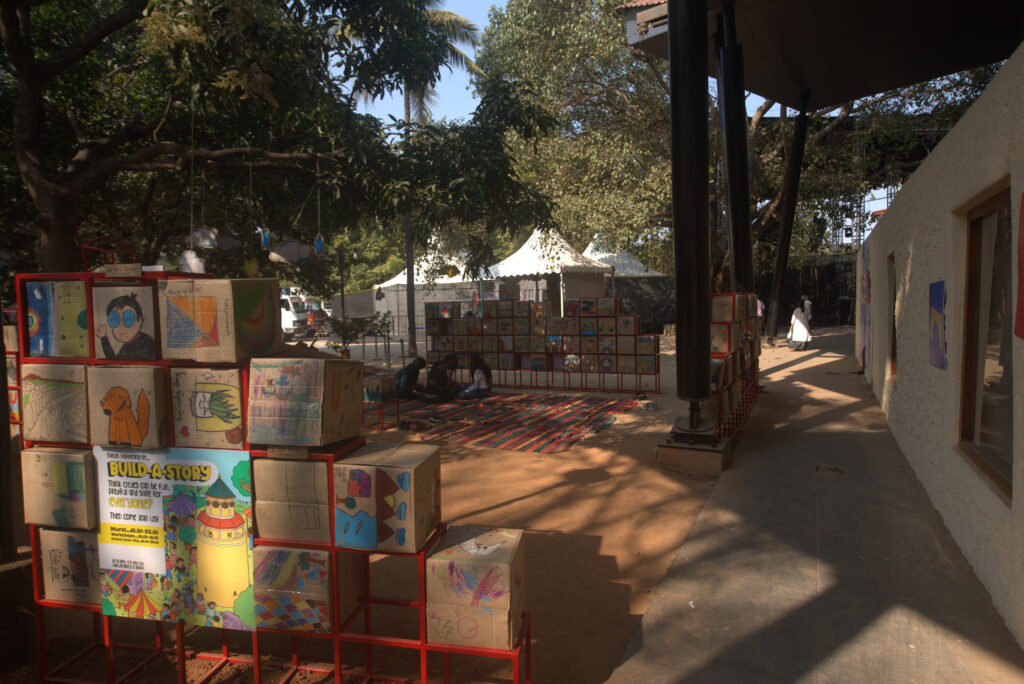
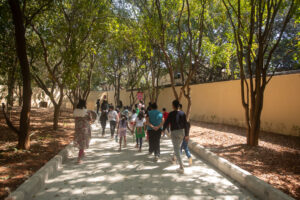
For ten days in January 2026, Freedom Park opened up in a way the city rarely does. The grounds held installations, trails, books, music, and movement, but more than that, they held time differently. Children lingered. Adults stayed close without directing. People moved through the space at their own pace.
Makkala Hubba brought together a wide set of practitioners. Artists, architects, educators, designers, storytellers, and community builders worked alongside each other to shape what the park became. The curatorial direction by Bhawna Jaimini, along with a large team across design, production, and communications, gave the Hubba its structure while still allowing each piece to breathe.
Explore the full Makkala Hubba programme here.
What unfolded across the park was varied and layered.
There were immersive environments like Phytoplankton World, supported by the Museum of Goa Foundation, where children moved through a glowing ocean and encountered marine life through touch and imagination. In another part of the park, Where the Wild Things Are by Made in Earth Collective created a suspended forest of grasses and foliage, inviting children to sit, sift through red earth, and stay with the textures of the land.
The Children’s Art Studio (CAS), led by Sharada Kerkar with Tincy Paulose and P. S. Soorya, brought storytelling and art into a shared, open space where making and learning happened side by side.
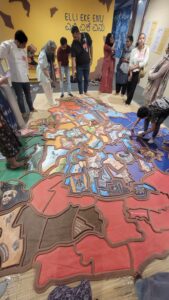
Games and city-making took shape in installations like Elli, Ekke, Ennu, shaped by Anchita Kaul, Akshata Avarsekar, and A. Shree Tej, where children pieced together Bengaluru through clues and shared discovery. Nearby, Atada Angala by Games for Ed turned local culture, food, and sustainability into playful, social experiences.

Structures like Aata Ooru: Play City by Roshni Gera and Bharat Raj Thukral offered something more open-ended. Children climbed, paused, and returned, finding their own ways of engaging with the form.
Several installations stayed close to ecology and the city’s natural rhythms. Follow the Butterflies, shaped by Padmini Ray Murray along with Sanika Dhakephalkar and Majid Abidi, drew from migration patterns in the Ghats. Kere Party by Deepa Juliana brought lake ecologies into a story-led experience, while Bana Trails, led by Saidevi Sanjeeviraja, invited children into guided explorations of their immediate environment.
Food, memory, and everyday culture also found their place. Cook & Keep by Shruti Taneja, with illustrations by Aaryama Somayaji, turned regional ingredients and recipes into a life-sized game. In another corner, I Dream in Blue by Rohini Kejriwal transformed small, familiar objects into blue-toned dreamscapes that children and adults returned to.
Reading and storytelling moved through spaces like Odu-Nali, anchored by Kahaani Box, founded by Neha Jain, and Bee’s Bookspace, founded by Apoorva B. A, where books, drawing, and conversation sat side by side. Nearby, Build-a-Story by BBLOX Design and Leewardists gave children a way to imagine and draw their own versions of the city.
There were also moments that gathered people differently. Hush Hour, held each evening by Akash Narendran and Deepthi Bhaskar, brought people into a shared space of lullabies and rest. The Godhadi Project, supported by the Museum of Goa Foundation, gathered thousands of textile works created by students into a collective reflection on inclusion and difference.
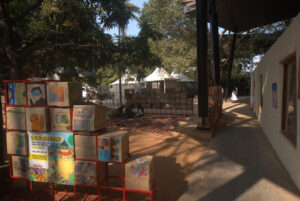
The Hubba was anchored by UnboxingBLR and supported by EkStep Foundation through Bachpan Manao, along with a wider network of collaborators, schools, and community partners who contributed across the ten days.
Across the Hubba, the many elements that shape early childhood came alive in ways that felt familiar and easy to recognise. Children moved freely between play and moments of rest, spending time outdoors with soil, water, and living systems, while also returning to books, stories, and shared imagination. They built things with their hands, took on small tasks, and found their own ways of solving problems, often alongside other children and adults. Friendships formed in passing, across ages and spaces, and learning unfolded through curiosity rather than instruction. Art, music, movement, and storytelling created space for expression, while pauses in between allowed children to slow down and take it in.
What emerged was not a set of separate experiences, but a continuous flow where play, social connection, creativity, learning, nature, everyday skills, stories, and rest sat alongside each other, shaping how children explored and made sense of the world.
Across the park, people moved between installations without urgency. Children returned to the same spaces, each time finding something new. Conversations unfolded in passing, often between people who had just met.
Makkala Hubba held all of this together for a brief period of time. A shared space shaped by many hands, where childhood could feel whole, relational, and held within the life of the city.
Watch the Hubba
A glimpse into how the Hubba unfolded across days, spaces, and shared moments here, here, here, here, here, and here.
In the Media
The Hubba was also documented and interpreted across platforms, each capturing a different slice of what unfolded at Freedom Park. From on-ground reportage like this piece in The Times of India, which described the park turning into a “living classroom” shaped by mud, maps, and microbes, to reflections such as Scale Magazine’s take on Makkala Hubba that framed it as a shared public act of reclaiming childhood, the coverage stayed close to the experience itself.
Previews and city-wide context from outlets like The New Indian Express and Hospitality News situated the Hubba within the larger BLR Hubba moment, while shorter formats like News Minimalist captured its essence as a space of discovery and play. Across formats, what emerged consistently w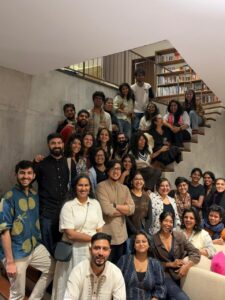 as a sense of the city pausing, even briefly, to make space for how children experience it. The LURU Magazine team hung out at Makkala Hubba that week too – watch them enjoying and celebrating childhood here.
The People Behind the Hubba
The many hands, minds, and hearts that came together to shape the Hubba.


 )
)