

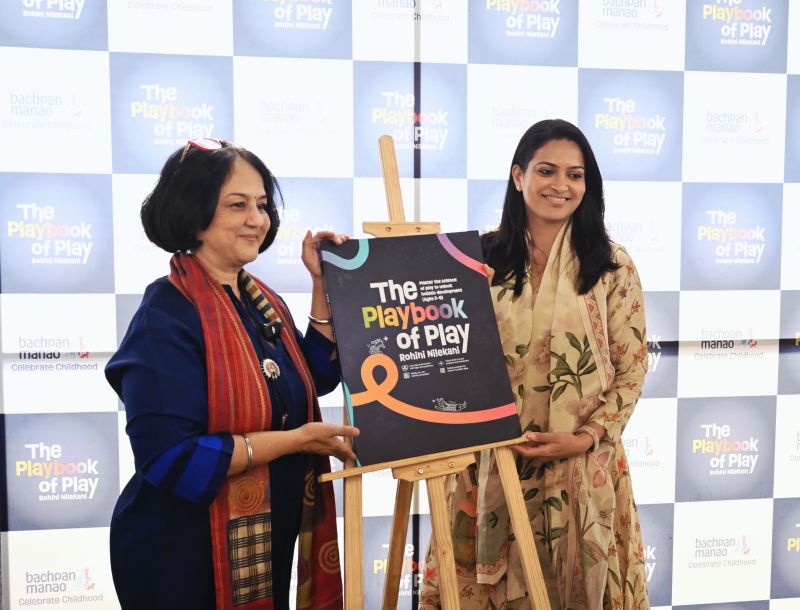
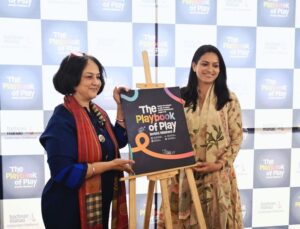
At Makkala Hubba this year, the Playbook of Play was introduced by Rohini Nilekani in a format that stayed true to the idea it was putting forward.
The playbook itself was presented as an empty book.
It was not introduced as a finished guide or a compiled set of activities. Instead, it was positioned as something to be built over time, through lived experience, observation, and participation. The moment of unveiling brought together members of the press and social media practitioners, but the emphasis remained on what the playbook could hold going forward, rather than what it already contained.
The setting of the launch made this clearer. It took place within Makkala Hubba 2026 at Freedom Park, in the middle of an environment already shaped by play, movement, and interaction. Around the launch, children were building, drawing, climbing, listening, and returning to spaces in their own time. Adults moved alongside them, sometimes participating, sometimes watching, often adjusting their role without being prompted.
Within this context, the playbook did not feel like an external addition. It felt connected to what was already unfolding.
Developed as part of EkStep Foundation’s Bachpan Manao initiative, the Playbook of Play sits with a simple idea that the early years of childhood are shaped through everyday environments and interactions. The time adults are able to give, the materials children can engage with, and the freedom to explore without constant correction all influence how children learn and relate to the world.
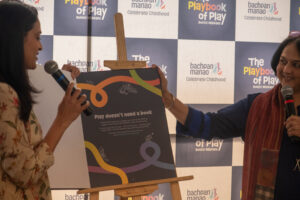
At Makkala Hubba, these conditions could be seen across the park. Installations were not structured around completion or fixed outcomes. Children moved in and out of spaces, often returning to the same installation multiple times, each time engaging differently. What held across experiences was a sense of continuity, where play, curiosity, and interaction unfolded over time.
The playbook aligns with this way of thinking, not by prescribing what should be done, but by creating a frame that can be shaped through use. It leaves room for interpretation, for local contexts, and for the specific relationships between children and the adults around them.
Through Bachpan Manao, there has been an ongoing effort to make early childhood more visible in public life, to bring it into shared spaces and conversations. The playbook becomes one way of extending that effort, allowing people across homes, schools, neighbourhoods, and community spaces to engage with these ideas in their own ways.
Across the Hubba, many of the elements that shape early childhood could be seen coming alive in familiar ways. Children moved between play and rest without being rushed, spent time outdoors with soil, water, and living systems, returned to stories and books, built things with their hands, and formed connections with other children and adults around them. Art, music, movement, and imagination sat alongside everyday tasks and moments of pause, shaping how children explored and made sense of the world.
Seen together, these were not separate activities but part of a continuous flow, where play, social connection, creativity, learning, nature, stories, everyday skills, and rest existed alongside each other.
The launch of the Playbook of Play sat within this flow. It did not stand apart from it. It pointed to the possibility of carrying this way of seeing and engaging with childhood into other spaces, shaped by the people and contexts that take it forward.



 )
)