



The experience of a child, going to preschool, starts the moment they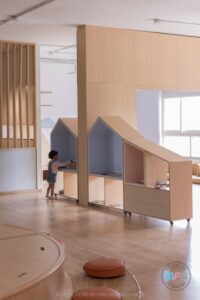 stand before the entry gate of the school. While they spend most of their time in the learning and activity spaces, sometimes the transition spaces are most impactful.
The entry gate or building entrance marks the first big transition as the child leaves the family zone to enter the social zone- this marks the first opportunity for growth. Allowing a child to comfortably make that transition, growing above their discomfort, is the role a well designed transition space can play. The learning spaces are the spaces which welcome a child to explore, to engage and to connect.
In our experience of designing schools of various curriculums and varying scales, what remains a strong underlying vision is one where the space is the backdrop to the child’s learning and development. The space which contains all the activities the child engages in, is like a canvas, allowing it to be recreated in different ways on different occasions. The 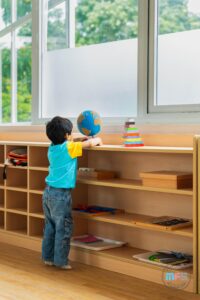 space that is subtle allows the child to remain the focus and shine through. The space allows the learning aids and the toys to perk the interest of the child, while itself melting as the backdrop.
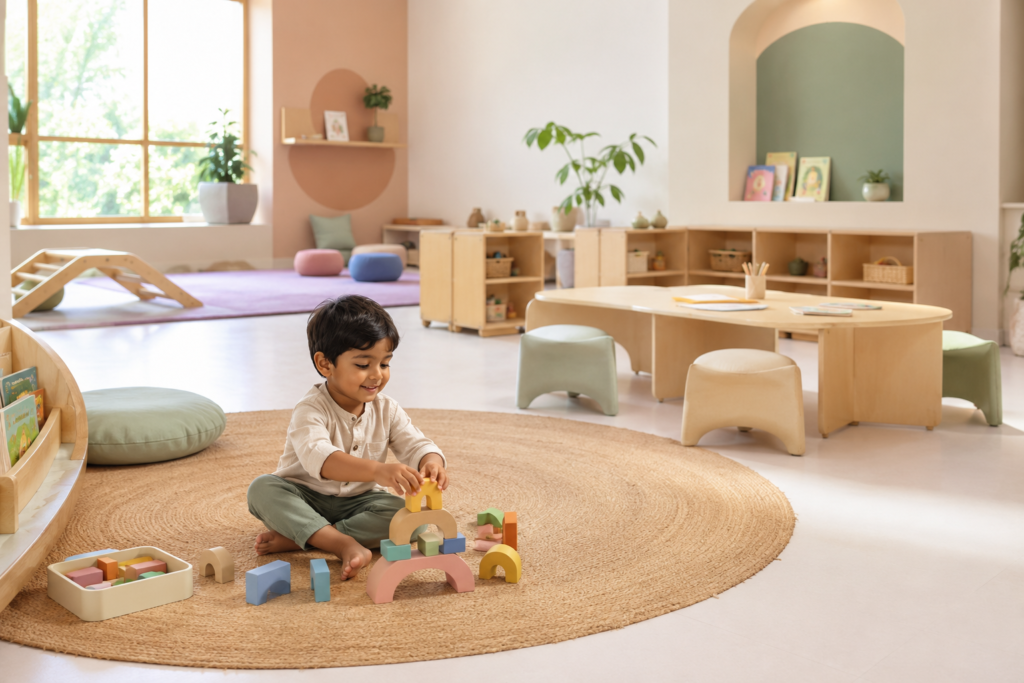
The use of clean lines, light subtle hues, soft silhouettes and open ended surfaces – some key ideas which make the backdrop beautiful. In a space which has the above elements, the child remains adequately stimulated, without multiple colours and forms vying for attention.
At different stages of development, children have varying needs and areas of focus. For example, as toddlers, with their peak development happening in the areas of motor skills and sensory skills, a suitable space allows and creates opportunity for these skills to be practiced.
Materials allowing tactile exploration, while ensuring ease of movement with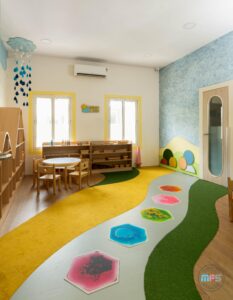 simple levels, light mono colours create rich opportunity for toddlers to engage their senses while not challenging their developing physical stability.
At an age of 6-9 years, for example, a child who is focused on cognitive growth, would do well in a space which allows for least distraction and facilitates areas of quiet activity.
Spaces that encourage little groups to gather, for 2 friends to pause and engage in an activity together, passively become the cheerleaders for psycho social development .
In such an environment, the furniture nudges a shy child to reach out independently, invites a quiet child to sit down, an excited child to slow down. The layout directs the child to independent movement, instilling the confidence of freedom.
A well designed space allows the child to make their choice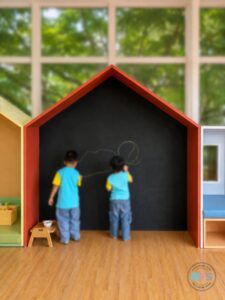 and for facilitators to be the guides- the best balance between optimised stimulation and open ended usage. An ideal shared space for children facilitates learner’s autonomy, itself being the backdrop for growth and learning. The space is the stage on which each child shines, While children come and grow,the space remains a dynamic yet passive spectator and backdrop to the development and learning that each child experiences. A well designed space continues to stand a spectator, supporting the many stories that unfold within its confines.



 )
)