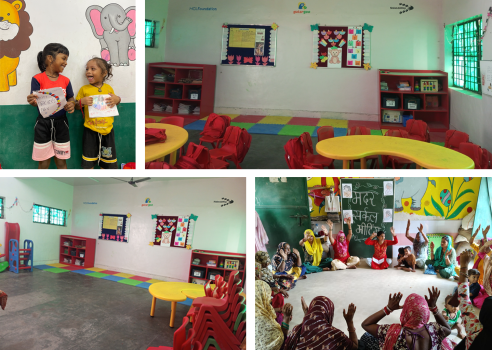
A leaking roof left Hoshiarpur Anganwadi Centre in Noida unsafe for a month, damaging wiring and walls. NalandaWay Foundation’s intervention brought repairs, new furniture and paint — restoring a safe, joyful learning space for the Centre’s 43 children.
Mastiwadi, by KhojGhar in Sukma, Chhattisgarh, reimagines Anganwadis as spaces of joyful, self-directed play. Its 15 locally-sourced installations include the Texture & Material Wall — a giant fish holding 34 tactile materials — turning everyday objects into sensory stories that connect children’s play to their surrounding world.
A day-in-the-life account of Rita, an Anganwadi worker in Bhuj’s Ward 8, showing how a job once dismissed as “2 kalak ni naukri” (a two-hour job) actually stretches across meals, health monitoring, digital app burdens, ration distribution hurdles, and unpaid dues — yet she stays for the children who keep her coming back.
A piece examining India’s childhood screen-time crisis, where feeding-time device use displaces essential unstructured play. It highlights Bachpan Manao’s non-shaming “Less Screen, More Play” pledge and its second-year “Bachpan is Gr8” framing, including PM Modi’s recent remarks urging play over screens for children.
Screen time isn’t the disease, it’s the symptom. Deepika Mogilishetty traces what free play’s disappearance from Indian childhoods really cost: unstructured hours, public play spaces, and present adults. Drawing on Bachpan Manao’s Voices of Play data and evidence from Anganwadis to J-PAL trials, she argues play is infrastructure, not a soft add-on, and funding it is cheap.
On a former garbage dump, a Mobile Creches centre in Barrackpore is teaching children discipline, routine, and independence — one row of slippers at a time.










 )
)