

2 Kalak Ni Naukri, follows a day in the life of an Anganwadi worker, Rita,in ward 8 of Bhuj city, understanding how her day usually expands . Rita’s day begins before the children arrive and continues long after they leave. From preparing activities and monitoring children’s health to distributing rations, maintaining digital records and taking on additional government duties, the work stretches far beyond the classroom. Through a day with Rita, we look at many works that make an Anganwadi function.
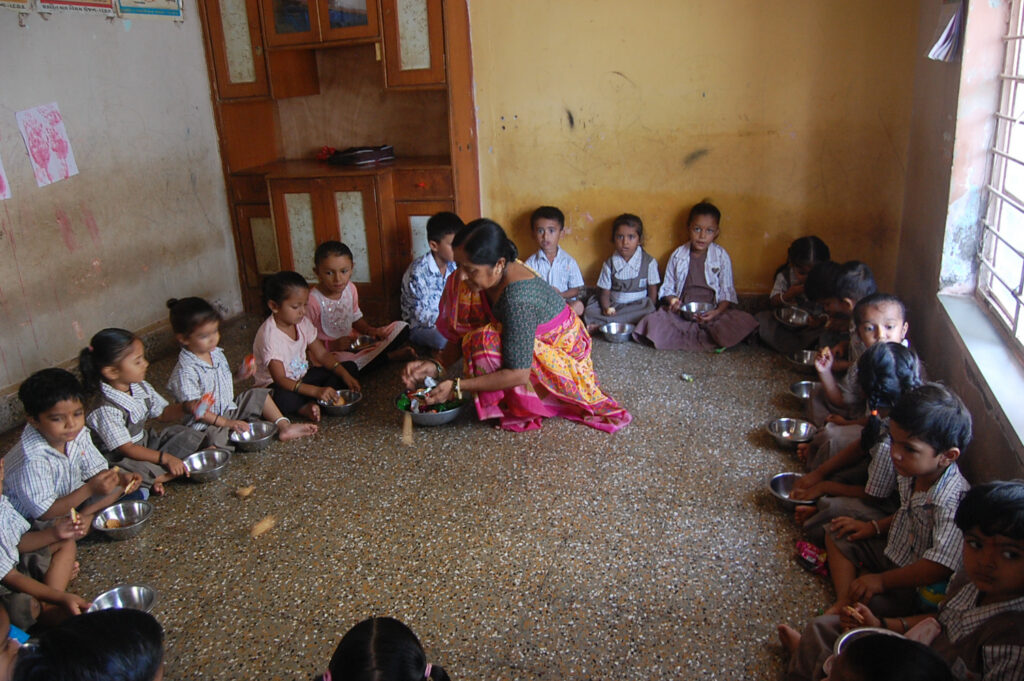
At 9:30 in the morning, Rita, an Anganwadi worker in a neighbourhood Ward 8 of Bhuj, reaches the Anganwadi. The helper has already cleaned the space, and Rita starts the day by rearranging the room and getting the plates ready.
Swadha and I, from the Centre for Urban Commons, spent a day with Rita at the Anganwadi.
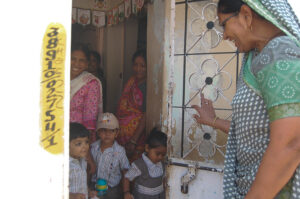
The children begin arriving at the Anganwadi, accompanied by parents and grandparents.
Soon, the children begin arriving, dropped off by their parents and grandparents. The day starts with a warm breakfast prepared by the helper. Rita serves the children, makes sure everyone is eating, and then clicks a photograph for the Poshan Tracker app.
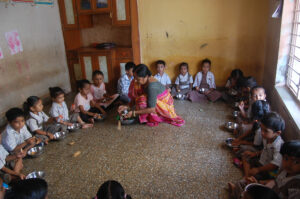
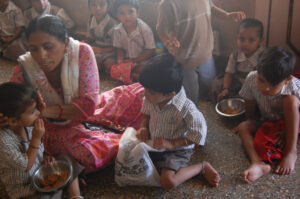
The day begins with a warm breakfast, prepared and served by the helper.
For Rita, keeping up with the Poshan Tracker app has become one of the biggest challenges of her work. Attendance, breakfast, activities, lunch, and weekly height and weight updates all have to be recorded online.
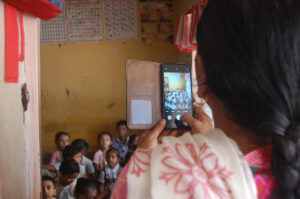
Attendance is recorded for the day, along with the many other details that Rita has to update online.
“They have not given us a mobile phone. Everything needs to be done through our personal phone. They don’t even give us money for the internet,” Rita tells us.
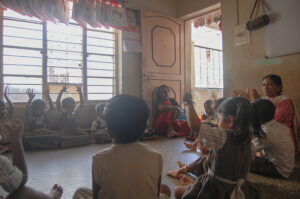
Every month brings a new theme, around which different activities are planned for the children.
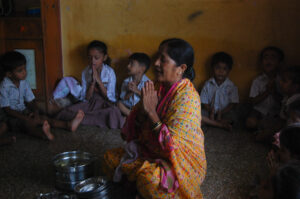
Before eating, the children gather for their daily prayer.
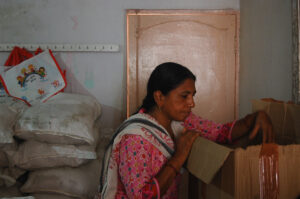
After the children leave, Rita continues with the distribution of Take-Home Ration packets.
Rita tells us that distributing rations has also become more complicated. The guardian’s face has to be captured, followed by an OTP verification, before the ration can be given. Without Aadhaar or completed KYC, children cannot be registered. The number of registered children has now fallen to 65; earlier, there were as many as 100. “Earlier it was easy. We just needed to get their signature and give them the THC packets. Now the app has become additional work.”
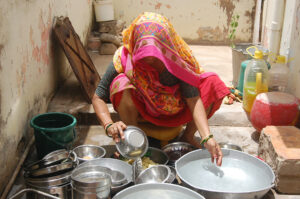
Even after the children leave, the work at the Anganwadi continues.
It is Tuesday, and the ASHA worker visits the Anganwadi to check the height and weight of the children and conduct health check-ups for pregnant and lactating women.
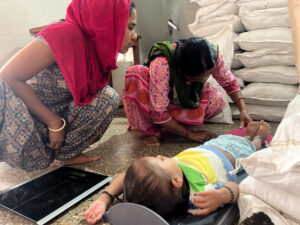
Rita keeps track of the children’s height and weight as part of their regular health monitoring.
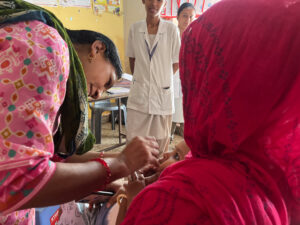
Weekly, children also receive their routine health check-ups and vaccinations.
Before becoming an Anganwadi worker, Rita, like many others, thought of the job as “2 kalak ni naukri” – a two-hour job.
But the day stretches far beyond two hours.
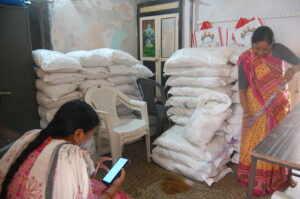
While the helper cleans, Rita catches up on the work that has to be recorded online.
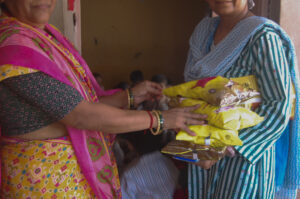
Take-Home Ration packets are distributed to registered children and families
After the children leave, Rita cleans up while parents, mothers and kishoris continue to come for their rations. There are registers to complete, photographs to upload, and information to update online.
All this comes with a monthly salary of ₹10,000. Rita says she has not received her rent reimbursement for six months, and she often spends her own money on groceries for the children’s meals while waiting months for reimbursement. Even her weekends are now spent working on the ongoing Special Intensive Revision (SIR) of electoral rolls.
When asked how she continues despite these disparities, Rita talks about the children.
She loves working with them, she says, and the affection she receives from them is what keeps her tied to the Anganwadi.
What was once seen as a “2 kalak ni naukri” stretches across the entire day but it is the children that keep her coming back.





 )
)