

Field Visit to Mobile Creches, Barrackpore
Names of parents have been changed to protect their identities.
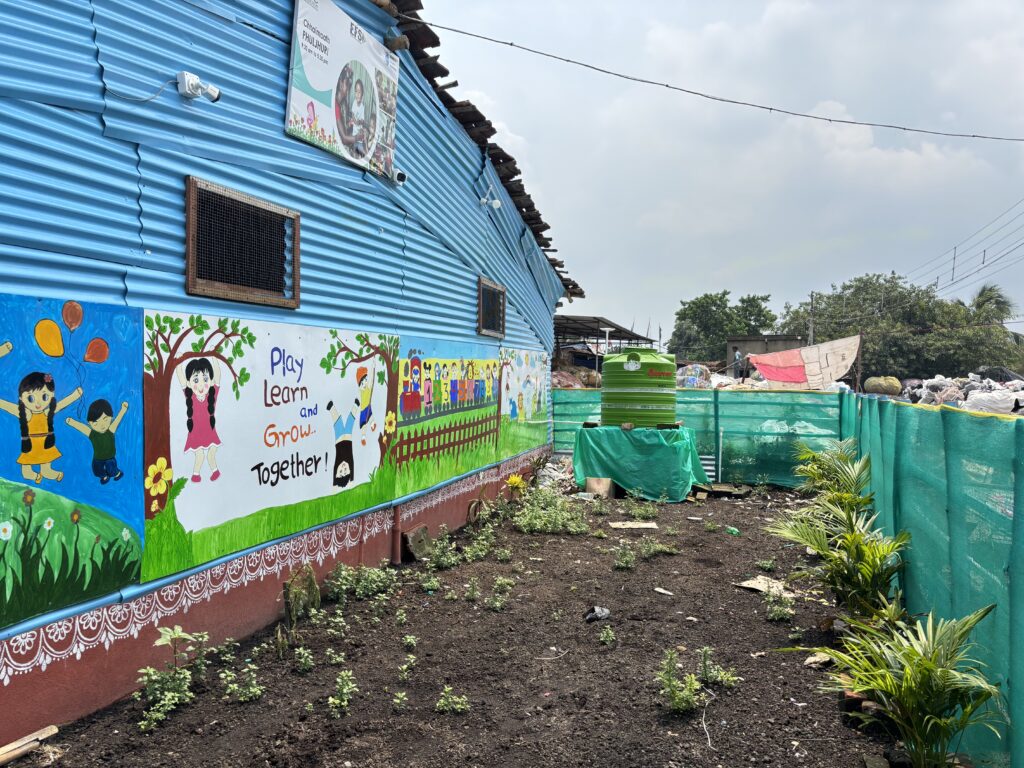
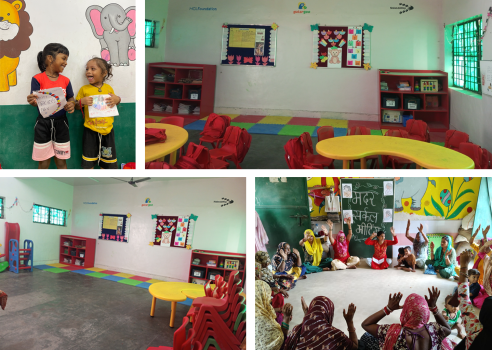
We visited the Mobile Creches centre in Ward 16, Barrackpore, on Muharram, which meant the centre was quieter than usual, though not empty. The site itself used to be a waste dumping and segregation ground, and now sits pat in the middle of it, like an oasis constructed in asbestos. The centre’s implementing partner, SPAN (Society for People’s Awareness), a Kolkata-based organisation active in this locality for about fifteen years, had to negotiate permission from the local councilor and spend months clearing the site before it could take in a single child. Before that, this stretch of ground was where children in the area already spent their time, sometimes sorting through waste alongside their parents.
The centre now runs three age bands under one roof: a creche for 6 months to 3 years, a Balwadi for 3 to 6 years, and a bridge course for 7-to-12-year-old school dropouts. Around 49 children move through an 8-to-9-hour day that includes three meals, monthly growth monitoring on a weighing chart, and a fixed daily rhythm drawn out, hour by hour, on a board inside the centre. There’s a Child Protection Policy posted and explained to every visitor before any photographs are taken — group shots only, with consent, no image of a single child alone.
Slippers
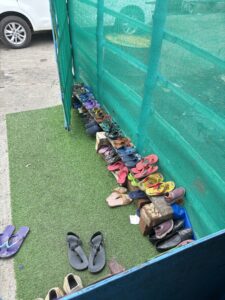
Ask a facilitator here what’s changed for the community since the centre came to be, and more than one reaches for the same example, something we noticed as we walked into the centre as well: chappals.
Children are taught to leave their slippers in one designated spot before entering. A facilitator explained it directly:
“We don’t keep them (the slippers) for them; we teach them because discipline is very important… Before, they used to leave chappals anywhere, but we encouraged them to keep them right there” (she points at the little fence that doubles up as their front door).
It’s repeated by staff almost like a fixed reference point, a visible, at-the-door proof that something has shifted, before a parent has even walked past the threshold.
Slippers are just the tip of the iceberg.
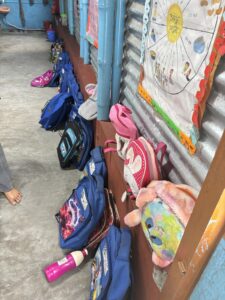
Rekha, whose child has been enrolled for over a year, described the effect on her household routine:
“I learned that children need a timetable… now on a regular timetable… tension-free (chinta mukt).”
Anjali, on nutrition:
“The nutrition problem is solved now. We took her to the doctor here, and to one outside too — both said she’s fine. Before, she wouldn’t eat mashed potato, wouldn’t touch taro. Now she eats everything.”
What the facilitators told us about their own approach
Ask what the discipline here is built from, and facilitators don’t point to correction — they point to repetition. Nobody is scolded into it. One put it directly:
“We don’t scold, scold, or scare them… We don’t say, ‘I will stick you inside,’ or ‘I won’t let you go out.'”
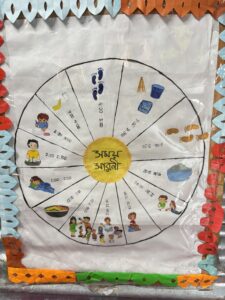 What they describe instead is the same shape as the slippers: a rule shown once, then shown again, at the same spot, at the same time, until a child d
oes it without being told. The timetable does a version of this too — not as a constraint but as the thing that made Rekha’s household “tension-free.” Discipline here isn’t a correction applied to a child; it’s a rhythm a child is folded into, repeated daily until it becomes theirs.
That same rhythm carries into how the centre teaches. Learning is built around monthly themes — fruits one month, vegetables the next, then transport, then professions like doctors and engineers — taught through recognition games rather than instruction. For the youngest children, even simpler: learning what their own hands do, what “hot” and “cold” feel like, through movement and drama. It’s the same method as the slippers by the door, just aimed at a different kind of knowledge: nothing here is announced once and left to stick. It’s returned to, monthly, daily, until a child owns it.
What actually convinces a parent to send their child here
Asked directly, parents didn’t describe a single deciding moment so much as a stack of practical relief — worries that got solved one at a time. Proximity and safety came up first and most often, tied specifically to the busy road running past the settlement.
Nutrition was the second thing named, almost every time, framed less as a nice-to-have and more as a problem that had simply been closed off.
And underneath both of those sits something more structural: this is a community built around rag-picking and plastic sorting, work that doesn’t pause for childcare. Meherun put the calculation plainly:
“Biggest thing is knowing they are safe while we are at work.”
What we noticed as a field team
Nothing about this visit involved a big reveal, and nothing about the site made that obvious. The building sits on what used to be a dump. There’s asbestos in the roof. When it rains, water gets in and mattresses have to be pulled off the floor mid-nap. By any measure of infrastructure, Barrackpore has less than almost anywhere else on this project.
And yet it was the centre that felt the fullest. The day of our visit the power cut out; the educators produced a small flashing light using their smart phone and the room turned into a dance floor. On a wet afternoon, nap time got cancelled and the children sang rain songs instead. Nobody planned either of those. And near the entrance, in a detail so ordinary it would be easy to miss, we watched a line of children queue for the bathroom on their own — no adult organising it, no one told to wait their turn. They just did.
That queue is the same skill as the slippers by the door: a small, self-directed act of order that a child has practiced enough times to own outright. It’s easy to read a place like this only for what it lacks. It’s harder, and truer, to read it for what it has built anyway — coordination, independence, the quiet confidence of a child who knows exactly where his slippers go and exactly how a queue works, learned nowhere but here, out of nothing but repetition and someone paying attention. Bachpan is Gr8 calls this all-round skills: the ordinary, daily competencies a child builds through the plainest kind of participation. Barrackpore builds it on a floor that leaks. A row of slippers by the door, a timetable at home, a mother calling herself tension-free, a queue nobody had to ask for — this is what abundance looks like when it has to be built out of very little.







 )
)