

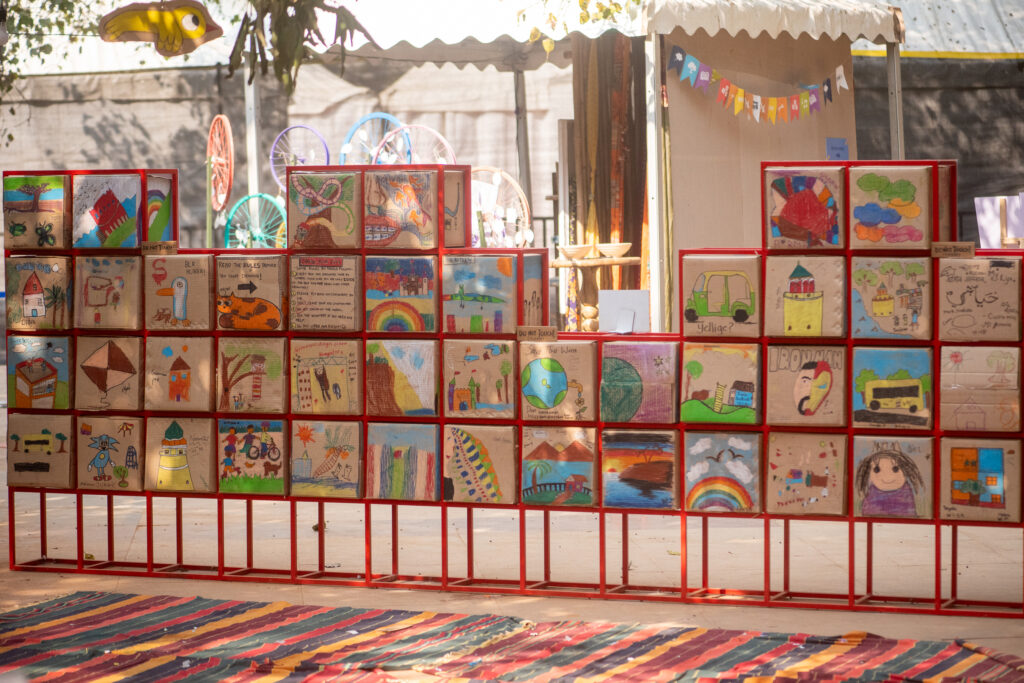
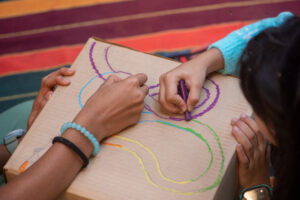
On 23 January, at Makkala Hubba in Freedom Park, Bachpan Manao brought together a small group of educators, designers, CSR leaders, parents and practitioners to reflect on what it means to invest in childhood. Before sitting down, we walked through the festival grounds. Children were building small cities out of cardboard, listening to stories, experimenting with materials and moving between installations without self-consciousness. The setting shaped the conversation that followed.
At one point, we asked a simple question: what if children were treated not as future adults, but as present citizens?
The responses came quickly.
“More colour in our lives.”
“Cities would be playgrounds.”
“Create spaces and conversations for all children.”
“The world would become a place where we think, imagine and create with a lot of presence.”
There was a noticeable shift in tone as people wrote. Removing the word “future” changed something. It suggested that childhood does not need to justify itself as preparation. It already has standing.
One note read, “Focus on validity and development needs of a child.” Another added, “Not always be problem solvers.” These responses seemed to point toward a different starting point. If children are citizens now, their needs are not simply steps toward productivity. They are valid in the present.
Several notes moved toward governance. “They could vote.” “Influence our policy.” “Children will decide the schools, how the schools will run.” “They will appoint the Minister of Child Welfare.” Whether literal or symbolic, these responses reflected a desire for children’s voices to matter in decisions that shape their lives. Imagining children voting was less about electoral procedure and more about participation.
There were also reflections on pace and priorities. “There would be a lot more conversation and less money making.” “Freer, no agenda driven lives.” These statement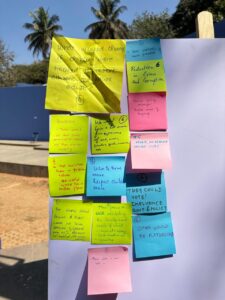 s suggested that when childhood is framed primarily as preparation for economic life, adult priorities dominate. If children were recognised as citizens now, perhaps conversation, imagination and shared presence would carry more weight.
Freedom appeared repeatedly. “Less control, more freedom.” “Free expression of art, music, theatre, literature, sports, science.” The list was wide-ranging, as if citizenship meant access to the full spectrum of expression rather than a narrow set of outcomes.
Some responses linked this idea to urgency. “Faster policy changes.” “Higher sense of urgency.” “Reduction in crime and corruption.” There was an implicit belief that if children were acknowledged as stakeholders in the present, decisions might feel more immediate and accountable.
Amid these broader visions, one note simply said, “Better place.” It was understated, but it captured something essential. Treating children as present citizens might not lead to one dramatic reform. It might gradually shift how cities are designed, how schools are run, how public spaces are imagined and how conversations unfold.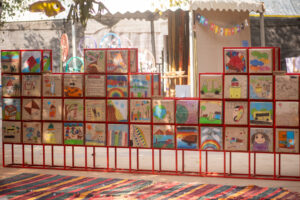
What stood out in this prompt was the scale of thinking. Very few responses focused on correcting children’s behaviour. Most imagined changes in systems, infrastructure and public life. The shift was not about producing better children. It was about rethinking the environments and decisions that surround them.
The exercise did not argue that children should carry adult burdens or responsibilities. It asked what changes when we stop deferring their legitimacy to a later stage. If children are always framed as “the future,” their present experiences can be sidelined. Recognising them as citizens now invites a different kind of attention.
The post-its did not provide a roadmap. They offered a perspective. And sometimes perspective is enough to make familiar systems look slightly different.


 )
)