

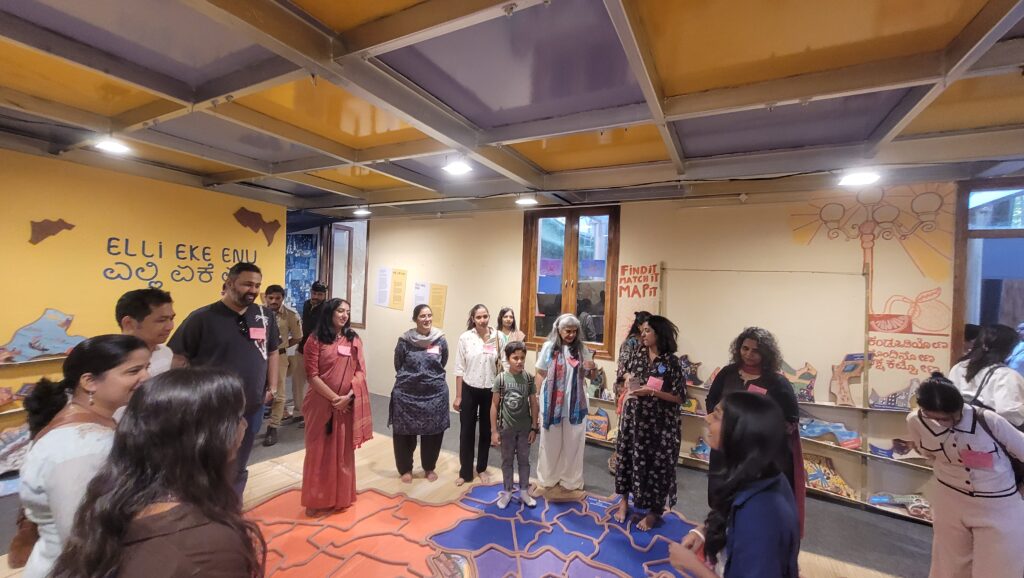
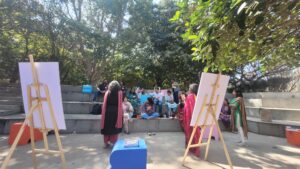
On 23 January, at Makkala Hubba in Freedom Park, Bachpan Manao invited a small group of educators, designers, CSR leaders, parents and practitioners to sit inside a children’s festival and think together about childhood. Before the conversation began, we walked through installations full of movement and colour. Children were climbing, experimenting, listening to stories and drifting between spaces without much instruction. That atmosphere stayed with us when we sat down.
One of the prompts asked something that did not require much explanation.
What did you have as a child that today’s children are losing?
The responses came quickly.
“Roads to play.”
“Parks to play.”
“Lots and lots of free play.”
“Outside playtime.”
“Playing without goals and structures.”
“Freedom to do nothing.”
“Free time to get bored.”
“Boredom.”
There was very little commentary attached to these words. They stood on their own. Boredom appeared more than once, written without embarrassment. It was not framed as something that once had space to exist.
“Enjoying the me time with various activities like jumping around” suggested a kind of looseness in the day. Jumping around not because it was scheduled, not because it was a class, but because the afternoon allowed it.
Physical space surfaced repeatedly. “Amazing parks.” “Outdoor spaces.” “Freedom to pla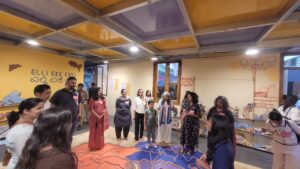 y on the road.” “Cycling.” “Access to street parks without parenting worry.” That last phrase carried something specific. It was not only about the presence of parks, but about the absence of constant adult anxiety. Movement without heavy supervision seemed to be part of the memory.
Family and neighbourhood life appeared all across the additions. “Playtime with grandparents.” “Spending time with other family members and local members.” “Local corner stores.” These are small things, but they create texture. Knowing the shopkeeper. Walking between houses. Being in the company of older relatives without it being organised or intentional.
“Time in slower spaces” and “being truly free” suggested a rhythm rather than an activity. A sense that days stretched differently. That there were pockets of time not already assigned to improvement.
Technology showed up in simple contrasts. “No TV.” “No mobile phones and screens.” “Reading printed books.” It was becoming clear that the background noise of childhood has changed.
What stood out across the wall was that very few people named specific achievements or material advantages. The memories were about atmosphere.
There was no clear conclusion offered in the room. Only a shared awareness that some of these elements feel thinner now. Childhood today may be richer in some ways, more connected, more exposed, more structured. At the same time, the texture described on those post-its feels harder to locate.
When we speak about investing in childhood, it often sounds like building more. The prompt did not suggest that the past was ideal. It simply revealed what people associate with their own childhoods. Outdoor space. Informal play. Intergenerational contact. Boredom that does not need to be solved.
The wall did not argue for returning to another era. It simply recorded what people remember having. And in that remembering, it asked a simple question that lingered in the room: what would it take for some of that texture to remain available now?




 )
)