


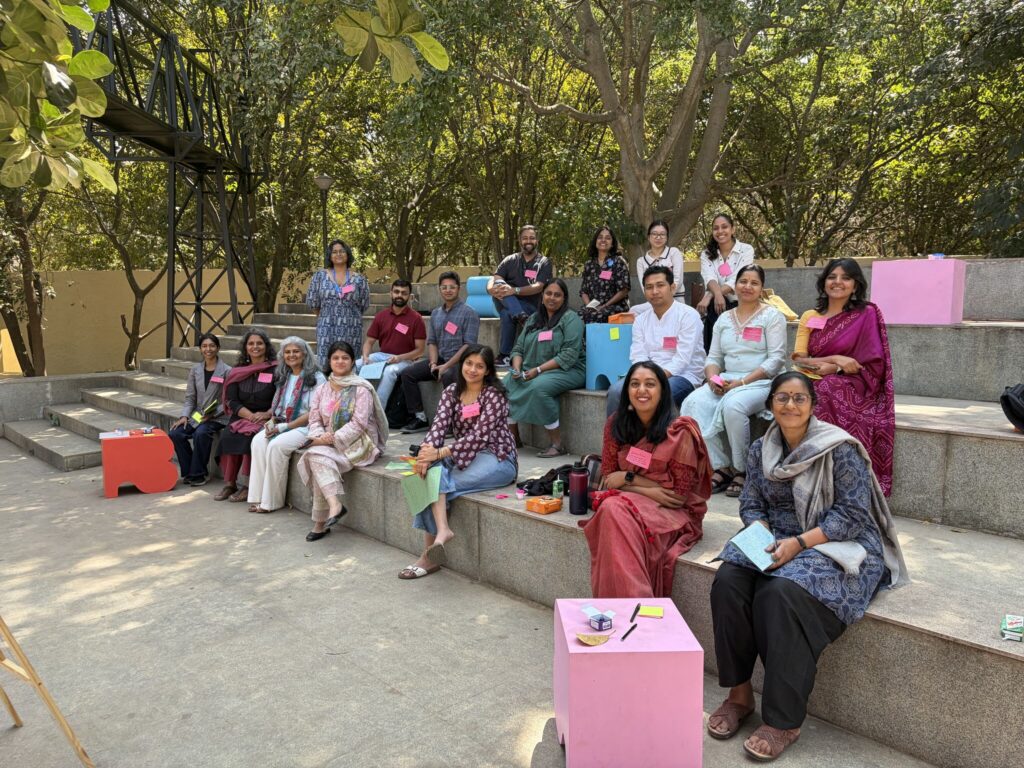
On 23 January, at Makkala Hubba in Freedom Park, Bachpan Manao invited a small group of educators, designers, CSR leaders, practitioners and parents to spend a morning together inside a children’s festival.
The intent was simple.
To make childhood visible in spaces where it is often discussed in abstraction. To learn from what is already happening on the ground. To bring together people who influence childhood in different ways but do not often sit in the same room. And to move the conversation beyond sectors and into something more shared.
The Baithak was designed with that in mind.
We began by walking through the festival. Children were building with cardboard, listening to stories, testing materials, moving between spaces. The starting point was observation, not discussion.
The group was mixed by design. The setting was informal. The pace was unhurried. The prompts were structured to move from personal experience to larger questions.
We started with memory. What shaped you that never made it to your CV?
From there, the conversation moved into harder questions. What adult conveniences are we subsidising? What are children losing? What would change if children were treated as present citizens? If childhood itself were measuring return on investment, what would count? And what headlines in 2050 would suggest that we paid attention in time?
The sequence was intentional.
Memory grounded the conversation. Discomfort surfaced trade-offs. Imagination opened up possibilities. The future question required people to take a position.
What emerged was not a set of conclusions. It was a clearer view of what sits underneath the idea of investing in childhood.
People spoke about experiences that shaped them but were never formalised. There was recognition that adult life is tightly scheduled, and that children are often expected to fit into those patterns. Curriculum, early schooling and controlled environments were seen as reflecting adult pace as much as developmental need.
There were also shifts in how people described outcomes. Joy, friendship, the ability to try and fail, and time to explore were named as important, even if they do not fit easily into systems of measurement.
The letters written at the end of the session brought the conversation closer.
Each person wrote to a child in 2050 from themselves today. Some wrote with clarity, others with uncertainty. Several named the pressures they carry and the need to not pass them on. The exercise did not resolve the discussion. It made the implications more direct.
Throughout, children remained in the background of the conversation. Building, moving, negotiating, trying things out. That proximity shaped how the discussion unfolded.
The Baithak was not intended to produce a framework. It was intended to create the conditions for a different kind of conversation.
For Bachpan Manao, this is the approach. Bring together diverse voices. Stay grounded in lived experience. Keep the structure light but intentional. Create space for reflection before moving to solutions.
We sat down at Makkala Hubba because childhood was already present.
The question was whether we are paying attention to it in the way we design systems around it.




 )
)