


We believe, an Anganwadi is not just a place to prepare children for school, it is a place where childhood itself is celebrated. Where play is the language of communication. Where laughter fills the air along the rhymes of the alphabet and learned counting. Where every participant is a child before they are a student and play is not a break from learning but the beginning of it.
We call it a Mastiwadi.
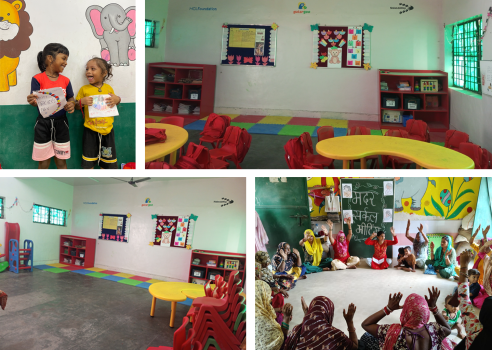
Mastiwadi is a modular set of play installations designed to be integrated into the Anganwadi building, transforming it into an environment that invites self-directed play and exploration. Rooted in joy, wonder and curiosity, the installations create opportunities for diverse forms of play that nurture children’s cognitive, physical, social and emotional development while laying the foundations for Grade 1 readiness.
The story of this masti begins in Sukma, a predominantly tribal district in the Bastar region of south Chhattisgarh. Here dense forests, flowing rivers, agriculture and foraging surround the everyday lives of children and their families.
For more than fifteen years Shiksharth, a non-profit, has worked with children, communities, educators and the government to create access to education, positive childhood experiences and a rooted and contextual education for children of this region.
It was with Ashish bhaiya, the co-founder of Shiksharth that a few simple questions emerged.
- How might we take the idea of BaLA (Building as Learning Aid) beyond painted walls?
- Could the Anganwadi building itself become an invitation to play, explore and learn?
- Could an Anganwadi become a place full of joy that children want to spend time in and return to?
With these questions as our starting point, and guided by Ashish bhaiya and Shiksharth’s vision for the Anganwadi, we began imagining a space where children’s natural curiosity led the way.
It was important to remember that this intervention would be part of the Anganwadi ecosystem in Sukma and every design decision needed to support its installation, scalability and sustenance. As a result our design brief became very clear.
- Every intervention would become a permanent part of the building.
- Every installation would invite self-directed play, without relying on facilitation.
- Children should be able to play independently as well as together.
- The installations should fit naturally within the everyday functioning of the Anganwadi.
- They should be safe, robust and designed to withstand years of use.
- They should be affordable, easy to repair and simple to recreate.
- Every material should be sourced locally. We committed ourselves to finding everything within a 100-kilometre radius of Sukma.
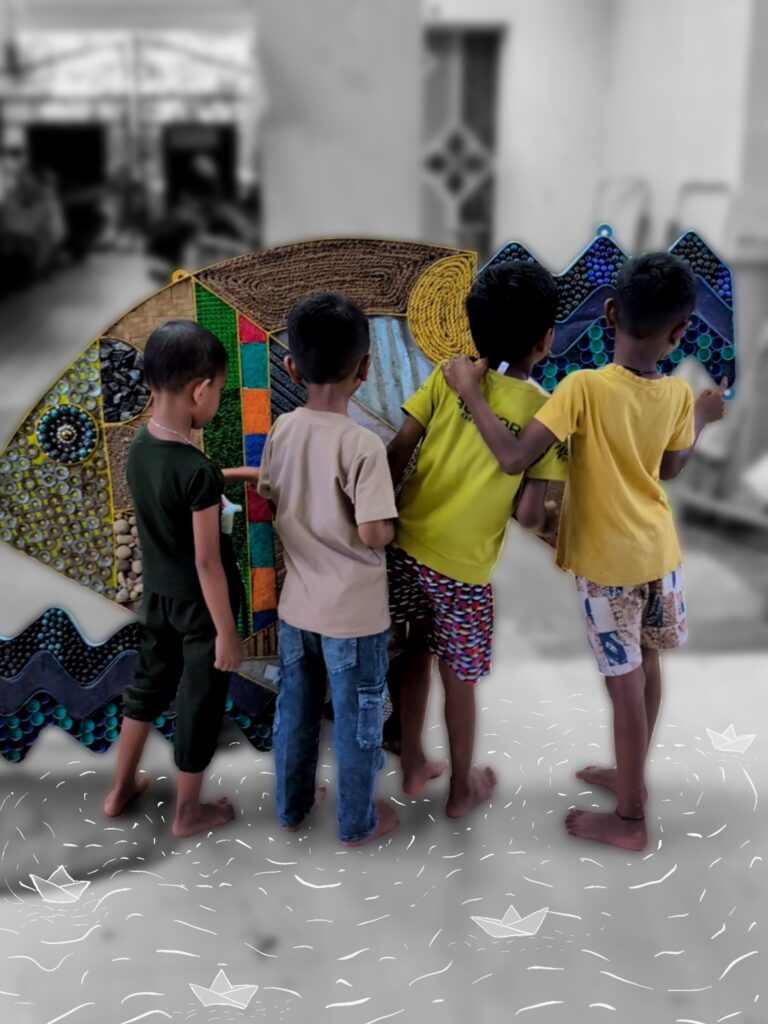
As part of the Mastiwadi, a collection of 15 indoor and outdoor installations were designed for diverse forms of interaction. Among these our favorite to build and to watch children discover was the Texture & Material Wall that encourages sensory exploration through touch, helping children discover and engage with a variety of textures and materials..
The Texture & Material Wall is designed as a large fish that holds 34 different materials within its structure. The jute sacks, coconut ropes,fishing nets, bamboo sticks, marbles,fishnet beads, tarpaulin, tin sheets, river stones, rocks and many more create a rich sensory landscape for children as they see, listen to, touch, graze, hit, and scrape them.
To our surprise, the Texture and Material Wall becomes much more than a tactile experience. It also becomes a ‘sound wall’ as children not only touch the different materials and see their colours and shapes and textures but also explore the kind of sound they all produce. From exploring a single material and dozens of ways of hitting and rubbing it to feeling the difference between all of them.
Texture walls have long been used for early childhood development for sensory exploration, cognitive growth, developing fine motor skills and nurturing curiosity. However all the examples we could find limit themselves to a selection of manufactured materials creating a rich sensory diversity but being alien to the children. With building this Material wall we wanted each material to be familiar, to carry a story, to help children draw connections between them and the world around.
Alongside offering endless opportunities for sensory exploration, the Material Wall helps children build a vocabulary of touch, observation, expression and thought. Creating moments of joy and conversation when they see something from their world in the material wall or a similar moment in the haat or in their village when they recognise something from the Material Wall in the real world.
For each material to mean something, build a connection and carry a memory, hidden within the many materials of the wall are small narratives. A tiny foam fish caught in a fishing net surrounded by fishnet beads, or a sequence that moves from crushed granite to river sand and finally to smooth river stones, tracing a journey from construction sites back to the riverbank. The Material Wall we hope creates an experience that leaves more to be discovered for years and years as children enter the Anganwadi to become old enough to leave for grade 1.
The texture wall is an amalgamation of textures but also many people’s friendships, love and care. Ateeq Bhai’s welding shop became its birthplace. Najju Bhai’s scrapyard became our material library and his son the material wall’s first tester. Illu Bhai and Parmen Bhai helped us choose marbles and colours not based on what they like but by thinking like parents who knew what would be attractive to their children.
The texture and Material Wall in such is a bearer of stories and connections from stories of our experiences to those of the villages, markets and melas the children see. And it makes us question.
When was the last time we explored the world through touch?
How many stories are hidden in the objects we pass every day?
What if every wall invited curiosity instead of instruction?
KhojGhar creates playful experiences for the child within!



 )
)