

There are questions that sit quietly in the background of our work—until a space, a gathering, a moment brings them sharply into focus.
What does a library look like when it actually welcomes every child?
Not in principle. In practice.
That was the question at the heart of The Shared Shelf—a full-day convening on Diversity, Equity, and Inclusion in libraries, held at the BLR Design Centre.
A Room Full of Possibility
It wasn’t just an event. It was a coming together—of librarians, educators, disability practitioners, authors, and community workers. People who rarely sit in the same room, but who are all, in their own ways, shaping how children encounter books, stories, and learning.
The day began with a conversation between Deepika Mogilishetty and Nita Luthria Row on the importance of the question of libraries as inclusive spaces. As spaces that are not mandated by the structure of a school set up and curriculum, libraries are free to design for true inclusivity. Libraries house stories, one of the wonder areas that make bachpan gr8, through its potential to reach each and every child through imagination, connection and joy.
This was followed by a read-aloud of Our Library by Raviraj Shetty, a reminder that libraries are not just spaces, but lived experiences of belonging (or exclusion).
Uma Mahadevan Dasgupta’s keynote addressed why inclusivity is important and what the Govt. of Karnataka has done to make libraries inclusive. She said “public libraries by definition should be inclusive. Inclusive means not just ‘people like us’ but everyone regardless of age, gender, disability, class etc. Public libraries should not only be open to all, but also make efforts to see who might be excluded and reach out specifically to these groups.
For example, Karnataka’s rural public libraries now have assistive learning devices for users with visual impairment. Digital voice assistants help those with visual impairment and also those who would like to practise their language skills. Ramps, railings, and magnifying lenses for reading help the elderly to access library services. Even children from low income families, where parents may be semiliterate or illiterate, should be encouraged to take books home & read to their family members. These are some ways in which the public library can be made more inclusive in its services.”
That idea of intentional inclusion anchored everything that followed.
Asking Better Questions Together
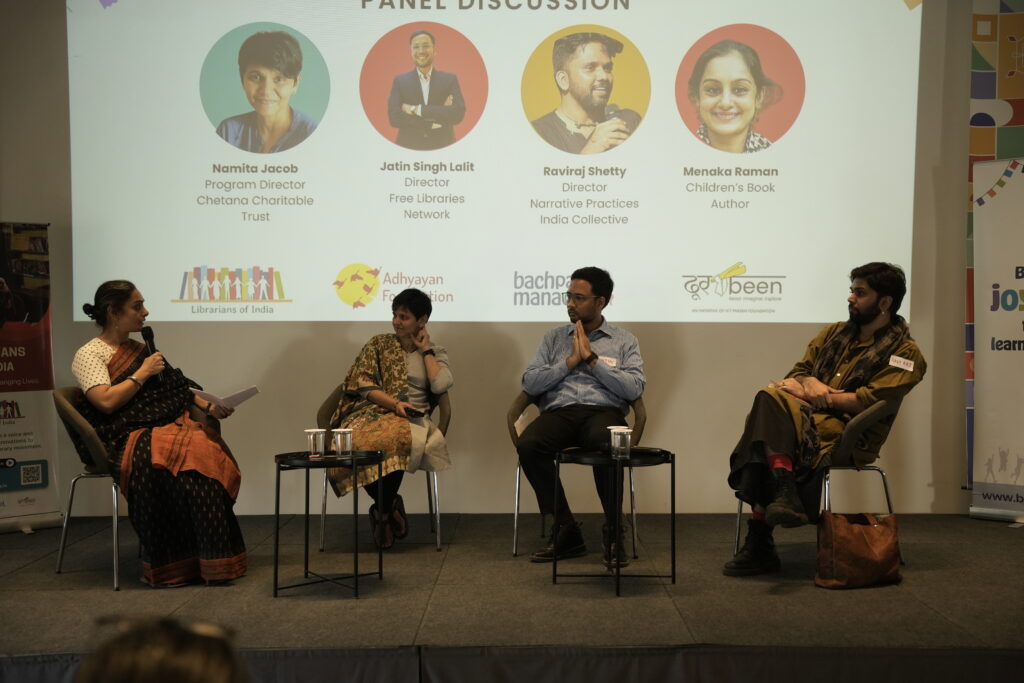
The morning moved into a rich, layered conversation featuring Namita Jacob, Jatin Lalit Singh, and Raviraj Shetty, moderated by Menaka Raman. It opened up the complexity of inclusion:
- Libraries as a right, not a privilege
- The gap between access and meaningful participation
- The role of community in shaping what libraries become
Intentional inclusion is not a checklist, it is a continuous negotiation with context, people, and purpose.
The panel also highlighted the power of the narrative as a tool and how exclusionary practices must be highlighted, even though they may be distressing to discuss. The library also serves as a place of “firsts” where children have the choice to sit wherever they like – be it a chair, or the library floor – as well as a place of joy where we “discover personalities of children because we send books home!” (Namita Jacob) and intentionally build a supportive rapport, not with “Dos & Dont’s but pyaar se” (Jatin Lalit Singh).
From Visual to Tactile: Shifting Perspective
The session on “From Visual to Tactile” brought a crucial shift, from thinking about inclusion to experiencing it.
Participants explored how stories can move beyond sight into texture, touch, and sensory engagement. It challenged a deeply held assumption: that reading is primarily visual.
Later, in the breakout workshop “Stories at Your Fingertips” led by practitioners from Chetana, this came alive fully. People didn’t just discuss accessibility, they made tactile books by hand.
One reflection stayed with me:
“Why don’t these conversations happen?”And the response:
“They do—but online. How do you talk about tactile books virtually?”
The answer, perhaps, is that some things must be felt to be understood.
Reimagining Libraries in Practice
The afternoon breakout sessions moved the conversation firmly into practice:
- “Haq Ki Library” with Jatin Lalit Singh reframed libraries as spaces of equity and rights, grounded in community ownership
- “Reading Between the Lines” with Barkha Sharda explored what it means to curate collections that truly reflect diverse lives and realities
- The tactile workshop continued to deepen understanding of accessible design
Across these sessions, something important happened:
People began to see that inclusion is not an add-on. It is in:
- What books we choose
- How we design spaces
- Who feels seen, heard, and invited
When a Conversation Opens Something
What stayed with me most was not just the structure of the day—but the energy it created.
There was a sense of discovery:
- There is a library community in Bangalore waiting to connect
- Inclusion, when experienced, opens up entirely new ways of thinking
- People have been waiting for spaces like this
Facilitators and participants alike spoke about the rarity of such in-person, practice-based conversations.
Many conversations happened on the sidelines, opening new relationships and possibilities.
A Shelf That Must Keep Growing
As the day ended The Shared Shelf made visible, a truly inclusive library begins with intention but is built through practice, participation, and community. It lives in:
- The shift from visual to tactile
- The move from access to belonging
- The courage to ask better questions, together
And perhaps most importantly, it reminds us to keep asking: What must we do, differently and deliberately, to ensure every child finds a book and through that themselves on the shelf?






 )
)