

The earliest building blocks of reading may begin in a caregiver’s voice, long before a child opens a book, writes Deepika Mogilishetty
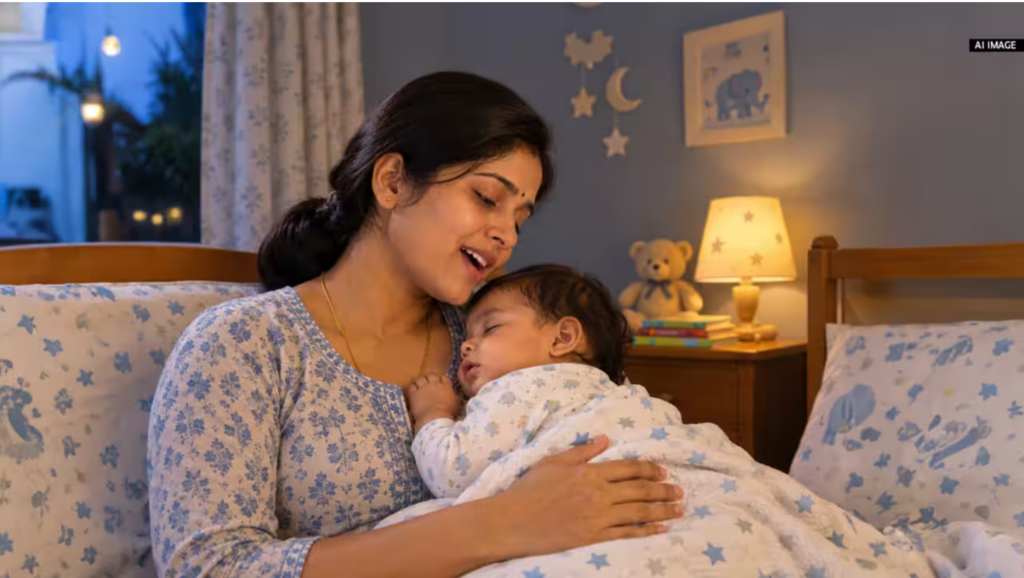
In a Bengaluru courtyard, a mother hums to her newborn. The baby’s fingers curl around her sari.
Nothing about the moment looks like learning. But it is as long before a child knows a single letter of the alphabet, she is already fluent in sound: which sounds repeat, where words end, and which syllables carry weight. A lullaby delivers all of it slowly and repeatedly, in a voice she already trusts.
Lullabies are simple, repetitive, and melodic. Those three qualities also happen to be building blocks of early literacy: phonological awareness, vocabulary, rhythm, and narrative structure.
Researchers at Harvard University and UCLA, studying song across dozens of cultures have found that infants as young as two months old, relax when they hear a lullaby from a culture they have never encountered, even when its melody and language are unfamiliar.
Other studies tracking infants’ brain activity as they listen to sung and chanted nursery rhymes have found that how well a baby’s brain tracks rhythm predicts language skills a year later.
Music and language seem to share neural scaffolding infancy. When a caregiver sings, auditory discrimination and memory are being built, note by note.
In India, a lullaby is rarely only a song. It is a story, a list of names or a local idiom folded into melody: a grandmother’s refrain about the monsoon, a father’s chant about mangoes. Vocabulary lessons are wrapped in the one thing an infant already trusts completely: emotion.
India may hold more lullaby traditions than almost any country on earth, and each has its own name and logic. A Tamil thalattu rocks a child to the rhythm of a swaying tongue—the word itself means “to sway”. A Bengali ghum’er gaan is an evening song for the edge of sleep. A Kashmiri wanvun carries the valley into a child’s ear. A Marathi palna geet sings from the cradle itself, while a Punjabi lullaby borrows its beat from the dhol. The words change from state to state. The instinct does not: give a child the sounds and stories of their own place before they can ask for them.
A study following families over several years found that a parent’s musicality and reading habits shaped an infant’s auditory processing, measured in the brain within the first six months, and that this predicted the child’s phonological awareness years later. The same refrain, day after day and night after night, is patterned input, with effects appearing long before a child picks up a book.
There is a deeper mechanism at work too. Infant-directed speech and songs are naturally slower, more exaggerated and more rhythmic than the way adults usually speak to one another.
Babies’ brains pick up the rhythm of stressed syllables in this slower, sung-out speech, helping them recognise patterns in sounds: an important foundation for phonological awareness and, later, reading.
Research also suggests that children who are less sensitive to these rhythmic patterns can be more likely to face difficulties with reading. A lullaby naturally does what a struggling reader may find difficult: it slows language down, stresses the sounds and repeats them until they begin to make sense.
Sleep matters as well. Lullabies lower cortisol and improve sleep, while regulated attention and better sleep support the memory consolidation that allows new words and sounds to be encoded. Community programmes that build singing into caregiving report more responsive caregivers and more engaged infants, both linked to language outcomes.
Across India, efforts to document these songs are helping preserve them in the languages in which they were first sung. A Bhojpuri lori or an Assamese cradle song can be recorded in the very words a grandmother used, rather than reduced to a translation.
At a masterclass, a young father from a Kannada-speaking neighbourhood said he was too shy to sing. He tried a short rhyme anyway, just a line taught in the session: “Jo jo laali, nidde maadu kanda.” Hush now, sleep, little one. Within days, his toddler was pointing at things around the house and babbling the words back at him. The song became their private code, for calming down and naming the world at once. A literacy routine born from a lullaby had begun with a father who almost did not sing it.
From First Songs’ field recordings comes another version of the same story. A lullaby about a river taught a child the word for flow long before she could read it. The word surfaced later, on its own, in her play. A song had planted vocabulary, and storytelling grew from the ground it left behind.
These simple interactions—short, repetitive and full of emotion—show how much learning can happen through everyday moments that cost nothing and require no special tools.
Repetition matters more than musical skill. Sing in your own language. Home language and daily life expand the vocabulary that actually means something to a child. Point while you sing. Naming and showing at once links a word to an object. It is one of the oldest literacy techniques. Use the routines already there. Bedtime, feeding and playing are already part of the day. The windows are open.
Interventions like these are rare. They need no device, electricity or classroom, and almost no training. Early-childhood programmes can notice it, name it and support it. Call it a thalattu, a lori, a ghum’er gaan—beneath the different words, it is the same first lesson in sound, story, and everything a name can carry.
Listen closely the next time a lullaby is heard. That hum is where reading starts.
(The writer is chief of policy and partnerships, EkStep Foundation)
This was first published in Economics Times on 02 October 2026



 )
)