

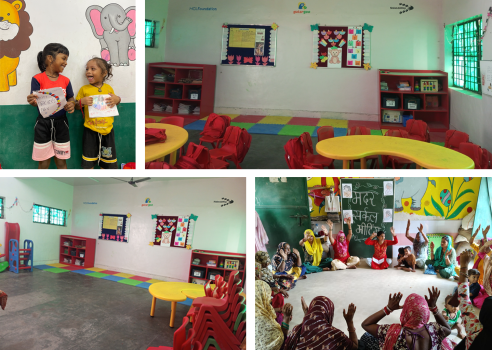
A row of slippers at an Anganwadi door. A blank drawing sheet. A henna cone. Chalk dust on a tailor’s fingers. A cup being washed again and again.
Early childhood is full of moments like these, the kind we walk past because they look ordinary. They happen in kitchens, in Anganwadi rooms, in doorways, in the middle of a school day. And yet, they are where everything actually happens.
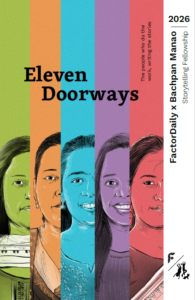
To make these moments more visible, in homes, in communities, and in public conversation, Bachpan Manao partnered with FactorDaily to create a storytelling fellowship for people who are already embedded in early childhood work but don’t always have the language and the space to hold what they witness. These eleven stories were written by our second cohort of fellows over the course of the FactorDaily and Bachpan Manao Storytelling Fellowship 2026, anchored by journalist and FactorDaily co-founder Pankaj Mishra.
The cohort had one goal: to help early childhood practitioners take the moments they already carry, and shape them with enough craft that another person can feel them too. Most social sector writing tries to do too many things at once, explain, critique, conclude, and ends up doing none of them well. This fellowship asked the fellows to do the opposite. To become more specific. To choose one lens. To build the story around one doorway moment. To find a proof scene that cannot be explained away.
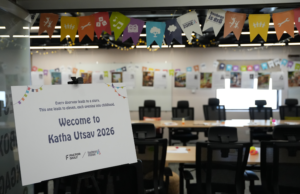
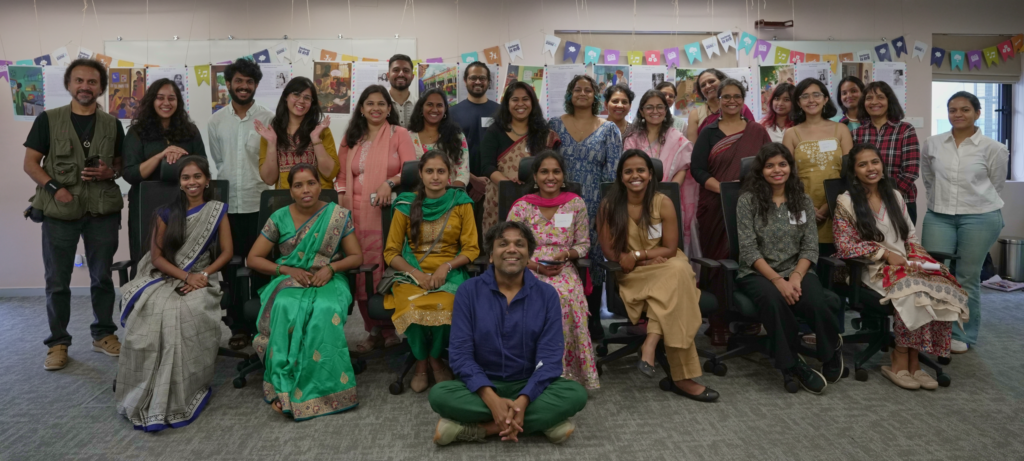
This July, the eleven of them came from all across the country to Bengaluru to read these stories aloud at their graduation, Katha Utsav. Their stories were already on the walls when they walked in, each one illustrated, each beside a photograph of the fellow who wrote it.
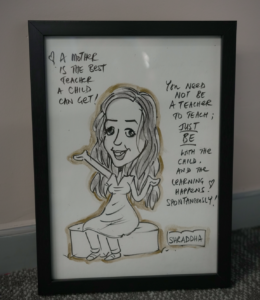
Shraddha Thopate, from the Gyan Prakash Foundation in Pune, read Learning Didn’t Begin at School. In it a mother named Asha believes teaching is only for people who studied, until it says instead: in the evening, I sit. The work, Shraddha told us that day, is getting a mother to trust that she is her child’s first teacher.
Varuni, who founded RAHII in Delhi and works with neurodivergent children, read Ehsaan aur Ehsaas. A mother dejected by schools that keep refusing her daughter Aaru is steadied by Aaru herself, who sets an empty glass in her hands and then makes them clap, exactly the way her mother soothed her.
Sangam Sumalatha, who works for the Aga Khan Foundation read She Came Back the Next Day. Sadiya’s daughter is autistic, and the other parents do not want her there. Each morning Sadiya sets her daughter’s slippers back in the neat row of children’s slippers, a small claim that her child belonged there too. Sumalatha had first noticed those slippers on her field visits.
Rashi Anchalia, who comes with six years of experience in early childhood, much of it building government partnerships at Rocket Learning, read The Day Rajni Stopped Counting. An anganwadi worker trained to test whether children are ready for school watches them organise a water relay through a power cut, and writes that night: I stopped counting what they couldn’t do, and started seeing what they could. A hand pump on one of Rashi’s field visits was the seed.
Ashwini B, who trains anganwadi teachers with Makkala Jagriti, read Not Just a Worker. Nirmala’s morning with the children keeps dissolving into paperwork, until she stops apologising, walks back to the circle and teaches. Sometimes, Ashwini says, you just talk to them and hold their hands, and that alone gives a child so much.
Charu Pal, from the Samanta Foundation in Laldhang, read Farzana ki Udaan, about the first girl in her area to study past Class 5. There is no big or small here, this school belongs equally to all of us said charu to Farzana’s mom who in many ways didn’t feel like she had the right to be there.
Ramlesh Devi, who had never before put a word of hers into the world, read Jimmedariyon se Lada Bachpan. Kamini, in Class 4, comes to school with a bag on one shoulder and her baby sister on the other arm, and her drawing sheet stays empty. Some children, Ramlesh writes, come carrying a childhood in their arms.
Shital Raut, who runs a learning centre and library, read The Noise Behind His Silence. Vihaan is seven, and after his father’s death is forced to silently carry the responsibility of a ritual no one will explain to him. Even their pain, Shital writes, tries to be polite.
Sangam Rajput, a counselling psychologist with the Salaam Baalak Trust, read The Weight of a Henna Cone. Rohan opens his fist to show seventy rupees, his first earnings from applying mehandi, already promised to reference books. Art has no gender, a counsellor tells him, when his friends and his father call the work shameful.
Two fellows could not travel. Their stories filled the room anyway.
Ritika Dutta works with Aavishkaar’s Moms For Math, helping mothers see the math already in their hands. The Math My Mother Didn’t Know She Knew turns to her own mother, a tailor who swears she is no good at math while she cuts necklines freehand and folds cloth into perfect symmetry. It ends with the mother running a measuring tape through her fingers and asking, half to herself, so this is also math?
Tannu teaches in anganwadis with the Samanta Foundation, and comes from a place where girls were rarely sent to study. In Chande Maa se Chanda Mama tak, four-year-old Rihana says the moon’s name the way her Van Gujjar tongue says it, chande maa, and a classmate corrects her. Rihana’s teacher instead says you said that beautifully, say some more.
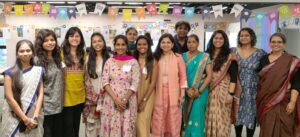
Somewhere over those seven months, the questions in our sessions changed. The fellows stopped asking, is this written well? and started asking: what is my doorway moment? What scene proves it? Whose lens am I inside? What is the smallest action that completes the arc? Each of them now leaves with a story they can carry back into their work, and, more importantly, a way of looking that was not there before. When the readings were done, Hita, who holds this fellowship for Bachpan Manao, told us what had stayed with her: in every story, someone was there, looking out for that child, noticing the silence. This fellowship makes space for that someone to be heard.
None of these stories have a clean, tidy ending. No closure, no lesson at the bottom. Rajni still has her forms. Vihaan still walks the lanes. Sadiya still comes back to the same gate. The stories refuse to resolve, and they refuse to let you look away. They ask you to stay with them. To be moved. To be changed. To see.
Read them slowly, they were written that way.





 )
)