

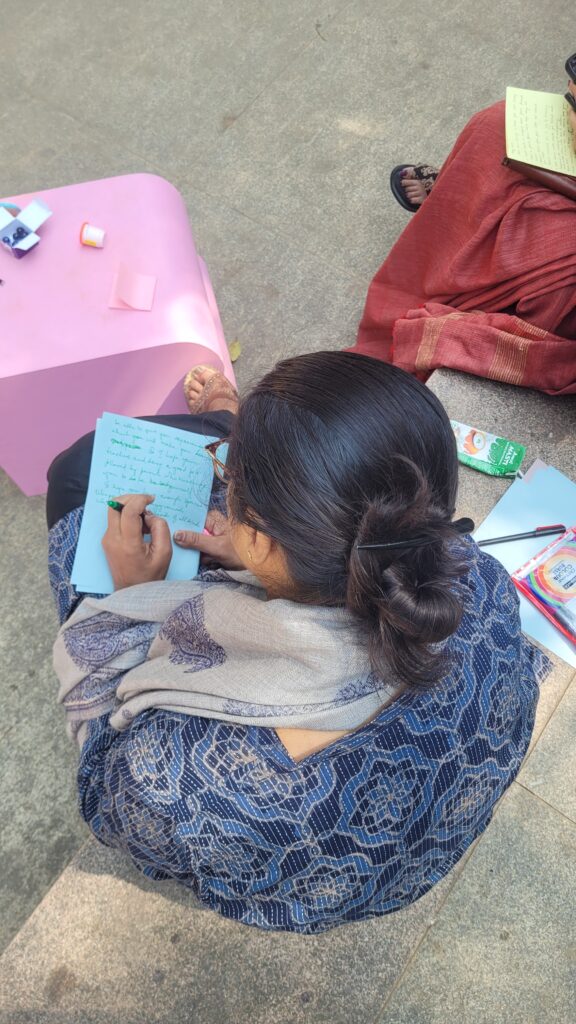
On 23 January, at Makkala Hubba in Freedom Park, Bachpan Manao invited a small group of educators, designers, practitioners and parents to spend a morning reflecting on childhood. We had already moved through memory and trade-offs. Toward the end, we turned the room toward the future.
If you opened a newspaper in 2050, what headline about childhood would make you feel genuinely happy?
People began writing in the style of headlines.
“Children from ages 0 to 10 learn from exploration and play only.”
“Right to play is for all.”
“The world is the new classroom.”
There was something steady about the way learning was imagined; learning that begins with exploration and play.
Several notes focused on schools. “School psychologists and special educators are mandatory in all schools across India.” It was specific and practical. The kind of line you could actually see printed. Another said, “There is a preschool for every child in the neighborhood.” Proximity, availability and access for all.
Public infrastructure showed up clearly. “There is a park in the neighborhood which is functional.” The word functional carried weight. A park that works. “More parks, more children mobility pathways” imagined cities where children can move safely and independently, not only inside fenced spaces.
Access to public goods was written plainly. “Costless, gender equitable, free school, public spaces, libraries, parks for all.” Childhood supported by systems that do not depend on income or geography.
Some headlines imagined deeper participation. “Children will decide the schools, how the schools will run.” “They will appoint the Minister of Child Welfare.” One note stretched even further and imagined “a 13-year-old newly elected Prime Minister.” Whether literal or symbolic, the idea was that children are not just recipients of decisions. They are part of them.
There were cultural shifts in the mix too. “Children love paper, trees and clay again.” The sentence evoked texture and material life. “Zero percent phone users of children” reflected a desire for limits around digital saturation.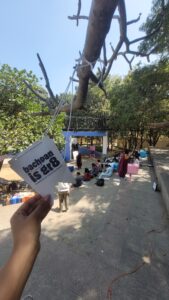
Wellbeing appeared repeatedly. “Families spend more time together.” “Reduced stress, reduced non-communicable diseases.” “India lands highest in the happiness scale of children between 3 and 10.” These were not narrow wins. They imagined a society where childhood health and happiness are visible at scale.
What stood out across the wall was that very few headlines centred on competition. No one wrote about children outperforming others. The imagined future leaned toward access, play, wellbeing and functioning public systems.
The exercise made hope concrete. Instead of saying we want things to be better, participants wrote the sentences they would want to read. Sentences about parks that work, schools that include mental health support, preschools within reach, cities that allow movement, families with more time, children who are not overwhelmed.
Reading them together felt like scanning a future edition of the paper. A world where childhood is not squeezed or deferred. One where systems have shifted enough that joy and access are visible in public record.
The prompt did not promise that these headlines will appear. It simply asked what would feel worth working toward. And once written down, those headlines stop being abstract. They become markers for what is possible.






 )
)