

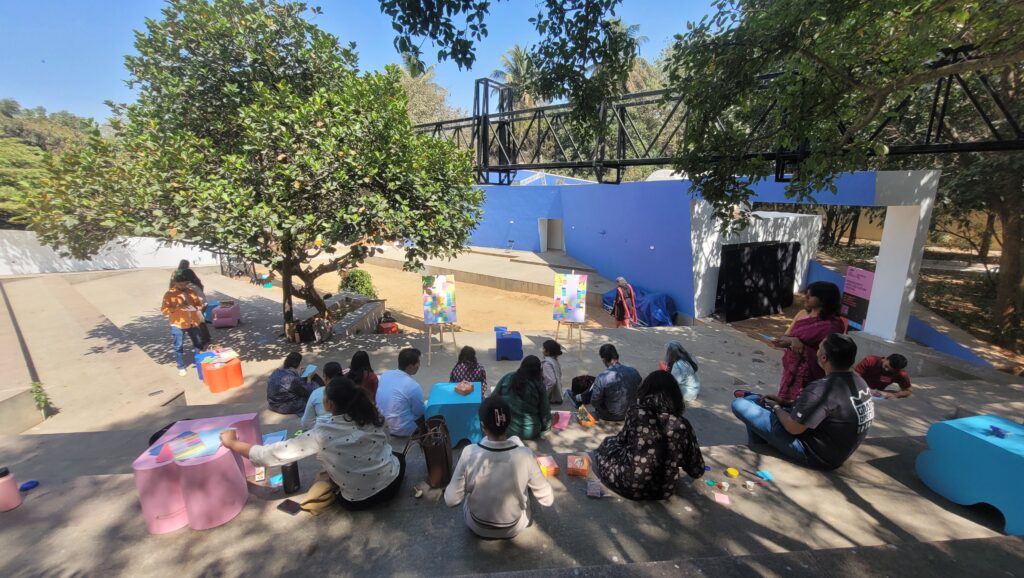
On 23 January, at Makkala Hubba in Freedom Park, Bachpan Manao invited a small group of educators, designers, CSR leaders, parents and practitioners to spend a morning thinking about childhood. Before sitting down, we walked through the festival grounds where children were building cities out of cardboard, listening to stories and moving freely across installations. The atmosphere was open and energetic. It felt like the right place to ask a harder question.
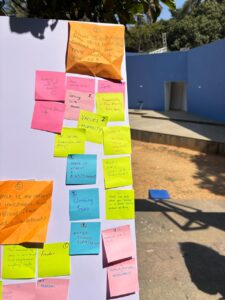
At one point in the Baithak, we asked participants to look at their own lives through the eyes of their four-year-old self. What adult conveniences are you currently subsidising for your child’s discomfort?
There was a short pause, and then the post-its began to fill.
“Food habits and pressure of academics.”
“Rest.”
“Sterile spaces and regulation.”
“Urbanisation and lack of green spaces.”
“Time rushing, hurried.”
“No plans to play, no places to play.”
“Controlled activities with closed groups.”
“Clean air.”
“Spending time in preschool.”
“Taking adult roles as a child.”
“Examinations.”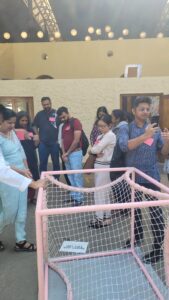
“Early school.”
“Heavy curriculum to subsidize the need for parents’ work and to have children in a safe space.”
“The ability to be tracked all the time.”
“Be quiet while I want to work.”
“Their clothes choices, not sexy clothes.”
The words were plain. There was no drama in the room, but there was recognition. Many of the notes pointed toward academic acceleration. Early schooling, structured preschool hours, examinations and heavy curriculum are often framed as preparation, but they also align neatly with adult work schedules. One post-it captured it directly by naming curriculum as something that subsidises the need for parents’ work. In that sentence, school is not only about learning. It is also about containment and predictability.
Time appeared again and again. “Time rushing, hurried” suggested that childhood now moves at a pace set elsewhere. The four-year-old self, might not recognise this tempo. When play has to be scheduled and rest becomes conditional, spontaneity narrows.
Space came up in a similar way. “Sterile spaces and regulation” and “controlled activities with closed groups” described environments that are organised for safety and order. “Urbanisation and lack of green spaces” hinted at constraints beyond the home. These are not careless choices. They often emerge from concern and practical limitations. Still, they shape how a child experiences the world.
Surveillance was named without commentary. “The ability to be tracked all the time” sat on the post-it as a simple fact. Being locatable at every moment can feel reassuring to adults. It may feel different for a child.
One of the most striking notes was “Be quiet while I want to work.” It described an everyday scene. In that sentence, adult productivity and childhood energy share the same room. Silence becomes a form of efficiency.
Even clothing choices were mentioned, framed as protection but also as regulation. In these small decisions, care and control sit close together.
What made this prompt powerful was that none of these responses came from indifference. They came from adults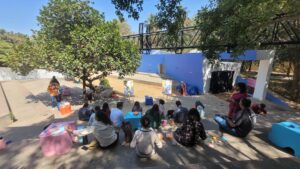 trying to balance safety, ambition, financial pressure and urban constraint. The exercise was not about blame. It was about seeing trade-offs clearly.
Looking through the eyes of a four-year-old shifts perspective. Being hurried, scheduled, evaluated early and constantly supervised may feel normal from the adult side. From the child’s side, it might feel confusing or tight.
The conversation did not resolve these tensions. It simply named them. Convenience often solves one problem while creating another. When adult life becomes compressed, children sometimes absorb that compression.
The wall of post-its did not offer easy fixes. It offered honesty. And honesty, even when uncomfortable, is a useful place to begin.







 )
)