

Introduction
The approach to transformation and systemic change has mostly been one of scarcity where we identify the gaps and attempt to address them. Often, this leads to solutions that are created for the stakeholder but not situated in their context. Parents, Teachers, Anganwadi workers and our youngest children are subject to a myriad of experiments towards achieving ‘outcomes’.
‘Bachpan Manao’ is a movement born out of a collaborative effort from organisations working in ECE across India. This journey aims to identify and celebrate the very nature of childhood and the abundance of the early environments that exist. This can take various forms in different contexts ranging from celebratory events to showcasing stories of transformative change. Through this, we believe, agency can be restored to the stakeholder and a larger community can be invested in systems change. Bachpan Manao showcases the role of the collective in making communities and schools conducive for young children.
“Are we in a hurry to turn children into students”
“A child is not an adult in progress”
“It’s like flying a kite”
These are three of about more than 150 insights that emerged from the journey of seeing, thinking and doing as a community. These insights are thought-provoking conversation starters, and they came from engaging with over 200 deep conversations with individuals from all walks of life in different parts of the country. The many insights resulted in synthesising, sifting and eventually articulating a meta-insight, which is food for thought and action and through this article an invitation as well.
The first eight years of a child’s life are inherently abundant* and unlike any other period that will emerge after that – the fastest pace of growth, and the highest levels of curiosity and engagement which is inherent and intuitive. Shall we then treat the first eight years as a period of celebration of abundance, joy and growth? Bachpan Manao, Badhte Jao became the rallying cry for this deep insight. An idea was born and a conversation started across the country – each with its flavour and expression. Since the launch on 5th September 2023, the initiative has 100+ organisations working in different geographical areas of India.
In 2020, the National Education Policy followed by the National Curriculum Framework -Foundational Stage, articulated the demand for focus on learning in the early years. Enough scientific research has emphasised the unique window of opportunity** presented in the first six years of the life of a child. The importance of play as a way to learn has been presented in research and reflected in policy intent***. The challenge of executing and bringing this intent alive meaningfully for every child is a significant task. With 25 million children born in India each year, we are presented with the opportunity to do better for the new cohort of children and parents.
To unlock this opportunity, a need was felt to understand and acknowledge a deeper sense of care and perhaps even generate a positive narrative and societal imagination for the early years children. This led to qualitative research, insightful conversations and workshops, which created a reflective space for those interested in a conversation on early years’ child – this space was called the Childhood Workshop. These workshops created moments of connection, pause and reflection, and a space to showcase the abundance and diversity of work being done in the ecosystem. The Childhood Workshop also became a space for connections and offers of public goods made by each organisation.
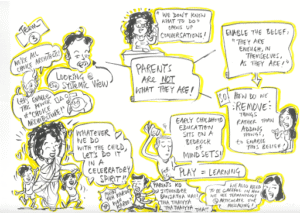
To craft a narrative for the early years, one key insight that was unlocked by the entire community at the first Childhood Workshop was exploring the idea of abundance vs scarcity. Are we, as an ecosystem, approaching early childhood with a scarcity mindset? When the Preschool Educator or Anganwadi worker or Parent talks about what she does not have access to – time, resources or even space, sometimes referring to the inadequacies of the children themselves, is there a sense of scarcity and helplessness? But, in deeper conversations, parents, teachers and workers speak of the joy and freedom of childhood. This inevitably led to the question: how do we see what’s abundant rather than what’s scarce? Can we make the abundant useful and, more than anything else, can we see the abundance in childhood itself?
The creative expression of this idea took the form of Bachpan Manao Badhte Jao, an invitation to see the first eight years of every child as a celebration of childhood and see the growth of every child in all its diversity. The hypothesis was that this celebration of childhood, when combined with active collaborative action, has the potential to create a ‘surround-sound’ effect and generate reusable public goods.
Bachpan Manao in Action
With leaders of more than 80 organisations sharing their commitment to the idea of celebrating childhood and the early years, engaging in the network and the number ever growing, Bachpan Manao has become a voice in our collective conscience. The movement allowed space for many of us to observe the problem and arrive at a more collective understanding of the societal shifts we must enable in the long run. The insights that emerged in the initial months and workshops gave way for us to unpack the root-causes and target them in innovative ways that pushed the boundaries of communication and enabled various stakeholders to exercise their agency and make it their own.
| Insight: Are we in a hurry to turn kids into students?
Current context and identification of the root causes:
|
Irrespective of organisational models of implementation, this movement fosters campaigns, context and action-oriented research, workshops, storytelling and more to ensure cross-fertilisation and exchange of ideas.
A Bachpan Manao film was launched as a conversation starter – a film made by Prakash Varma of Nirvana Films, which captures the myriad and simple moments of learning and growing of children. The film was played by PVR cinemas in over 1,000 screens for over two weeks across the country. The movement saw actors and creators alike advocating for the cause of play. A poem and a song on Bachpan are more such examples of public goods that organisations and individuals are able to create and share in the ecosystems for others to adopt and use in their own contexts. The film was screened in various settings – mothers groups meetings, community gatherings, as part of training and parent teacher meetings, and it created spaces for reflection and sharing. The film has been used by Anganwadi trainers to conduct parenting and anganwadi training sessions, making it a public good and a visual tool to bring alive the essence of the early years for all caring adults. The role and importance of play in early years was endorsed by Hindi cinema actor Ranbir Kapoor.
Under this initiative, organisations and experts host masterclasses and workshops in an effort to share our collective knowledge. The Bachpan Newsletter ensures that every initiative is communicated effectively through the network and beyond.
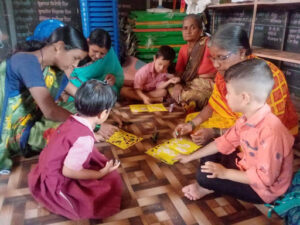
Celebrating childhood: Various initiatives under Bachpan Manao
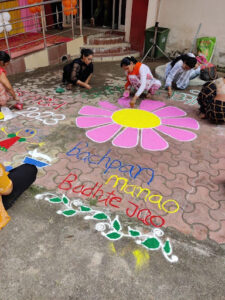
- Many organisations have taken celebrations to the villages and communities they work with as a Bachpan Manao Tyohar, a celebratory event.
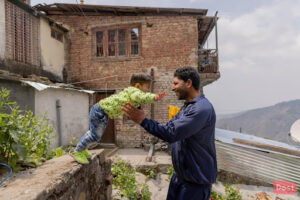
- Others have curated events and creative spaces to build awareness like a visual capture of responsive parenting in a photo series by Dost Education, these images are available as a public good on a microsite Baatein Sneh Aur Kehl.
- Many in the network have sprung into action to create and share meaningful research like insights on mothers, conversations with fathers, a deep-dive on professional development of early educators, expanding spaces for children by making gram panchayat libraries in Karnataka welcoming for children and turning librarians from caretakers of books to storytellers all celebrated with the launch of Librarians of India.
- In addition, there were several digital public goods created and made available including a virtual assistant to help understand policy in the form of NCF Sakhi.
- In February 2024, the e-Jaadui Pitara was launched by NCERT, in addition to relevant access and content for the early years from NCERT and states, it contains curated content from diverse collab-actors in the Bachpan Manao ecosystem. It also contains access to three AI bots – virtual assistants created as a public good to generate stories in diverse languages, a parent bot called Parent Tara and a teacher bot called Teacher Tara.
Bachpan Manao comes alive through organisations and individual actions, in diverse ways, using unlikely formats and forums. Bachpan Manao brings a diversity alive for the early years child, caring adults and the early years ecosystem – transcending narrative, storytelling, transformation and technology.
Collabaction v/s Collaboration:
This movement has provided a myriad of actors with a shared language and mission co-created with and by them. It is for every individual and organisation to interpret this in their contexts and do it in the ways that they know best. The key term here is in the active-doing of it – which makes this Collabaction and not a collaboration that is governed by shared rules of the game. Collab-’action’ brings with it a sense of urgency and enables problem-solvers to be creative in their actions. The actions add up to verify our initial hypothesis of a surround-sound effect that has generated a societal movement to create early environments for children to thrive in India.
“Bachpan Manao has served as that open-ended, creative space for organisations and their stakeholders to think and work towards a mission that extends far beyond the programmes they are implementing. I am amazed at the diversity of people I am able to connect with. There are those from the private education sector but also those from advertising, technology, art and communications!”
– Samyukta Subramanian, Co-Lead, Early Years, Pratham Education Foundation
A Bachpan Manao Story: A District Celebrates Early Childhood
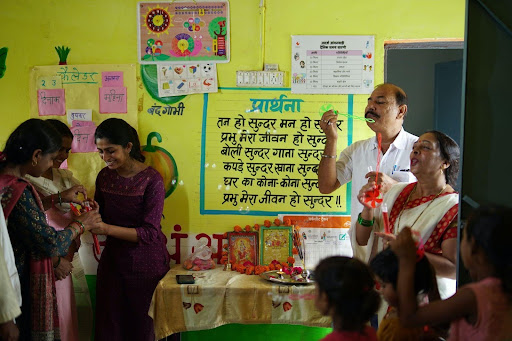
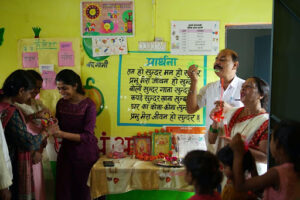
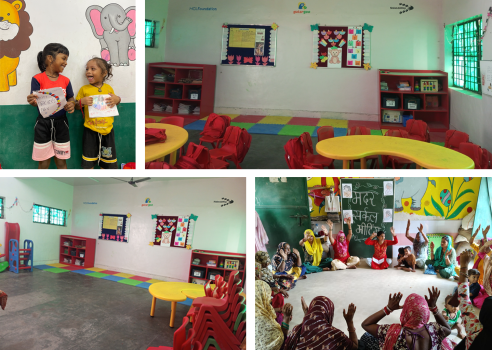
September and October, 2023 was a celebration of all things childhood in Chattarpur District in Madhya Pradesh. The District Administration embraced the Bachpan Manao Campaign by conducting a first-of-its-kind Anganwadi-level celebrations in 50 of their Adarsh (Ideal) Anganwadis with support from Key Education Foundation. Every Anganwadi organised games, activities, dances and more to allow their communities to explore and understand early experiences of children through play. The celebration saw active participation and ownership from various department officials and more than 1,500 children and their families.
This culminated in a district-level event that recognised efforts of parents, community members and most importantly, Anganwadi workers for their efforts towards ensuring an excellent Early Childhood Education for every child in their village. The district officials are committed to creating an annual celebration for their children as a recurring event.
Key takeaways
Bachpan Manao is now a mission for some, a celebration for others and has taken on a myriad of forms but more than anything, this is a movement of people who care deeply about the early years of every child in India. The movement has unlocked a bigger creative energy via the shared collective without bringing with it the set burden to ‘implement’ something external.
Engaging with Bachpan Manao has helped us gain some unique insights:
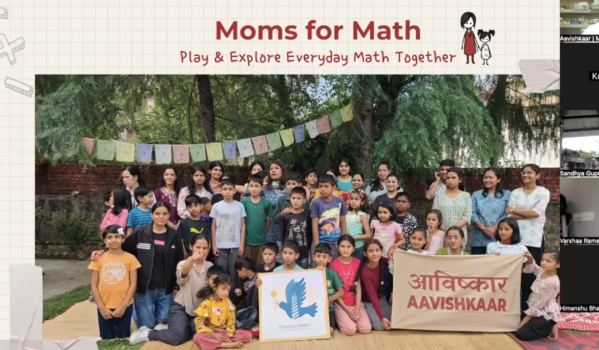
- The idea of involving parents in play where they ‘do’ alongside their children and celebrate childhood instead of attending workshops or being taught can be transformational in building a community that cares about children.
- The early years ecosystem in India is choosing to learn from each other – taking ownership, hosting master classes, offering learning to the wider ecosystem and this can expedite each of our individual impact journeys.
- Having a safe but connected [to a big idea] space unlocks new potential for organisational and system leaders to set fresh and audacious goals for ECE.
Citations
* Chow, J. Y., Davids, K., Renshaw, I., & Rudd, J. Nonlinear Pedagogy. Encyclopedia of Educational Innovation, 1–7. doi10.1007/978-981-13-2262-4_92-1, 2020
** Bailey Jr, D. B. (2002). Are critical periods critical for early childhood education?: The role of timing in early childhood pedagogy. Early Childhood Research Quarterly, 17(3), 281-294.
*** Saraswathi, T. S., Kaul, V., & Bhattacharjea, S. (2019). As We Look Ahead. Early Childhood Education and School Readiness in India: Quality and Diversity, 235-246







 )
)