


Friends. A social circle. People to talk to, laugh with, spend time with.
They are such an ordinary part of our lives that we rarely stop to think about how important they are.
But what happens when you don’t have a place to meet them?
I was in Chhattarpur, Madhya Pradesh, recently on a field visit to understand how the idea of the Bachpan Manao Tyohar had been received in the villages where it was implemented.
The Tyohar itself had been received warmly. That didn’t surprise me.
What did surprise me was why it mattered so much to people there — particularly the mothers.
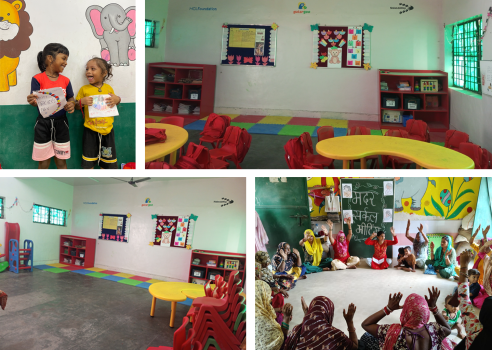
The idea behind the Tyohar was simple. Celebrate childhood and celebrate children. An Anganwadi worker invites the community into the Anganwadi, where everyone can come together to play, sing, dance and read stories. It is an opportunity for families to experience what an Anganwadi can be, while also understanding why play, relationships and joyful experiences are so important to children.
That happened.
But something else happened too.
“It’s like a mini kitty party, and we love it!”
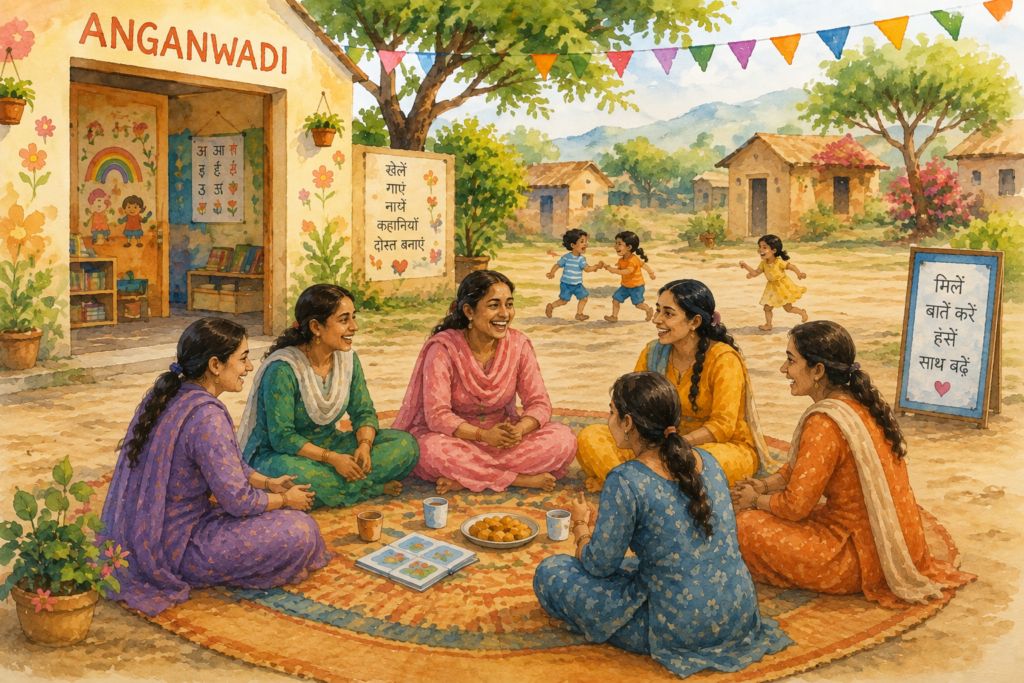
In Nowgong village, the mothers told us that they loved coming to the Anganwadi because it was one of the few places where they could meet other mothers.
And over time, they became friends. This may sound like a small thing; But it really isn’t.
Research with mothers of young children in rural Odisha has found a high degree of social isolation, with marriage, mobility and work among the factors that shape women’s opportunities to form and maintain social ties.¹
For many of these women, getting married meant leaving behind the social worlds they had grown up in. Their days are now filled with household work, caregiving and responsibilities. There is very little time, and even fewer places, simply to be with other women their age.
They told me that they didn’t really get to “hang out” with each other.
There was always work to be done. At home, with their families, they felt they had to maintain a certain seriousness. There was little room for silliness, laughter, jokes or simply being themselves.
But the Anganwadi offered something different: it offered a place to sit together, talk, laugh, sing, dance and share stories. It offered a space for fun.
During the Tyohar, some mothers told us it was the first time in a long time, especially since getting married, that they had danced and sung and simply enjoyed themselves with their friends.
One of them described the experience perfectly:
“It’s like a mini kitty party, and we love it.”
And perhaps there is more to this than simply having fun.
Friendship can be a resource too
We often think of friendship as something personal; something that makes our lives happier and less lonely.
But for mothers, social networks can also be a source of information, advice and practical support.
A study of mothers of young children in Andhra Pradesh found that mothers with larger and more literate social networks tended to have children with better height-for-age outcomes. The researchers also found that women commonly sought and received health advice from people in their networks, suggesting that knowledge and resources can travel through these relationships.²
The point isn’t that having more friends automatically makes children healthier.
It is that relationships can give mothers access to things they may not otherwise have: information, advice, support and connections to resources.
Another study using data from more than 6,700 rural children under five across India found that children’s nutritional outcomes were positively associated with households’ connections to development-oriented organisations – a form of what researchers call bridging social capital.³
In other words, relationships can connect families not just to one another, but to information, institutions and opportunities beyond the household.
This makes the Anganwadi interesting in a different way: it isn’t only a place where a child receives a service; It can also be a place where the adults around the child find each other. Which is what happened in Nowgong.
Childhood needs friendship and play. But so do adults.
We talk a lot about the importance of relationships in a child’s life.
We talk about parents, caregivers, teachers and peers. We know that children need people with whom they can play, talk, explore and simply be themselves.
But perhaps we don’t talk enough about the relationships that surround the child.
A child grows up within a network of relationships. And those relationships don’t stop at the parent-child relationship. When mothers have opportunities to build friendships, exchange knowledge and support one another, they may also be strengthening the social environment in which children grow up.
This doesn’t mean that a mothers’ gathering is an early childhood intervention in itself. Rather, it means that the social world surrounding a child is part of the ecosystem of childhood. And that ecosystem includes the wellbeing, relationships and networks of the adults who care for them.
What if we created more places to meet?
In many urban and privileged contexts, meeting friends can feel effortless.
There are cafés, parks, community centres, clubs, neighbourhood groups, libraries and countless other places where people can gather. Plans can be made, coffees can be “grabbed”, parks can be spaces to hang out, and kitty parties can be organised.
But access to these kinds of social spaces is not equally distributed.
For many people, especially women whose days are shaped by care work and household responsibilities, friendship requires more than simply having friends; It requires a place, an opportunity and permission to spend time together.
So perhaps, when we think about designing spaces and programmes for children, we could also ask:
Where do the adults who care for children get to meet each other? Where can mothers sit together without having to accomplish something? Where can neighbours become friends? Where can people laugh?
Where can they share stories, exchange advice, complain about their day, “spill tea” — and just have fun?
Maybe an Anganwadi can be one such place; a school courtyard can be another; a neighbourhood library, a park, a community hall or even a street can become one too.
The question that we ask isn’t only:
How do we create more spaces for children?
But also:
How do we create more opportunities for the people around children to build relationships with each other?
Perhaps we need to think of social connection not as an accidental by-product of programmes for children, but as part of the infrastructure that supports childhood.
Because children don’t grow up alone. They grow up surrounded by adults, relationships, conversations, friendships and communities.
And sometimes, creating a better childhood might begin with something that sounds wonderfully simple:
Giving people a place to meet their friends.
Footnotes
- Andrew, A., Attanasio, O., Augsburg, B., Behrman, J., Day, M., Jervis, P., Meghir, C. & Phimister, A. (2024). Mothers’ Social Networks and Socioeconomic Gradients of Isolation. Economic Development and Cultural Change, 73(1), 487–522. The study followed 2,170 mothers of young children in rural Odisha over four years and found a high degree of social isolation, examining how marriage, mobility, work and socioeconomic characteristics shape mothers’ social networks.
- Moestue, H., Huttly, S., Sarella, L. & Galab, S. (2007). “The bigger the better” – mothers’ social networks and child nutrition in Andhra Pradesh. Public Health Nutrition, 10(11), 1274–1282. Among 282 mothers of young children, larger and more literate maternal networks were positively associated with children’s height-for-age. Women also commonly reported seeking or receiving health advice through their networks. The authors suggest that sharing health knowledge and other resources is one possible mechanism, while noting that further research is needed to establish causality.
- Vikram, K. (2018). Social capital and child nutrition in India: The moderating role of development. Health & Place, 50, 42–51. Using data on 6,770 rural children under five from the India Human Development Survey, the study found a positive association between children’s nutritional status and household connections to development-oriented organisations. It also found that the relationship between community-level social capital and child nutrition depends on the local development context.







 )
)