

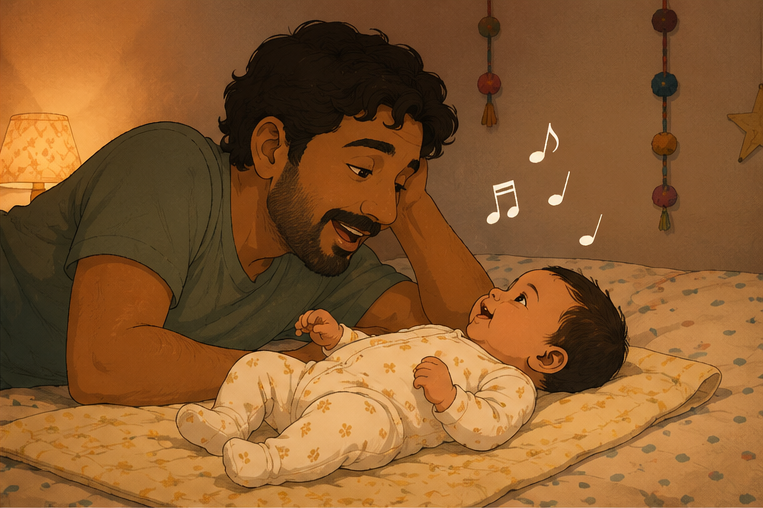
Until I began researching lullabies, I had never questioned who sang them, I simply assumed they belonged to mothers and grandmothers caring for their young ones. It seemed fitting when most of the research I was reading also supported this idea of lullabies being one of the integral parts of maternal caregiving. Then, in one of my conversations at home about my research, my father casually reminded me that he had sung lullabies to my sister and me when we were little. He reminded me that the only lullaby I can now recognise and recall ಲಾಲಿ ಲಾಲಿ ಸುಕುಮಾರಿ, ನನ್ನ ಮುದ್ದು ಬಂಗಾರಿ (‘Laali laali sukumari, nanna muddu bangari’), is the one he used to sing to me often.
This suddenly changed how I was viewing lullabies itself. A straightforward piece of research now felt personal.
The emphasis on mothers is not without reason. Long before a baby is born, it grows inside the mother’s body, surrounded by the rhythm of her heartbeat and the vibrations of her voice. Research suggests that babies begin responding to sound while still in the womb and are able to recognise their mother’s voice soon after birth. Mothers singing to their child after birth is, in many ways, a continuation of a conversation that had already begun in the womb. Learning about this, it made sense why lullabies are predominantly associated with mothers. But it also made me wonder why the lullaby that had stayed with me belonged to my father.
Curious about why my father sang to me, I asked him if he had made a conscious effort to learn lullabies from someone. He laughed and said, “Nobody teaches you how to sing a lullaby.” He believes he picked up a few words and tunes growing up in villages, listening to women naturally sing to babies as an everyday practice. The songs stayed somewhere in his memory until one day he found himself singing to his own daughters. He also told me that he did not always sing actual lullabies. Sometimes he simply spoke to me in a singsongy voice, describing my tiny fingers, my eyes or asking how my day was. Sometimes he hummed tunes he had heard on the radio. Hearing all this, I wondered if it even matters to babies how perfect the songs sung are. Maybe they are simply listening for a safe, familiar voice.
When I asked him whether it felt unusual for him to be the one singing and putting me to sleep instead of my mother, he shrugged it off and said “It wasn’t about who should do it, it was about getting it done.” Singing me to sleep was just one of the extensions of a caring parent rather than any particular idea of fatherhood. Listening to him, I realised that I had unconsciously inherited the same assumption as much of the research I had been reading – that lullabies somehow belonged only to mothers. But my own memory reminded me that it isn’t always true. In a way, the research and my own story were not really contradicting each other at all. The act of singing to children to soothe and comfort them had travelled through generations of women before eventually finding their way into my father’s voice.
There is enough evidence that young children often seek out familiar songs because their repetition and predictability offer reassurance. Lullabies are thought to strengthen emotional bonds between caregiver and child, creating moments of comfort and co- regulation that extend beyond helping babies fall asleep. Reading this, I found myself thinking less about the lyrics of the lullaby my father sang and more about what it had come to represent.
When I hear Laali laali sukumari today, I don’t only hear a melody. It is so much more. It is a reminder of my father’s voice and the certainty that I am cared for. Maybe that is what a lullaby becomes over time. Not simply a song that puts a child to sleep, but a memory that outlives childhood. A melody carrying the feeling of being loved. A small inheritance passed from one generation to the next.
For me, Laali laali sukumari is no longer just the first lullaby I remember. It is a little piece of my father that still travels with me whenever I hear it.
I began this journey believing that lullabies belonged to mothers, I still understand why they so often do. But now I also have the understanding that it isn’t necessarily limited to one gender only. The onus of singing a lullaby isn’t just on mothers, but can be shared by any caregiver who chooses to hold a child close enough to sing. What a child carries forward may not be the song itself, but the memory of the person whose voice made them feel safe.



 )
)