


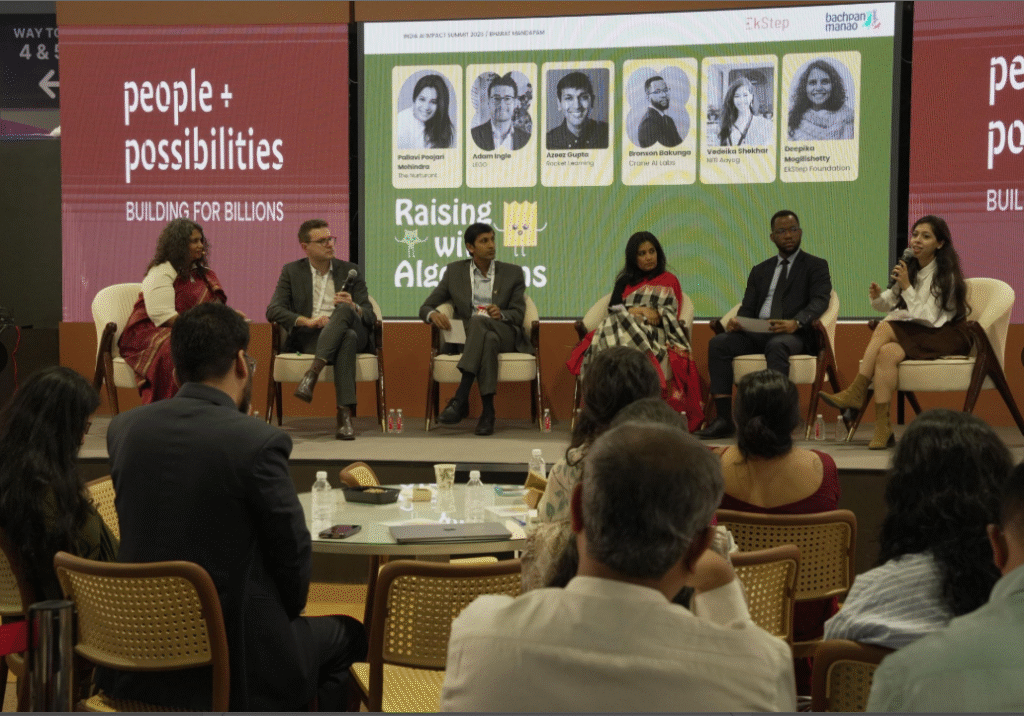
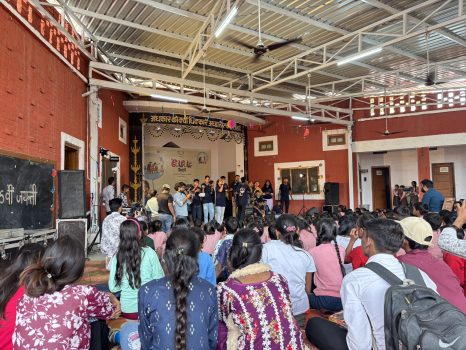
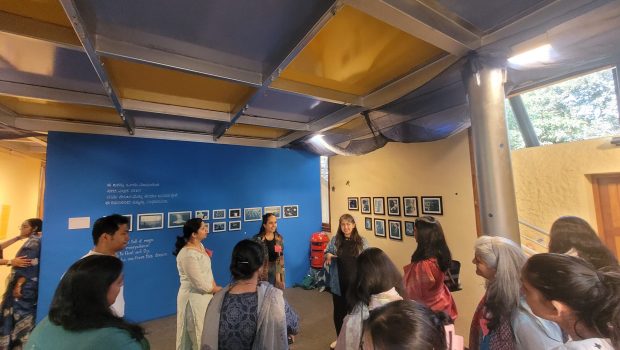
This reflection comes out of a conversation at the India AI Impact Summit during a session hosted by Bachpan Manao titled Raising with Algorithms – Who Shapes the World the Next Generation Grows Into. The room brought together people who do not usually occupy the same space for very long: Adam Ingle from the LEGO Group, working on digital safety and policy; Azeez Gupta of Rocket Learning, focused on early childhood systems across India; Bronson Bakunga of Crane AI Labs, building language technologies for communities often left out of mainstream AI; Pallavi Poojari Mohindra from The Nurturant, rooted in early childhood practice and attachment; and Vedeika Shekhar from NITI Aayog, approaching these questions from a public policy lens. It was an unusual mix of vantage points in one space. The conversation was moderated by Deepika Mogilishetty from EkStep Foundation, who moved it along without letting it drift too far from the lived realities being described. What became clear fairly quickly was that although everyone came from different systems, sectors, and pressures, the conversation kept circling back to the same centre of gravity: childhood itself, and what it actually takes for it to remain whole.
_____________________________________________________________________________________________________________________
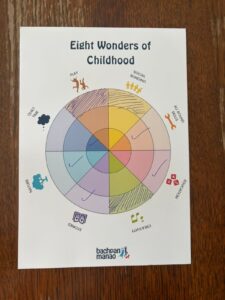
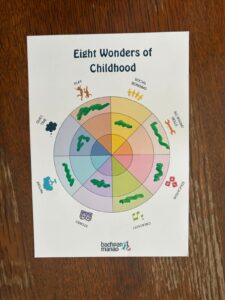
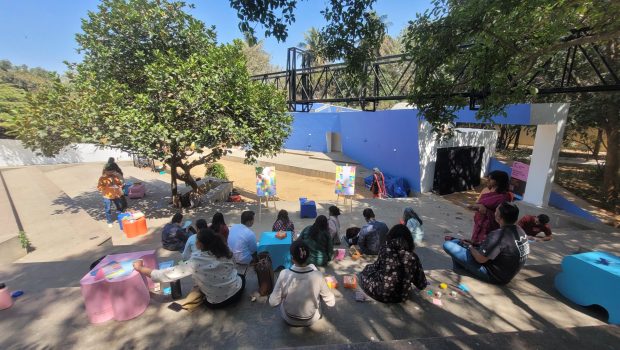
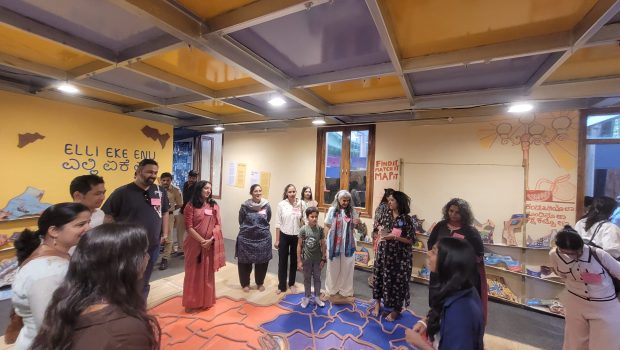
At the beginning of the session, we asked people to do something simple. Around the room were eight words printed on a wheel on sheets of paper:
Play. Social Bonding. All-round Skills. Education. Creativity. Stories. Nature. Quiet Time.
We invited people to mark each one low, medium, or high, not based on what they hoped was true, but on what they actually see in children’s lives around them. It was meant to ease us into the conversation. It didn’t stay a warm-up for long.
As people, both on the panel and in the audience, started filling it in, the tone of the room changed. What had begun as a simple marking exercise quickly became more reflective. When “quiet time” came up, it led to memories of school and how different children’s schedules feel now. When “play” was discussed, it moved into classrooms in Scotland, where children gravitated back to paper and crayons even with image tools available. “Nature” opened up a conversation about urban childhoods and the kinds of experiences that disappear across generations.
These weren’t abstract ideals. They were tied to lived examples people had seen or remembered. By the end of it, the exercise began to feel more like a quick inventory of what gets protected by default, and what needs active effort to stay in the room.
A different place to begin
Most conversations about technology and children start from the same place.
- What can systems do?
- How accurate are they?
- How efficient?
They are reasonable questions. But they assume the technology is the centre of the frame.
What if we shift the frame slightly? What if we begin not with capability, but with childhood itself?
Rather than beginning with what systems can do for children, it felt more useful to ask what children seem to need in their everyday lives, and whether the systems around them are supporting that or complicating it. Seen that way, the conversation shifts more than you’d expect.
Eight elements, and what started to surface
As people spoke, each word started to feel less like a category and more like a signal about what children seem to rely on.
Play: Children tend to learn by moving toward what interests them, not by trying to get something right. Environments that reward correctness all the time can, over a while, make that instinct smaller. Adam Ingle (the LEGO Group) shared a classroom moment from Scotland where children had image-generating tools available, but most drifted back to the table with big paper, crayons, paints, and each other. The biggest take-away was that play kept choosing contact.
Social bonding: Children don’t develop in isolation. They become themselves through interaction, through being with people who respond to them. Pallavi Poojari Mohindra (The Nurturant) called it the “cognitively distracted adult in the room”, not absent, but not quite there, and described how that weakens the emotional signalling children learn from.
All-round skills: There was a practical example shared by Azeez Gupta (Rocket Learning) that stayed, telling a child, “I’m going downstairs to work, I’ll be back at this time,” and then actually returning when you said you would. That rhythm of promise and follow-through is part of how trust and self-regulation form, long before anyone calls it a skill.
Education: Learning is shaped as much by tone, timing, and relationship as by curriculum. What is taught matters, but so does how it is held. Bronson Bakunga (Crane AI Labs) described noticing learning when a child becomes more curious, not when they get something right, you tell them a small story about an apple, and they come back later asking for more, or retelling it in their own way.
Creativity: Trying things that might not work is part of how children figure things out. Environments that are tightly structured can make that feel harder than it needs to be.
Stories: Children often make sense of things through narrative. Information helps, but it doesn’t always stay unless it’s attached to something they can imagine or relate to. Someone in the audience mentioned a child being handed a book and trying to swipe it like a screen. They also spoke about how a six-year-old got unexpectedly absorbed in a picture book about the history of their hometown. It was a reminder that stories aren’t just “content”. They’re how children practise perspective.
Nature: Being outdoors teaches scale, unpredictability, and care in ways that don’t usually look like lessons. Digital spaces can echo parts of that, but they don’t quite do the same job. One member of the audience said he grew up urban and didn’t have the same childhood memories of insects, trees, flowers that his wife carries from a more village-linked upbringing, and he realised he actually envies her for it. That kind of gap doesn’t show up in most learning conversations, but it shapes what children feel the world is made of.
Quiet time: Vedeika Shekhar (NITI Aayog) remembered school starting with 10–15 minutes of meditation and breathing at assembly. Now she watches her nieces move from one “activity” to another with barely any blank space. She also told a small story about them wanting Gemini to name their goldfish, and how different the room felt when they were nudged to spend 30 minutes coming up with names themselves.
No one described these as frameworks or principles. The conversation was centred around what participants had seen, or remembered, or were noticing in children around them.
Taken together, the words started to feel less like a list and more like a set of conditions that keep showing up whenever childhood seems to be going well. Is there room here for play that isn’t evaluated? Is there time that isn’t scheduled? Do children have people who are actually present with them? Is curiosity being followed, or redirected? Does this environment leave space for trial and error?
Those questions kept resurfacing, no matter which sector someone came from.
Where the tension starts to show
As the discussion went on, a slightly uncomfortable recognition began to surface.
Most adults already have a sense of what children need. Not in theory. In the everyday way people notice when a child feels settled, or withdrawn, or curious, or shut down. The difficulty isn’t that we don’t know. It’s what happens when we try to translate that knowing into systems. There was an example shared from an anganwadi visit near Indore: a child who had been labelled “weak at colouring.” It turned out the child wasn’t struggling with the task itself. They disliked the feeling of wet paint on their hands. The anganwadi worker only realised this after sitting beside them and watching closely. The child wasn’t behind. The environment just wasn’t matching them. A dashboard wouldn’t have picked that up unless the adult had space to describe what they noticed in their own words.
When systems get built, they often follow what institutions can actually track or scale. Timelines. Outputs. Comparisons. Those pressures are real, and they usually come from practical constraints, not indifference. But when that logic becomes dominant, other things don’t disappear so much as fade from view. Not because anyone chose to remove them. More because the structure didn’t leave much space for them to stay visible.
And once something slips out of view, it becomes harder to argue for, even if everyone still agrees it matters.
The things that don’t fit neatly into numbers
Many of the elements people named earlier share an easy-to-miss similarity: they don’t translate easily into metrics. Some things sit neatly in a tracker. Others don’t. Trust, curiosity, whether a child feels rushed, whether the adult in the room is regulated enough to be truly present, those tend to travel through stories, not spreadsheets. Systems don’t usually erase these qualities outright. What tends to happen instead is that something else becomes easier to see, easier to report, easier to reward. Over time, attention follows what is most visible.
And whatever sits outside that frame can start to feel secondary, even when it isn’t. That’s often where the tension tends to sit.
Rethinking what we mean by safety
When people talk about safety for children, they often mean protection from harm. That matters, and it should. But it may not cover the whole picture.
Vedeika spoke about how quickly children get labelled the moment they enter certain school systems, “not school ready”, “socially awkward”, “developmentally delayed”, sometimes within days. Her plea was simple: give children space, give them time, and don’t let a system set a trajectory too early.
There’s another sense of safety that comes up when people talk about childhood more carefully. It has less to do with threat and more to do with conditions. Time to think without being rushed. Space to try something and get it wrong. Relationships that feel steady enough for a child to take small risks. The sense that a mistake won’t follow them forever.
Seen from that angle, safety isn’t only about safeguarding children from danger. It’s also about making sure the basic conditions for them to thrive don’t shrink away.
What remains open
By the time the conversation wrapped, no one sounded especially certain of neat answers. If anything, there were more questions than when we began, and that didn’t feel like a problem.
Questions like these don’t belong to one field or one organisation to solve. They sit across classrooms, homes, product teams, policy rooms, and everywhere decisions get made about how children learn and live.
A question that kept returning, in different ways, was whether these tools help adults be more present with the child in front of them, or whether they pull attention away and turn the child into one more thing to interpret.
Because the future children grow into isn’t waiting somewhere ahead. It’s already taking shape in small ways, in tools, routines, interfaces, expectations, often long before anyone pauses to name it.
And maybe the question worth carrying forward is not about what technology might give children, but about what we don’t want it to slowly edge out.

 )
)