


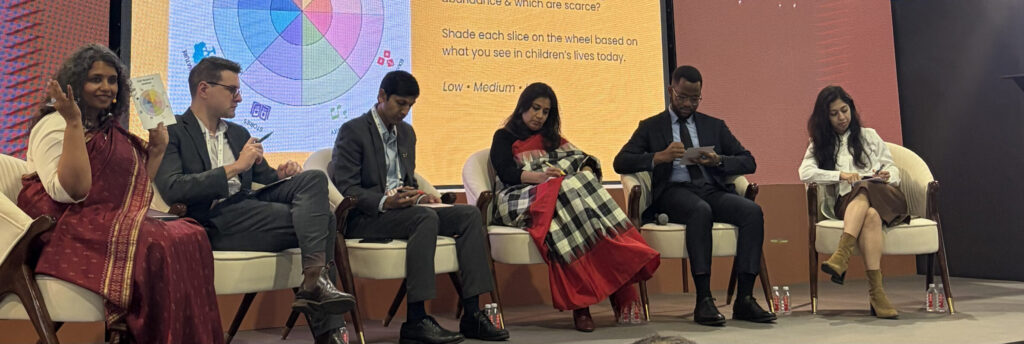
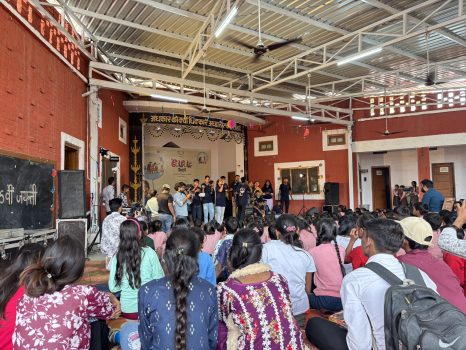
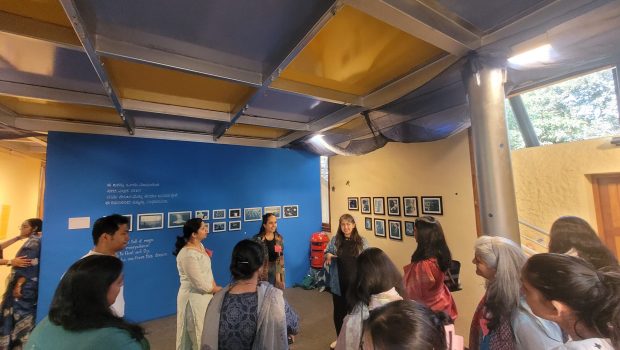
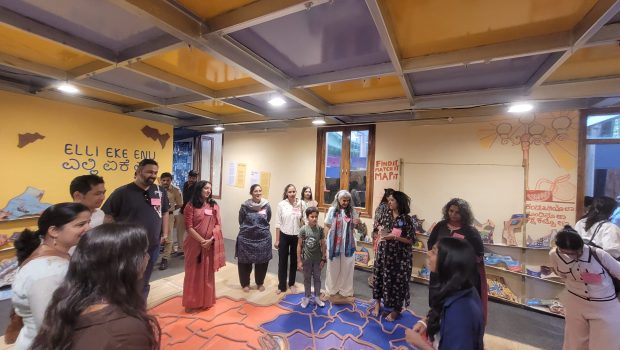
This reflection grows out of a conversation held at the India AI Impact Summit, where educators, technologists, policy practitioners, and learning designers came together to talk about children and intelligent systems. The session was titled Raising with Algorithms – Who Shapes the World the Next Generation Grows Into. What stayed with me was how quickly the conversation drifted away from abstract futures and settled into the texture of children’s actual, everyday lives.
______________________________________________________________________________________
There was a moment during the conversation that stayed with me long after the room emptied.
Someone said that children don’t meet technology as tools. They meet it as environments.
That distinction has been sitting with me ever since.
We often talk about digital systems as things people use. Interfaces. Platforms. Products. But for children, especially very young children, systems are really not things at all. They feel more ike atmospheres. They shape pace, attention, interaction, expectation, and even what counts as doing well. A dashboard isn’t just information to a child. It invisibly starts to define what seems to matter.
Which is why conversations about children and technology rarely stay technical for long. They have to stay anchored in how children actually grow.
A five-year-old asking a voice assistant a question before asking the adult beside them. A classroom where children raise their hands less because the tablet already shows the answer. A learning dashboard that marks a child “behind” before anyone has asked how they are doing that day.
This is already part of their world
Artificial intelligence didn’t arrive in childhood all at once. It found its way in gradually. It sits inside learning apps, recommendation systems, assessment tools, parenting forums, classroom dashboards, teacher planning platforms. It shows up in easy-to-miss ways. Often usefully. Sometimes invisibly.
Most public conversations still centre capability. What systems can do. How fast they improve. How accurate they are. What they might replace.
We don’t talk as much about what they often invisibly reshape. And much of that shaping begins long before anyone thinks to notice it. By the time adults begin debating effects, will patterns have already formed?
And the more capable systems become, the more that second question matters. We spend a lot of time asking what they can do. I find myself wondering more about what they might be changing.
The risk of simplification
What worries me more than faulty systems is narrow imagination. Not because people lack care, but because systems reward simplification.
- If systems are built only through a performance lens, they optimise performance.
- If built only through a measurement lens, they optimise what can be counted.
- If built only through a scale lens, they optimise what can be standardised.
Those lenses matter. But they aren’t the whole picture. Childhood doesn’t really fit inside any single one of them.
Children grow in uneven ways, through repetition, frustration, imitation, boredom, attachment. Development is messy long before it is measurable. When environments only recognise what is neat and trackable, they can slowly start misreading what growth actually looks like.
So designing responsibly for childhood is not about adding safeguards later. It is about holding multiple ways of seeing from the start.
The angles people were seeing from
What struck me most during the discussion was not that people disagreed. It was that people were looking from different vantage points.
Policy. Classrooms. Caregiving. Product design. Research. Implementation.
Taken together, those perspectives form something like a working map. These aren’t abstract ideas. You see them play out in ordinary decisions. You can see them in ordinary decisions adults make every day, often without thinking of those decisions as design.
Development lens: Children do not grow in straight lines. Systems that assume linear progress will misunderstand them.
Relationship lens: Learning is relational before it is instructional. If something weakens human interaction, it weakens learning.
Agency lens: Children need room to try, fail, and try again. Over-predictive systems can softly remove that room.
Context lens: A child’s world is shaped by where they live, who they live with, and what surrounds them. Systems that ignore context flatten experience.
Attention lens: Every interface nudges attention somewhere. What it rewards becomes what children learn to value.
Time lens: Childhood needs pauses. Reflection rarely happens on schedule.
Power lens: Someone decides what gets measured, labelled, and prioritised. Those decisions travel far.
Accountability lens: When something goes wrong, who carries responsibility: the adult, the institution, or the system?
None of these lenses belong to one profession alone. They belong to anyone shaping environments children grow up inside.
The moments that mattered
It was not the big statements. It was the small examples.
- A caregiver who always returns when they say they will.
- A teacher noticing that a child avoids paint because of how it feels on their skin.
- A classroom where curiosity appears as questions rather than correct answers.
- A child who learns because someone is watching closely.
You won’t usually find these moments captured anywhere. Yet they are often where development actually happens.
At one point someone said, very simply, that the most important learning moments resist being distilled into a system.
What this asks of design
Systems are already here. Children are already growing inside them. Removing systems from childhood isn’t really possible, and it probably isn’t the goal anyway.
The goal is to design them so they strengthen the conditions childhood actually depends on.
- Tools that can assist without taking over judgment.
- Support that does not crowd out attention.
- Ways of noticing patterns without collapsing children into these patterns.
And perhaps most importantly, tools that recognise that data is always partial. It can show patterns. It cannot hold a whole child.
The responsibility underneath all this
Whenever something new enters a child’s environment, it isn’t only a technical addition. It starts to shift the atmosphere around them in small ways. Adults begin paying attention to different things, some behaviours become easier to see while others slip past unnoticed, and slowly certain kinds of progress start to feel more legitimate than others. None of this is usually intentional, and it rarely happens all at once, but over time those shifts accumulate.
It’s difficult to ignore how much technology is already shaping childhood. The more uncomfortable question is who gets to shape the technology in return. I don’t think anyone in that room believed technology was the problem. But we all seemed aware that unexamined systems can begin to become one.
We are still early enough to do this thoughtfully. But only if we remember something simple: Children do not grow up inside products. They grow up inside worlds. Every adult who touches a system that touches a child is part of that design, whether they intended to be or not. And worlds don’t simply appear. They are shaped, slowly, by the decisions people make.


 )
)