Anganwadis can foster mothers’ friendships, social support, belonging, and stronger communities around childhood.
The first thing I noticed at Latika was that the parents had not left. In most schools the adults thin out by nine, and what I found instead was a village that somebody had sat down and deliberately built.
A speed limit sign at the gate is the first clue. What follows is a building that never once raises its voice: a reception desk at two heights, mirrors in every room, a ramp instead of an afterthought. This is what it looks like when a school designs backward from what a child’s body actually needs.
In a small room in Dehradun, women from the hills sing the songs their grandmothers gave them, songs for grinding grain, for weddings, for a plant that flowers once a year. One generation of migration is all it takes to lose them. This is the story of the ones who carried them anyway.
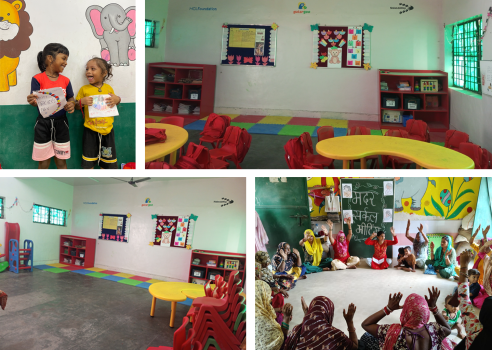
A transformed Anganwadi shows how better spaces, engaged teachers and community trust can together create thriving early childhood learning environments.
A participatory study of Bhuj’s Anganwadis reveals how care, spatial constraints, community knowledge, and the Anganwadi workers’ and helpers’ aspirations can shape inclusive design.