


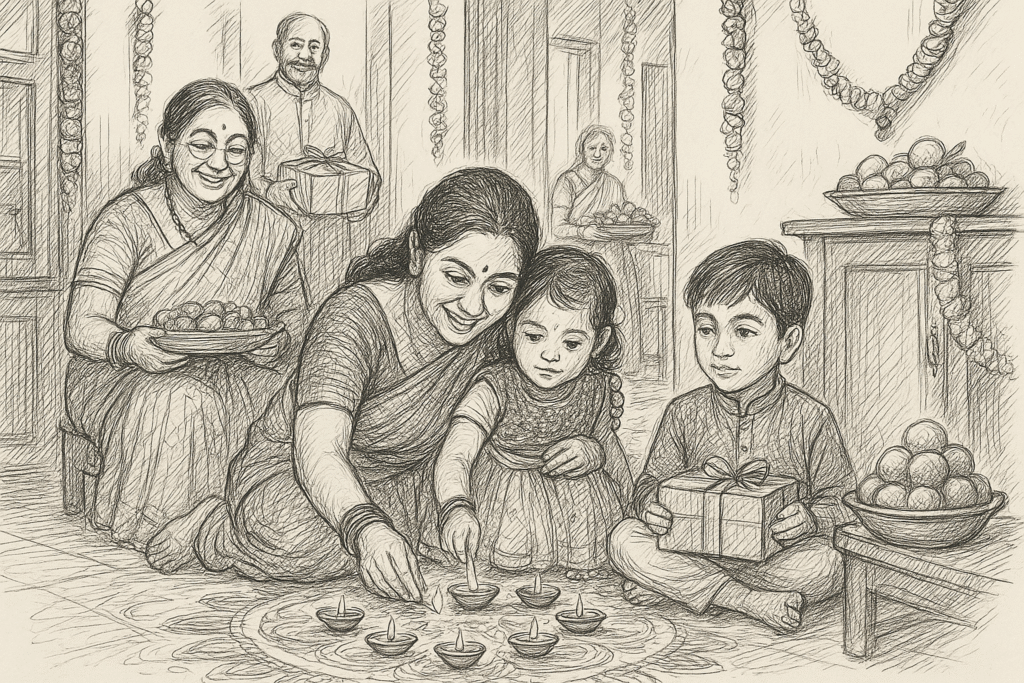
Festivals are meant to be joyful, especially for children.
That’s the line caring adults remind themselves while stringing up lights with one hand and untangling someone’s tantrum with the other. That’s the story playing in the background as WhatsApp floods with invitations, memes, and reels, and someone at home tries to figure out: Who’s eaten, who’s overstimulated, who’s too quiet, who needs cooling down, calming down, holding.
Because when you’re the caring adult, a mother, a chechi, a caregiver, a father who’s doing this solo, celebration comes with a side of stretching.
Not just your budget. But your time, your patience, your back, your ability to respond to “Can I open it now?” seven times before breakfast.
__________________________________________________________________________________________________________________________________________________________________________________________
At a home in Bhopal, Mahira wakes up early to begin the day’s cooking. Her toddler is already clinging to her leg. Her older son is busy tearing open the envelope with his Eidi before the guests arrive.
“It’s supposed to be a holiday,” she says, mostly to herself.
“But for mothers, it’s like an annual day, and we’re backstage, keeping it all together.”
She says it with humour, but her eyes flick to the stove again. The halwa can’t burn.
She wants the children to remember joy. Not heat. Not scolding. Not chaos.
So she smiles when the toddler throws henna-stained water across the floor. She’ll clean it later. Right now, they’re dancing.
__________________________________________________________________________________________________________________________________________________________________________________________
For others, it’s not joy but logistics.
Kavita is a domestic worker in Pune. Her employers have gone out of town for the long weekend. Her own children, 5 and 8, are home alone, watched by an elderly neighbour. She shares,
“During festivals, richer children get more time.”
“Poorer children learn patience earlier.”
She’ll finish work early and bring home two samosas and a quarter kilo of jalebi.
“We’ll light a candle. I’ll let them stay up late. We will play games. That will be our festival.”
She says it without bitterness. But with a tired sort of pride.
__________________________________________________________________________________________________________________________________________________________________________________________
In Delhi, Neel is co-parenting his son. It’s their first Christmas apart. His son arrives at 3 p.m., already carrying a sugar crash and stories from the other house.
“I just want him to feel… safe. Not torn.”
So they make Christmas cake from scratch, too soft, a bit lumpy, but homemade. They play old songs. They leave the crackers untouched.
__________________________________________________________________________________________________________________________________________________________________________________________
Care during festivals is not just about rituals. It’s about making a world within the world, where children can feel held, even when things around them are rushing.
It’s about answering 36 questions in 20 minutes. And not snapping when one child wants silence and another wants music. It’s about letting go of the idea that you have to enjoy the festival, and instead focusing on whether they are okay, regulated, rested, remembered.
__________________________________________________________________________________________________________________________________________________________________________________________
In some families, celebration means overwork. In others, it means stepping into roles that are not always ours.
In Bangalore, a teenage girl is put in charge of her younger siblings during Navaratri. Her parents are busy with guests. She braids their hair, warms their clothes, and shoos them away from the diya. Later, when everyone else is clapping during the aarti, she sneaks them an extra gulab jamun.
She’s fifteen. But she’s already a caregiver.
__________________________________________________________________________________________________________________________________________________________________________________________
We often hear,
“Make it special for the kids.”
But maybe what it means is: Hold space. Create joy. Absorb friction. Rewrite memory.
That’s the work so many adults do; often women, often unpaid, often unnamed, during every celebration.
It’s not seen in the main festival-day family photo. It’s behind the door, in the hallway, next to the changing mat, in the kitchen with a washcloth and a second round of rice.
__________________________________________________________________________________________________________________________________________________________________________________________
Years from now, the children may not remember the exact gift. Or which festival it was. Or whether the sweets came from a five-star box or a roadside stall.
But maybe they’ll remember that someone tied their shoelaces without fuss. That someone noticed when they were too hot, too full, too sad.
Maybe that’s what celebration really is. Joy. Play. Presence.







 )
)