

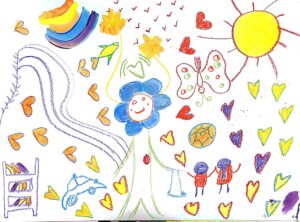
It was the kind of May morning many of us know too well — sticky, heavy, with the air thick from the night’s heat, and everyone quietly wondering, Will it rain or not? You could smell it in the air — that mix of dust, mango leaves, and far-off wetness.
At the Thriving Childhoods workshop during the Bachpan Manao Sabha, there were no lectures, no strict outcomes. Children from nearby schools arrived with their teachers, filling the room with quiet curiosity. They were joined by adults from many walks of life — anganwadi workers, librarians, lawyers, dancers, entrepreneurs, policy advocates, non-profit leaders, and small business owners.
The set-up was simple. No podiums or stages. Just piles of crayons, coloured pencils, glue sticks, and stacks of chart paper — the kind often seen in school corridors and community festivals, ready for making and imagining together.
And what unfolded wasn’t just art. It became a shared space of remembering and imagining — where everyone, no matter their age, carried their own stories of bachpan to the paper, mixing memories, wishes, and questions in every colour they picked.
Across two adjacent rooms, children and adults approached the same prompt in very different ways.
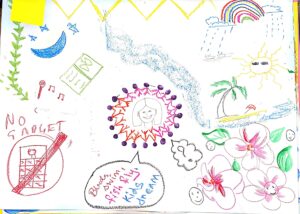
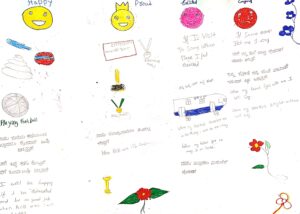
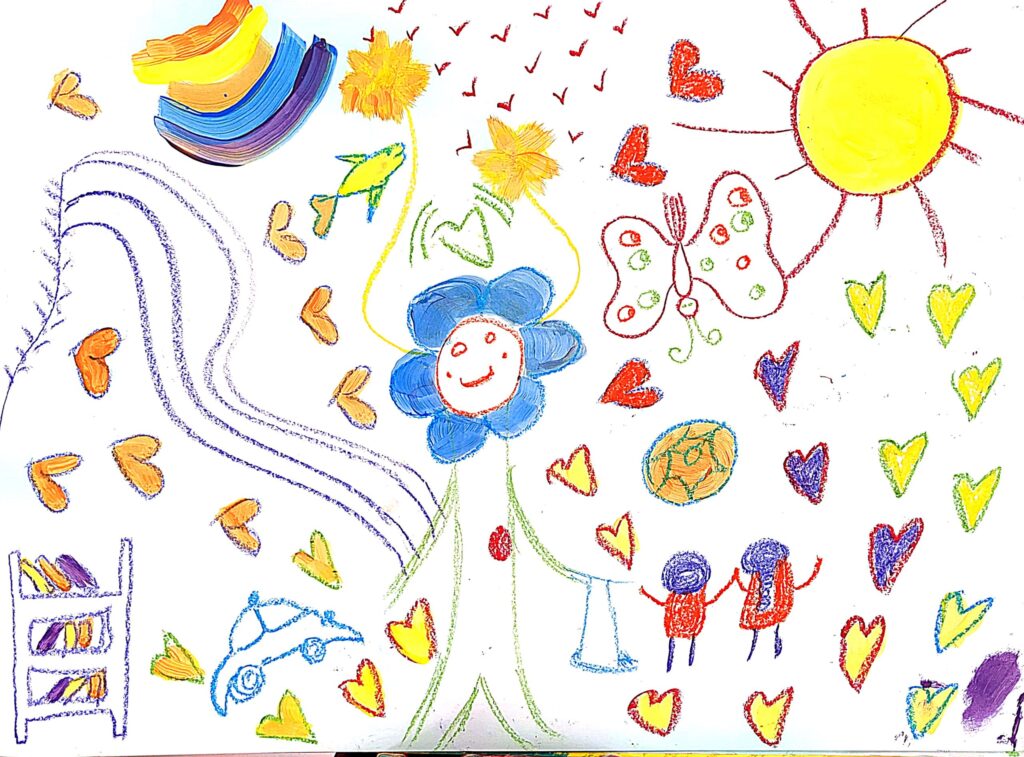
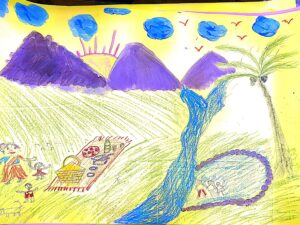
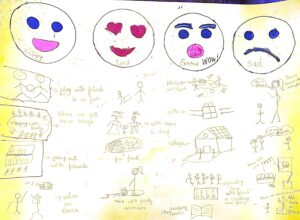
Children mapped feelings — joy, pride, excitement, and sadness — through simple drawings of their daily worlds: family, friends, school, and play. Their drawings were full of warmth and honesty, often revolving around connection: playing with friends, going out with family, getting surprises, or simply being noticed by those around them.
Their joys were rooted in the present — cricket matches with friends, school picnics, pocket money from siblings, birthday surprises, and even RCB winning the IPL trophy. For them, happiness didn’t need to be complicated. A short holiday, a treat, a playful afternoon — these were enough.
Adults, meanwhile, drew frameworks. They outlined how childhood could be “designed” — balanced spaces between play and learning, community and safety, homes and schools. Yet, in between these structured boxes, there were bursts of nostalgia too.
The Conversations That Stayed With Me
At my table, the talk drifted from toys to telephones. Someone recalled the excitement of dialling a rotary phone — how rare and magical that felt. Others spoke of climbing trees, stealing mangoes, making up games with cousins — and how today’s children rarely get to experience such unsupervised freedom.
We spoke of lost play:
- No more games passed down through generations.
- No more toys that carried family stories.
- Less time spent outdoors or in nature.

- Increasing dependence on screens — for both children and adults.
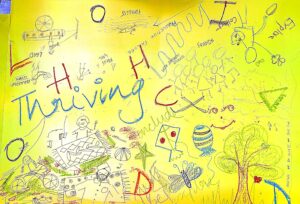
And with these memories came a quiet sense of what if:
- What if we hadn’t rushed childhood into something so structured?
- What if we allowed children to simply be bored again?
- What if we weren’t so afraid of mess, failure, or slowing down?
One teacher from Bobble, Manjunath, shared how his work with children under six had taught him a simple lesson: “We have to leave children as they are.”
Another participant, Amit from Physics Wallah, echoed this sentiment: “I am just a caregiver, not an instructor.”
Both of them reminded us: children do not need to be constantly guided. Sometimes, they just need to be allowed to explore.
The deeper we went, the more we questioned ourselves:
- Are we replacing curiosity with caution?
- Have we turned childhood into a “project” to manage?
- Why do we keep asking, “What did you learn?” instead of letting them simply experience life?
Many adults admitted they hadn’t painted or made a mess in years. The joy of it — the permission to be playful — sparked laughter and quiet reflection.
What Play Looked Like For Us (Then)
The adults’ stories were full of vivid detail:
“We made up games with our own rules.”
“We played outside until it got dark — no one came looking for us.”
“Every neighbourhood had its signature game.”
“We didn’t have much, but we had time and freedom.”
“Play just… happened. No one told us how to play.”
There was freedom, yes — but also a strong sense of togetherness. Cousins, neighbours, and friends filled their childhood memories.

What Childhood Looks Like Now (Through Adult Eyes)
Many adults felt today’s children are growing up differently:
- “Today’s kids aren’t bored enough.”
- “Even their play feels performative — it’s to prove something to adults watching.”
- “We’re doing bonsai parenting — trimming and shaping everything neatly.”
- “We’re too scared they’ll get hurt — especially after we’ve worked hard to build our homes and lives.”
- “We micromanage childhood like it’s a project.”
There was also deep discomfort with how screens now dominate family life. The question kept resurfacing — have we, as adults, forgotten how to be fully present too?
What Childhood Looks Like Now (Through Children’s Eyes)
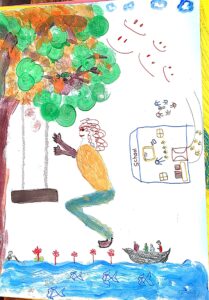
In their drawings and words, children painted a picture of happiness rooted in the everyday.
They spoke of pocket money from parents, playing cricket with friends, school picnics and waterpark trips, birthday surprises, and family outings where “everyone is happy.” For some, it was as simple as RCB winning the championship — a moment of shared celebration.
Their joys were immediate and uncomplicated: playtime with friends, time outdoors, treats, surprises, and the thrill of being noticed and included.
A Subtle But Deep Divide
This was perhaps the biggest learning from the Bachpan Manao Sabha.
Adults were carrying loss — longing for a slower, freer childhood that feels distant now. Their reflections were layered with nostalgia, regret, and worry.
Children, however, were simply living their version of childhood — finding joy in the small things they already have. Their drawings were not filled with longing. They showed hope, connection, and enoughness. What they asked for wasn’t more control or more structure — just simple joys: playtime with friends, laughter, outings, and a little more freedom from adult restrictions.
In a way, children were showing us something we had forgotten:
That even within today’s world, childhood can still thrive — just not in the ways we, as adults, might expect.
A Shared Question
Somewhere between these drawings and reflections, a shared question seemed to hover:
How do we balance our adult instinct to protect with the child’s need to explore freely?
Can we offer safety without smothering spontaneity?
One reflection from the day stayed with me:
“Maybe we need to stop designing for ‘children’ and start listening to this child.”
Perhaps thriving childhoods don’t begin with frameworks or nostalgia. Perhaps they begin with trust, listening, and letting go.
But maybe the real question isn’t how do we bring back the essence of the childhood we knew? It’s whether we can see the childhood unfolding right in front of us — on its own terms, in its own time.
The children at this Bachpan Manao Sabha weren’t asking for more.
They were already living it.
The work, then, may not be to reclaim childhood.
It may be to release it — to make space for it to thrive, just as it is.



 )
)