




As remembered by Vibha
 .
. 
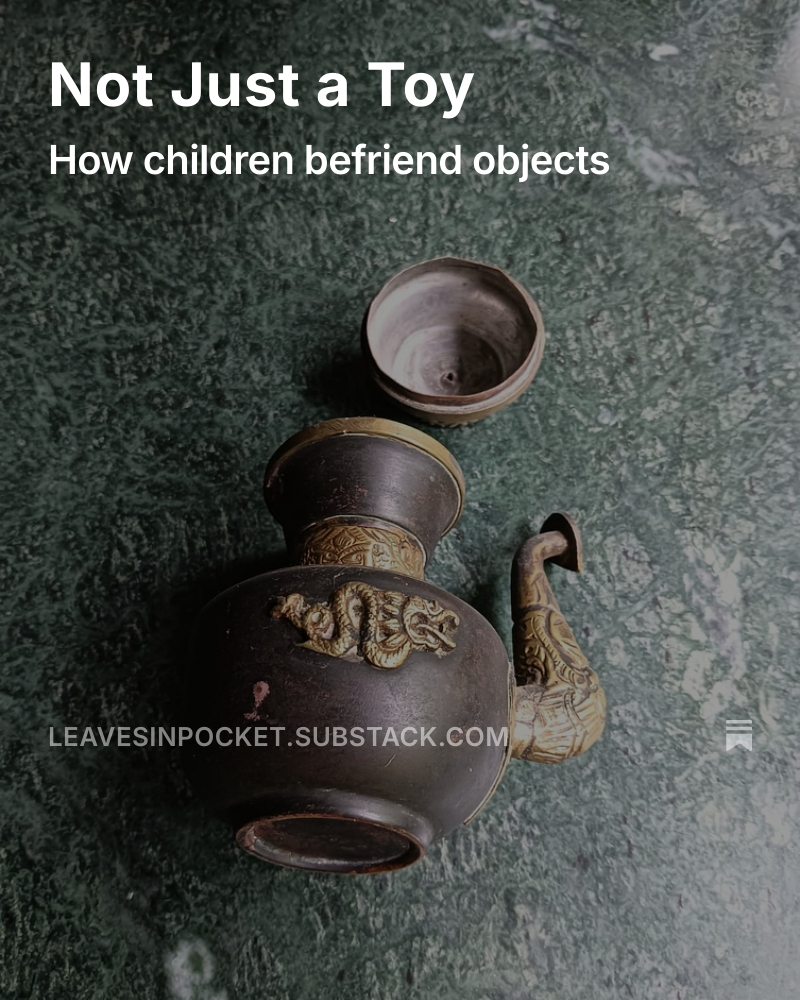
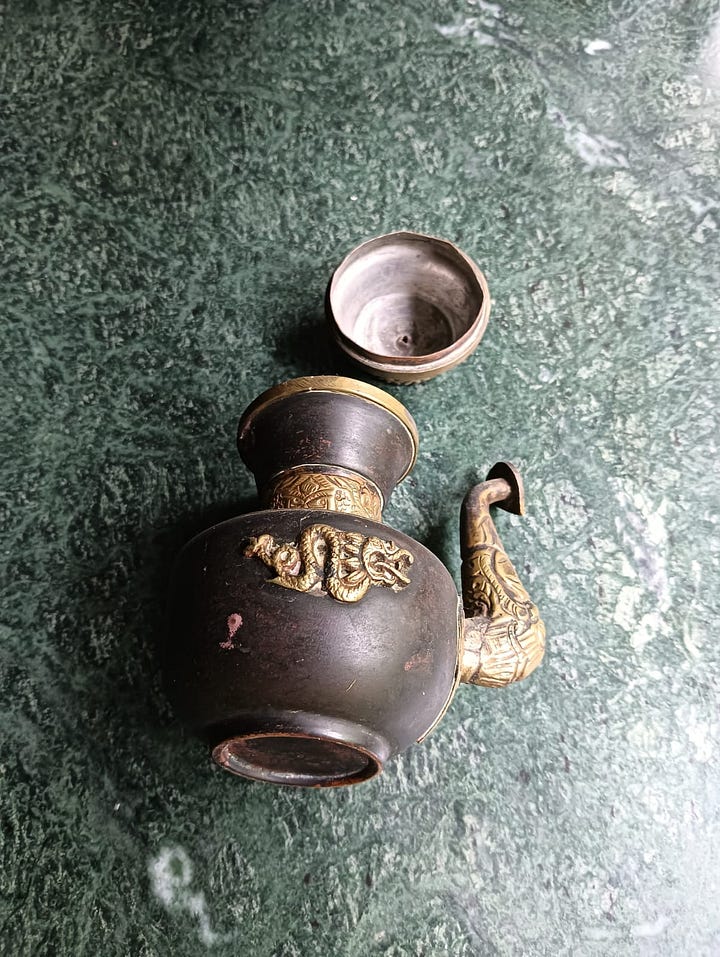
My childhood home was filled with little curiosities, trinkets that my father would pick up on his travels. I remember a brass vase from those years, small enough to hold in my then tiny hands, with a little spout and dragons engraved delicately along its front and back. I didn’t know where exactly it came from or what it was originally used for. But I remember it vividly, not because of what I did with it, but because of how it made me feel.
To me it was a portal to another land, an unknown land that I had imagined while reading Folk Tales or watching films. I remember how holding it conjured stories and imaginations that were alien to the world around me. In those moments, I was in places I had never been to before, with persons I had never met, to whom perhaps my little vase really belonged.
I remember, having spent hours with it, especially during hot summer afternoons, while everyone at home slept. I remember feeling bonded with it. It wasn’t ‘just a toy’, and I wasn’t ‘just playing’. I was with it. And it was with me.
Although I have lived away from this childhood home for over a decade now, each time I visit she looks longingly at the vase whenever my eyes land on it. It’s like an old friend, the sight of who reminds you of shared experiences, and a world that existed exclusively between you.
—
Each of us, perhaps, has memories like these. Of objects from our childhood that have participated in our imaginations and investigations. Their presence is oddly tender, and oddly alive. The sight of that object, or a whiff of something similar years later, carries us to places that are wrought with emotions. In the story above it was an imagined connection to someone unknown, to another culture, something that gets the writer curious even today. For you, the reader, it could be something else – perhaps in the realm of math, music or physics.
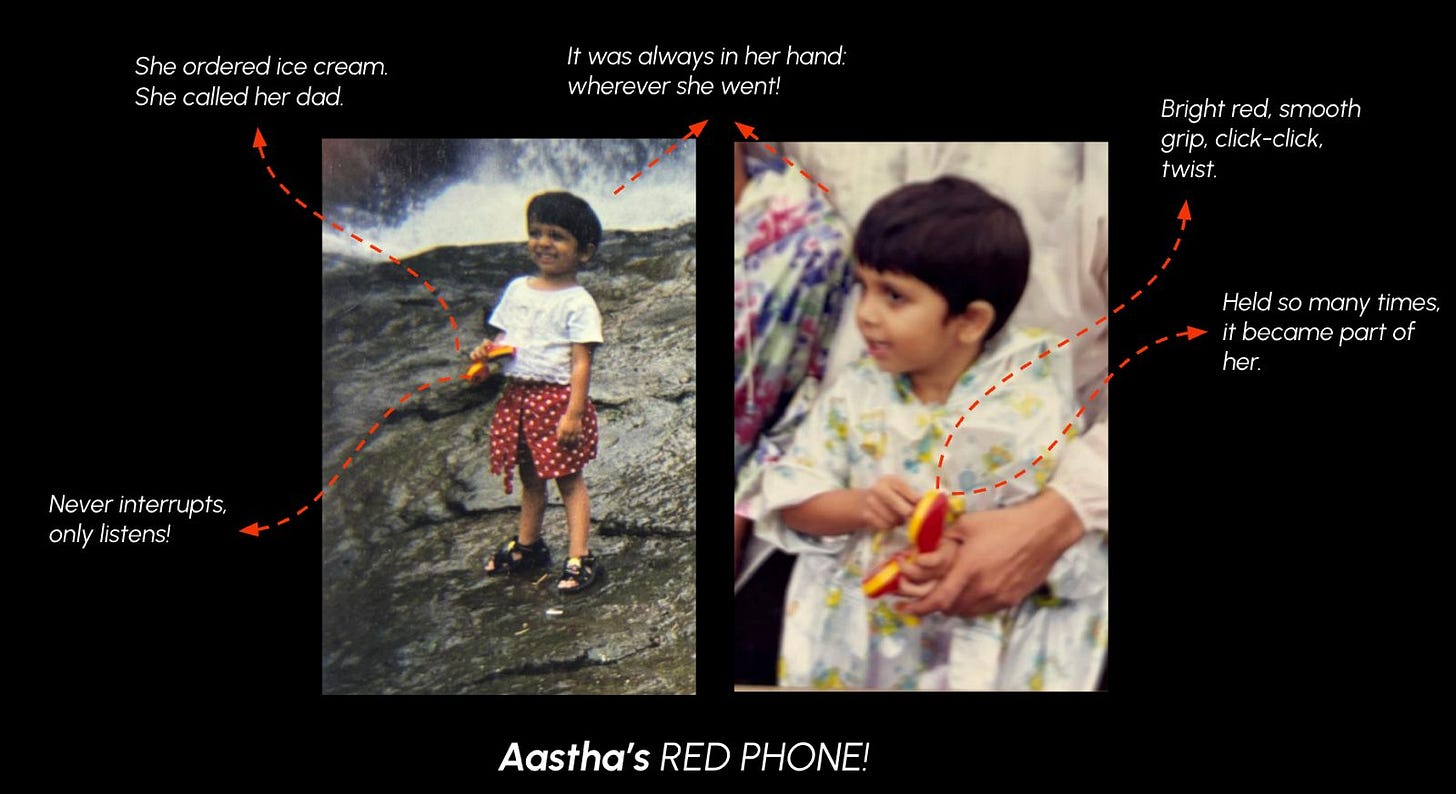
In our previous post, we looked at what children choose. This ongoing question allowed us to notice that certain objects appear over and over again in children’s play – in their palms, their pockets, and their beds. These objects are of all kinds – a coaster, a toy phone, a doll, a cot, a dupatta, a pebble, a toy car. What ties them together though, is the relationship between the object and the child. Children seek out these objects even in crowded rooms, they observe it with careful attention, studying its responses, they care for it like a loved one. Again, our observations of children had led us to a question:
What makes children choose certain objects? Attempting to answer this question led us to an understanding of the unnamed relationship between objects and children.
- They come alive in the child’s imagination
To adults, a spoon is just a spoon, but to a child it can be a phone or a magic wand. An object’s apparent stillness only underscores its potential to be animated by a child’s own creativity. - They engage the senses
Children explore the world through seeing, touching, smelling, hearing, and sometimes tasting. Objects that offer multi-sensory experiences – like a coarse snake engraving on an otherwise smooth vase, like the brr brr sound of tiny wheels when rolled on a floor, like a dupatta that makes waves as it flies – invite childrens’ senses to become alert and to pay attention. Through these sensory cues, children gather vital information about how their world works evoking specific questions, ideas, and emotions. - They are predictable and reliable
People can sometimes be inconsistent or busy, but objects remain the same day after day. The child can trust that what they have learned about the object is likely to hold true from minute to minute, day after day. This dependability builds familiarity and trust, inviting children to return and test out new ideas without fear of unpredictability or disappointment. A secure space for investigations. A familiar object also becomes a faithful companion – a go-to resource for comfort, security or discovery. - They don’t interfere with exploration
Unlike well-meaning adults who might interrupt or redirect, objects silently make themselves available. They act like patient grandparents, reflecting back exactly what the child initiates without distortion. This non-judgmental presence allows children to investigate freely, driven by their own sense of wonder.
Recognising these characteristic features of objects allowed us to see them as far more than trivial play-things. We began to see why children develop such strong relationships with everyday materials. Objects are not merely “things” lying around the house; they are reliable, and endlessly fascinating companions in a child’s journey of discovery.
Sherry Turkle, in Evocative Objects: Things We Think With, suggests that objects are more than functional. They are companions to our emotional lives and provocations to thought. We think with the objects we love, and we love the objects we think with. Similarly, Cognitive psychologist Jean Piaget reminds us that from our earliest years, objects help us think about number, space, time, causality, and life itself – lending them a unique epistemic quality.
When we begin to see objects as co-learners, we realize they aren’t just things, but active participants in a child’s unfolding understanding of the world.
So the next time you see a young one absorbed in an interaction with an object, consider this: Maybe you’re not the only companion in the room and maybe that’s a good thing.
 Click here to subscribe to ‘Leaves in Pocket’



 )
)