



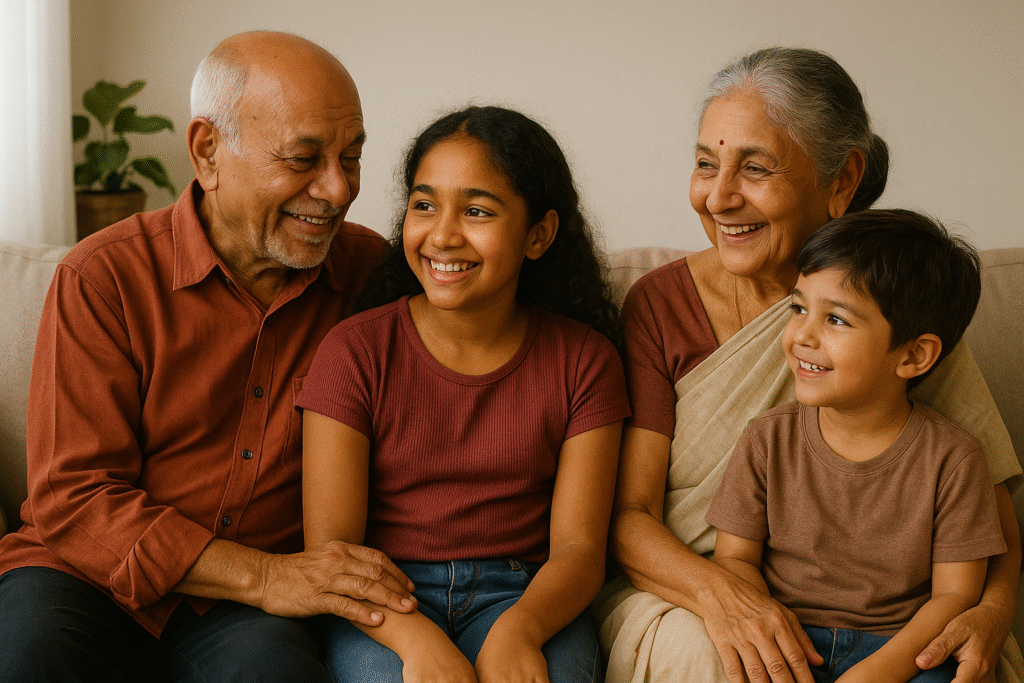
“Pehle toh poora ghar bacche ke uthne ka intezaar karta tha. Ab kehte hain—screen time ke dauraan call karo.”
— Aaji, Nashik
We didn’t start out asking about grandparents. But they kept showing up. In stories, in slips of memory, in quiet frustrations. Over the past few months, as part of Voices of Care, we’ve been listening in on conversations about care. And more than once, the voice that lingered belonged to someone older. Someone waiting for a call. Someone unsure of their place. Someone missing the messiness of everyday care.
There’s something shifting in how we think about care across generations. Especially between grandparents and grandchildren.
“I’m not the parent, but I’m not a guest either.”
That’s how Dadu from Kolkata put it. He lives just two metro stops away from his son’s family. But he’s told not to drop in too often—“routine bigad jaata hai.” So now he visits mostly for birthdays or when someone’s unwell. “Woh routine ke chakkar mein hum hi extra ho gaye,” he says, with a half-laugh.
In another conversation, Nani from Bhopal shared how different it felt raising her eldest grandson compared to now.
“Tab main full-time thi. Ab help aa gayi hai, schedule hai, Montessori hai. Mujhe dar lagta hai kuch galat na ho jaaye.”
It’s not regret or loss we’re hearing. It’s more like confusion. Love, yes—but also a sense of being out of sync. Still needed, but not quite sure where or how.
Even When Close, Still Far
Distance isn’t always about kilometres. Sometimes, it’s about rhythm.
Thatha from Chennai lives with his grandkids. But their days are packed—classes, homework, activities.
“Main unse zyada unke Google Calendar se milta hoon,” he jokes. Breakfast dosa might be the only shared moment in a day.
Elsewhere, an Ammima in Jaipur told us her daughter’s family lives abroad.
“December bolte hain. Phir kahte hain—flights mehengi ho gayi, exams aa gaye. I get it. But samajhne se longing thodi kam hoti hai?”
What we’re hearing over and over is this: there’s a whole middle layer in our care systems—one that often goes unnoticed. Not parents, not children. The ones who once held it all together. Grandparents.
The Systems Shifted. But the Roles Stayed Fuzzy.
The world around families has changed. But the scripts for grandparents haven’t. Urban homes are smaller. Families are nuclear. Childcare is professionalised. Schools and platforms focus on parents. Even apps made to “connect families” rarely imagine grandparents as primary users.
And in all of this, those who once passed down songs, fed stories, and knew the art of slowing down now find themselves unsure of what’s allowed.
One grandmother said,
“They ask me to share my childhood stories. But I wonder—what will they relate to? We didn’t even have fans. They’re growing up on AI.”
So Where Do We Go From Here?
Maybe the question isn’t “how do we involve grandparents more?” but “what systems need to loosen for them to fit back in?”
We’ve seen small glimmers of possibility.
In one Hyderabad school, there’s a monthly Ajji-Ajja circle where grandparents are invited to share lullabies and snacks from their childhoods. In a Pune apartment block, grandparents run weekend storytelling sessions. These aren’t grand innovations. But they’re gentle nudges. Little ways of saying: you still belong.
One Sentence Stays With Us
“Main job nahin maang rahi hoon,” Aaji said quietly, “bas yeh keh rahi hoon ki unki bachpan mein mera bhi thoda hissa ho.”
That one line held so much. It wasn’t about being needed. It was about being included. Not just during emergencies or holidays, but in the everyday—in the lunchboxes, in the walks, in the little routines that become memory.
Because when we say “care”, we can’t just think about it in terms of workload or efficiency. Sometimes care is just a warm hand on a restless back. A story told three times. A gaze that doesn’t rush.
Written as part of the ‘Voices of Care’ series.
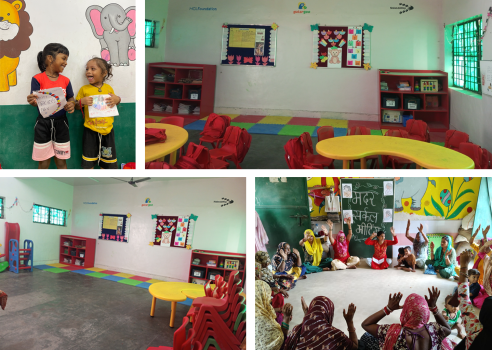
Voices of Care is a Bachpan Manao Collabaction seeded by EkStep Foundation in 2025. It is an ongoing inquiry into the caregiving systems that shape childhood in India. By understanding what enables care to thrive, we uncover what allows children to flourish. This work is anchored by Devina S. at mudito.




 )
)