


Mixed-Age Classrooms Should Be the Norm, Not the Exception
Each time I tell a parent we have a mixed-age classroom, I see hesitation.
“Won’t the younger ones slow the older ones down?”
“Won’t the older ones dominate?”
“Won’t the younger ones pick up bad habits?”
A mixed-age classroom is not a compromise—it’s intentional.
At work, do we collaborate only with colleagues our exact age? Do we grow up in families where every sibling or cousin is the same age?
No.
We learn and grow in multi-age communities—so why resist it in early childhood, when it matters most?
Vygotsky’s Zone of Proximal Development tells us children learn best from a “knowledgeable other”—someone just ahead of them in skill. We assume this is always an adult, but in mixed-age classrooms, it’s often a peer. The Reggio Emilia philosophy calls peers “the second teacher” after the adult. Younger children draw inspiration from those slightly ahead—watching, imitating, absorbing, and trying.
And this works both ways.
Yes, younger children learn from older ones. But older children? They learn patience, leadership, and how to hold space for someone still learning what they once struggled with. They learn that knowledge is not a privilege to hoard but something to share. That being smaller or less skilled does not mean being less capable.
Are we resisting mixed-age classrooms because they don’t work? Or because we never experienced them ourselves? Because we were raised in systems that emphasized competition over collaboration? Because we weren’t given spaces where older children mentored younger ones? What if our hesitation isn’t about the child at all—but about how much we, as adults, have unlearned the ability to trust community learning and cannot model it?
A single-age classroom is easier for adults. It allows standardized lesson plans, makes behaviour management predictable, and creates the illusion that children learn at the same pace. But children do not learn in lockstep.
I often group children not by age, but by how they learn.
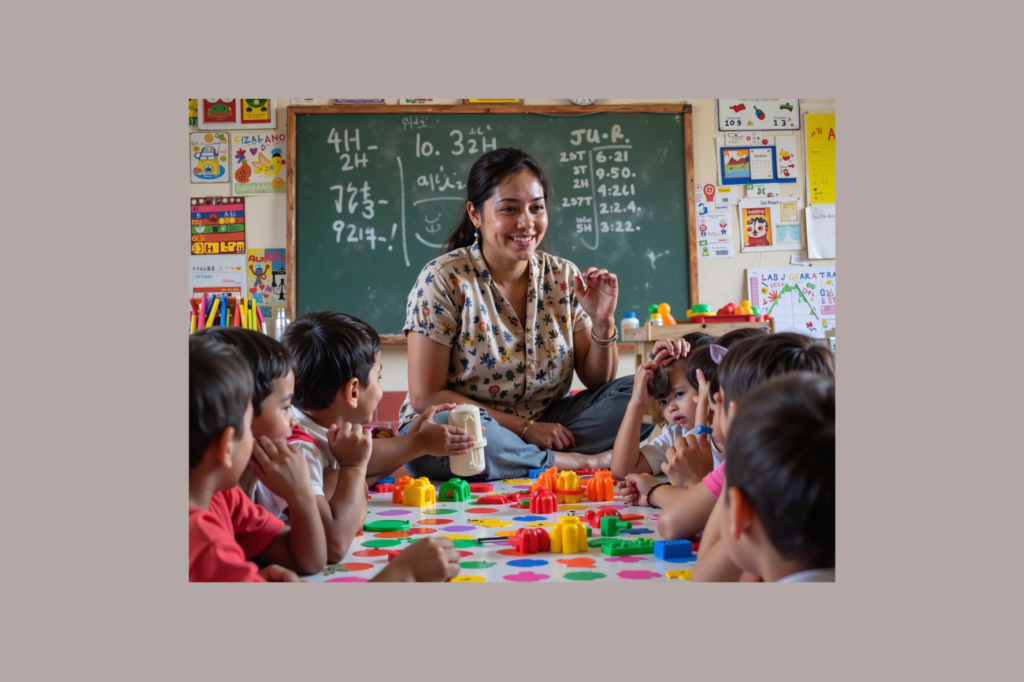
Because when given space, mixed-age classrooms become a microcosm of real life. A place where—
✔ The younger ones reach up.
✔ The older ones look back and remember.
✔ Everyone learns not just skills, but how to exist in a world where people are different yet connected.
So, the next time we hesitate at mixed-age classrooms, should we ask: Are we resisting because mixed-age learning is ineffective? Or because we’ve been conditioned to believe learning must happen in straight lines, at the same speed, in neat little rows of desks?
Because learning has never been neat. It has never been standardized. It has always been messy, organic, relational.
And when we stop trying to control it, we see the magic unfold.
A mixed-age classroom isn’t just where children read, write, and count. It’s where they learn from each other—to live, lead, and belong.
And isn’t that the kind of world we want them to build? Isn’t that the real purpose of education?
Pallavi is the Co-Founder & CEO at The Nurturant: Transforming early childhood education with holistic, research-driven approaches. She is also the Founder of Tinker Lab, leading a lab school revolution with child-led, inquiry-based learning






 )
)