



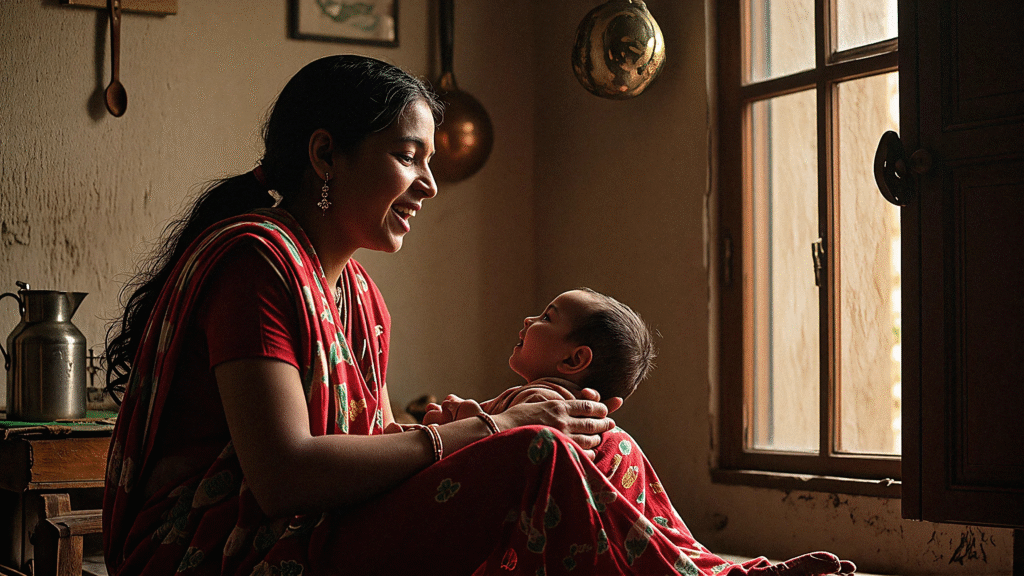
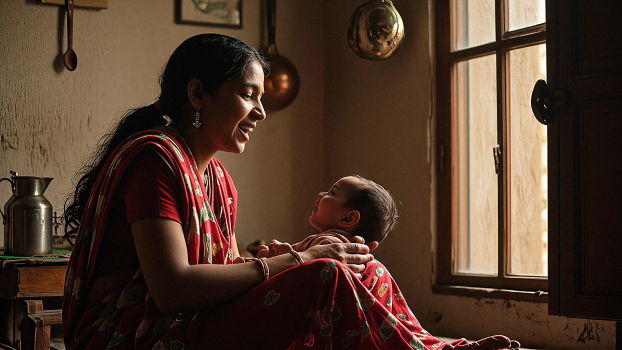
Imagine a baby lying in a cradle restless, agitated, and crying. And the mother then rushing to the baby to comfort it. She picks up the child, pats her on the back, and begins singing a soft lullaby. The child slowly stops crying and begins to rest and eventually goes into a deep slumber.
Across cultures and generations, singing to children has been an instinctive act by caregivers — to soothe, to connect, to comfort. Long before science caught up, this everyday act of care was already doing important work.
A concurrent cohort study titled ‘Maternal singing of lullabies during pregnancy and after birth: Effects on mother–infant bonding and on newborns’ behaviour’ (Persico et al. e214 – e220, 2017) examining the effects of mothers singing lullabies during pregnancy and early infancy offers strong evidence for what many families already know: singing supports bonding, calms babies, and reduces stress for caregivers.
The Study at a Glance
The study followed 168 mothers from pregnancy (24 weeks gestation) to three months after birth.
- 83 mothers were part of a singing cohort, encouraged to sing lullabies during pregnancy and after birth
- 85 mothers formed a comparison group
Researchers measured:
- Prenatal attachment using the Prenatal Attachment Inventory (PAI)
- Postnatal bonding using the Mother-to-Infant Bonding Scale (MIBS)
- Infant behaviour (crying, colic, night waking)
- Mothers’ perceived stress levels
What the Research Found
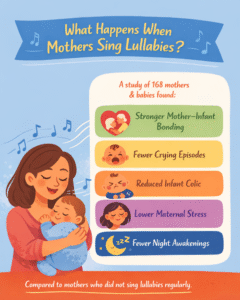
1. Singing Strengthened Postnatal Bonding
While singing did not significantly change prenatal attachment, it had a clear positive impact on postnatal bonding.
Three months after birth, mothers who sang lullabies showed:
- Significantly stronger bonding with their infants
- Lower MIBS scores (indicating better bonding) compared to the non-singing group
This suggests that singing becomes especially powerful once the baby is born, when voice, touch, and presence come together in daily care.
2. Babies Cried Less and Were Calmer
Infants whose mothers sang lullabies showed:
- Fewer crying episodes in the first month
- Lower incidence of infantile colic
- Reduced night-time awakenings
Importantly, these effects persisted beyond the first few weeks — with reduced colic still observed in the second month.
These findings point to lullabies as a regulating experience, helping babies settle into rhythms of rest and comfort.
3. Singing Reduced Maternal Stress
Mothers in the singing group reported:
- Lower perceived stress levels
- Greater emotional ease in early caregiving
This matters deeply. Early caregiving can be intense and overwhelming, and stress can affect both caregiver wellbeing and infant experience. Singing appears to support both nervous systems at once — the adult’s and the baby’s.
Why Singing Works: The Science Behind the Voice
The study situates lullabies within what we already know about early development:
- The foetal auditory system matures between 24–28 weeks of gestation, allowing babies to hear and respond to sound before birth.
- The maternal voice is the most consistent and meaningful sound a foetus hears.
- Repeated exposure leads to sound memory and habituation, allowing babies to recognise and prefer their mother’s voice after birth.
- Newborns can discriminate between their mother’s voice and other voices — and show a clear preference for it.
Lullabies are uniquely suited to this early communication because they are:
- Slow and repetitive
- Soft and rhythmic
- Emotionally expressive
- Culturally meaningful
Lullabies are relational signals.
Why Lullabies Matter Today
In many modern contexts, the tradition of singing to children is quietly fading — due to time pressures, early return to work, and the replacement of voice with screens or recorded sound.
This research reminds us that:
- Singing does not require musical training
- Lullabies do not need to be perfect or remembered fully
- The act of singing itself is what matters
Lullabies are a form of care. So, sing more to children.
Link to Research: https://www.sciencedirect.com/science/article/abs/pii/S1871519217300367?via%3Dihub
Would the same findings hold true for fathers as well? Could lullabies be a shared language of caregiving? With research looking only at mothers, we asked the question “Do fathers sing to their children?”. And the responses? Well, take a look below!

(The First Songs project aims to leverage lullabies for foundational literacy. Begun as a Bachpan Manao collabaction in November 2023, BIRD along with EkStep Foundation, and Pratham Education Foundation, are creating a collection of lullaby lyric videos with Same Language Subtitles (SLS) so families can listen, learn, and sing together.
First Songs invites you to contribute the lullabies you know and love—whether it’s a song you sing to your child or one you remember from your own childhood. You can find recording guidelines and simple ways to submit your lullaby on the site.)





 )
)