



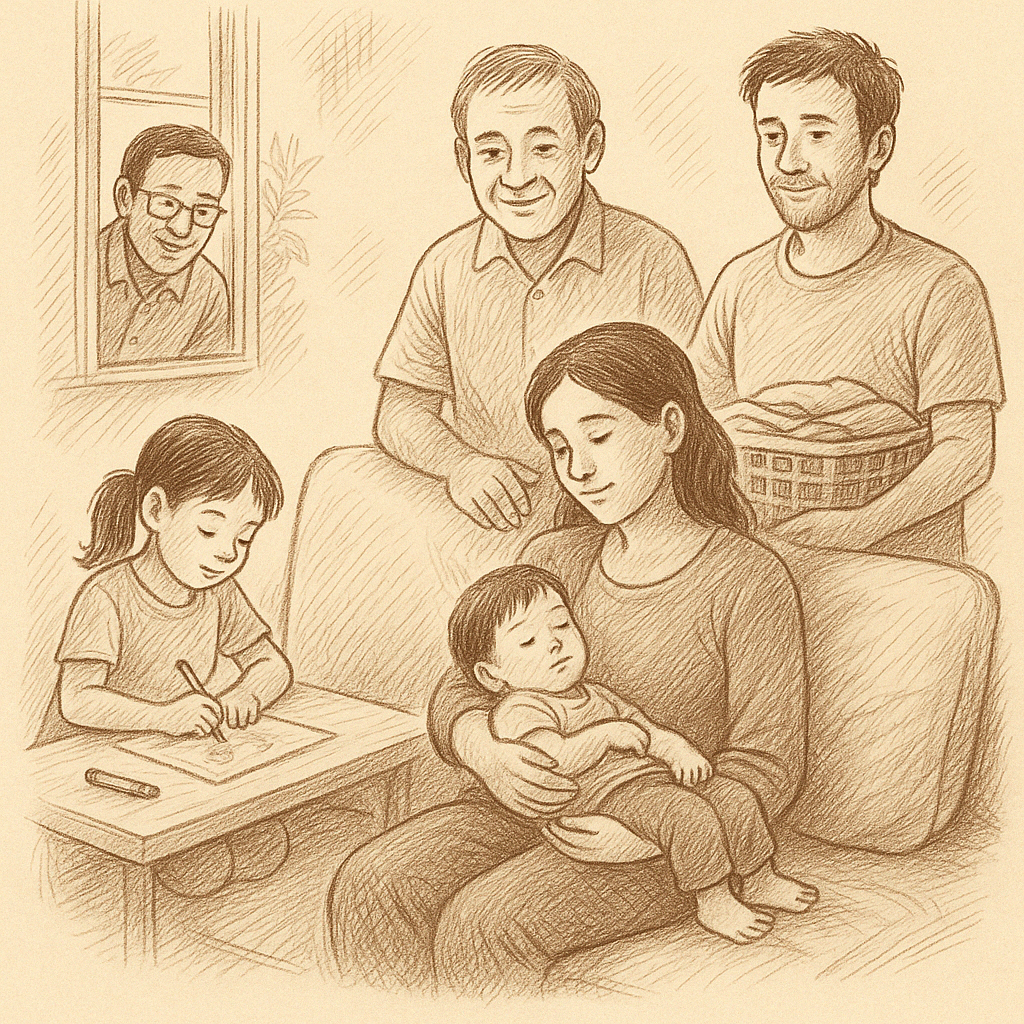
Over the past few months, we’ve been in quiet, ongoing conversation with caregivers across the country—mothers navigating urban work-life collisions, grandmothers raising grandchildren in rural pockets, fathers adjusting to new roles, anganwadi workers, teachers, informal childcare providers, and neighbours who step in when no one else can. Across languages, regions, and living arrangements, their stories surface a shared reality: caregiving is constant, often invisible, and rarely replenished.
This note is the first in a two-part series on Thriving Caregivers Enable Thriving Childhoods. We begin here—with those who care—because their well-being is too often treated as peripheral. Most systems designed for young children rarely pause to ask how the adult behind the care is coping, or what support they might need to stay steady. The second piece will turn toward the idea of resilient caregiving—what it means to raise and nurture children in the midst of uncertainty, shifting family structures, and daily pressures. It will explore how resilience in care is built not just through individual grit, but through relational ecosystems that allow both caregivers and children to feel safe, seen, and supported. The two—caregivers and children—are not separate stories, but deeply entwined ones.
Why Caregiver Well-being Must Come First
Public discourse around school readiness in early childhood still prioritises measurable outcomes, including literacy, height-for-age, language, and cognition. While these indicators matter, they rarely ask: who is holding the child each morning before school? Who is preparing the meals, calming the tantrums, noticing the fever, answering the questions? And how is that person doing?
Research across disciplines—from developmental psychology to public health—makes clear what caregivers have always known intuitively: children absorb far more than we teach. They mirror emotional states. They pick up on stress. The quality of early attachment, emotional regulation, and self-worth in a child is profoundly influenced by the mental, physical, and emotional health of their primary caregivers.
But despite this, caregiver well-being is treated as a personal concern, not a structural one. Support for caregivers is fragmented—some health services here, a maternity policy there. Fathers and non-parent caregivers are often left out altogether. As a result, many caregivers move through their days quietly stretched—holding both the child’s world and their own fatigue.
What Thriving Care Used to Look Like
In many parts of India, the caregiving ecosystem once rested on broader, more collective arrangements. Multi-generational families, neighbours as surrogate caregivers, older siblings playing with toddlers—all of these allowed care to be distributed, informally yet consistently. There was a rhythm. If one adult was unwell or overwhelmed, another often stepped in. This didn’t mean care was always equitable or gender-just—but there was breathing room.
In today’s nuclear households, especially in urban settings, that diffusion has collapsed. Care is more privatised, often falling disproportionately on women, especially mothers. Without structural reinforcements, this leads to cycles of isolation, burnout, and guilt.
What Might Thriving Caregiving Look Like Today?
To truly reimagine caregiver well-being, we have to start with an honest truth: no one can care endlessly without care themselves. Love, while essential, is not enough. Parenting and caregiving cannot be left to personal willpower or sacrifice alone—they must be recognised as collective and societal responsibilities.
Thriving caregiving rests on more than just good intentions. It requires strong structures. This means paid leave that doesn’t just stop at the birth of a child, but supports parents across the early years. It means affordable, quality childcare that is nearby, trusted, and responsive. It means access to mental health support that doesn’t treat parental burnout as a private failure. And it means workplaces that understand family life not as an inconvenience, but as part of life itself.
But structures alone are not enough. There also needs to be a cultural shift—one that redefines who gets to be seen as a caregiver. Fathers, siblings, extended family, neighbours, employers, even school staff—all have a role to play. The idea that a ‘good parent’ must do everything alone is not just unrealistic; it’s harmful. It isolates, it exhausts, and it closes off the possibility of shared care. We need cultures where asking for help is a sign of wisdom, not weakness.
Finally, caregivers need everyday permission—to be more than the roles they occupy. They need space to rest, to play, to create, to have days that aren’t defined by someone else’s needs. They need to be seen as people, not only as parents. When we create space for caregivers to feel whole, not just responsible, we create the conditions for more grounded, responsive, and joyful care to take root.
Thriving caregiving, then, is not a singular solution. It is a layered, shared, and evolving practice—made possible by systems, sustained by communities, and shaped by the everyday choices to care without losing oneself.
A Shared Responsibility
Children don’t need perfect caregivers. They need caregivers who feel held. A child who grows up watching an adult model boundaries, joy, asking for help, and recovering from stress learns more about emotional health than any textbook can teach.
When we invest in caregiver well-being, we’re not just supporting adults—we’re shaping the emotional climate of a child’s world. The home becomes more responsive. Learning becomes more joyful. Discipline becomes less reactive. And children begin to internalise care as something gentle, not strained.
Thriving caregiving isn’t a new idea—it’s a return to something older, more collective, and more humane. It’s not just the job of parents, or even families. It’s something that schools, workplaces, local governments, and communities must all begin to share.
Because at the heart of every childhood is a caregiver. And behind every thriving child is someone trying to show up, day after day. Our job is to make sure they don’t have to do it alone.




 )
)