


As remembered by Aastha
Every time I try to recall a day in my life when I was in school, I see flashes of being ‘super busy. I had a full-day school from 8 am to 4:30 pm. I’d come back from school, snack and then my mom would drive me to Bharatnatyam class. After that, I’d change into my tennis clothes and head to either tennis or swimming. By the time I came back, I’d be onto my homework and then off to bed. In some combination or the other, every day I had something that kept me busy from 8 am to 8 pm. Sometimes, when I had dance performances, our practices would go on till midnight. I remember eating a snack on my way to the next stop.
This went on until I reached grade 10, and then academics took over. I got busy preparing for the engineering entrance exam and studied day in and day out.
Only when I finished 12th grade and suddenly had time on my hands did I realise – I don’t know what to do with my time. I couldn’t handle it. I felt the need to be productive or do something. Even when I tried to watch a movie or a TV series, I’d feel guilty for not being productive. In many ways, I’m still trying to unlearn that.
Such a schedule gave Aastha a breadth of skills – Dancing, tennis, swimming, academic rigor and, perhaps more importantly, the discipline to work hard and put in sustained effort. But in many ways it also shaped her relationship with time in ways that only became clear much later.
There was little room for rest, boredom, or aimlessness. Every hour had a task, an adult supervisor and the next thing was already planned. O
It’s a pattern we see in many children today – days packed with school, tuitions, extracurriculars, competitions. There’s value in such exposure, no doubt. But it also raises a deeper question: What kind of pace are we normalising? And how does that shape how children learn and how they live, as adults?
In our last post we started with observations of young children, and their relationship with time and learning. Many of you, reached out to tell us that you really resonated with this piece. It seemed to have touched people even personally i.e. beyond the context of children, education and learning. Perhaps, what made this personal was the fact that many of us struggle with time.
It made us wonder: How do the systems we grow up in shape our relationship with time and with learning?
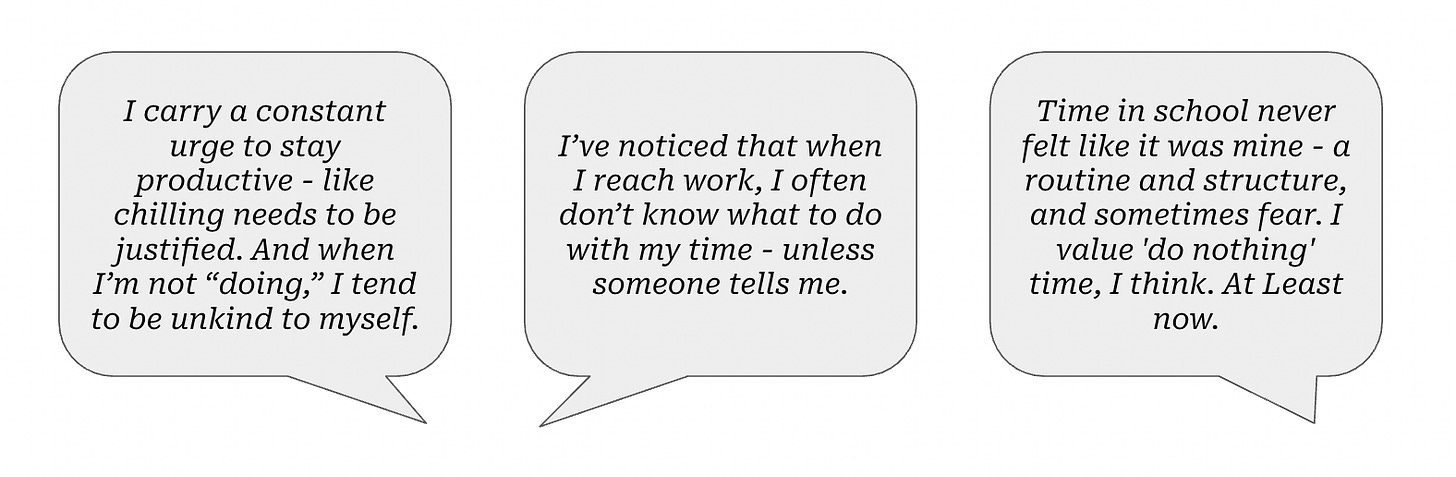
These reflections may feel individual, but they point to something more structural. We’re asking: What happens when our learning systems prioritise urgency, speed and efficiency?
So, in this piece we’re continuing our reflections on the relationship between time and learning but from a system and design lens.
How schools set the pace
If you think about it, schooling as we know it is one of the most time-bound systems we grow up inside.
Twelve years. Six periods a day. A defined curriculum.
In most schools, children of a certain age are grouped into a grade and expected to master a fixed set of outcomes within a single academic year. Whether or not they’ve fully grasped the concepts, they’re moved on. A score of 70% isn’t seen as a gap – it’s seen as “enough to pass and proceed.”
Let’s isolate two variables here: Time, Learning.
Time is constant, Learning is variable.
In theory, we might all agree that learning takes time, every child learns differently. But the structures we’ve built (curriculum timelines, timetables, test schedules) are all optimized for making it easier to manage the institution of a school. Within this design, the goal is to “cover syllabus” instead of feeding curiosity or achieving comprehension and mastery. And the pressure to “keep up” with time becomes embedded in the very experience of learning.
Let’s take a closer look at how this plays out in various features of school:
An Early Start to School
For starters, school timings are often set around logistical convenience i.e. traffic, bus routes, physical space at schools, working parents. But research shows that children and adolescents need varying amounts of sleep depending on their stage of development. Teenagers, for instance, typically need 8-10 hours of sleep, but many struggle to get enough due to biological shifts in their sleep-wake cycle and early school start times. Yet we expect them to be alert and attentive by 7:30 a.m.
Parents rushing to get their children ready for early morning schools can probably attest to feeling stressed during these hours.
Timetables and Bells
Once at school, a child’s day is split into rigid 35 – 40 minute periods. Every subject gets its time slot.

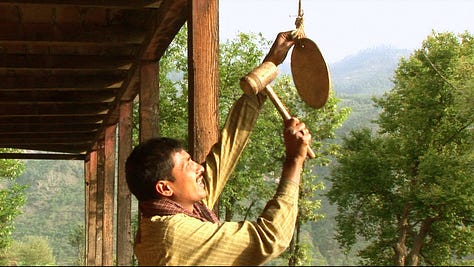

While this might not be a concern for some children, for others, the rapid shift from one subject to another can feel disorienting and stressful. Picture this: A child is slowly getting the hang of a mathematical problem. After much trial and error, they seem to have stumbled upon something. They are just about to test this theory ..have they figured something out? Suddenly the school bell rings, and it’s time to move on to Geography.
Remember Mihaly Csikszentmihalyi’s quote, from our last article? Deep engagement requires uninterrupted time. But how often do our systems allow children to stay with something long enough to truly enter that state of flow?
Exams and Report Cards
“Yaar, 3 questions chhoot gaye paper mein.”
“Man, I couldn’t finish 3 questions on the paper.”
You’ve probably heard someone around you say this or some version of this. We hear this so often from students at schools and colleges. Visuals of the last 2 minutes of the exam, students trying to just write at full speed. It isn’t simply that they don’t know the answers to the questions, it could be that they just didn’t have the time to work through it. We can’t help but wonder, why is speed the benchmark of learning here? What ‘real-world’ situation is this preparing children for? Can the problems of the world really be solved simply by working fast? (We’re pointing to something about our adult worlds here, we’ll return to this in a bit.)
While on the one hand, time-bound tests may claim to build quick thinking, they often punish deep thinking. Personally, we prefer the slow, brooding thinkers, who screw up their faces, pause and take their time to understand, often revisiting every tiny detail and asking a million questions along the way. For all we know, these “slow” thinkers have in fact formed a complex network of ideas in their mind that requires time to make sense of and articulate. Anyway.. kids like these, so many of them, begin to internalise the idea that they are in some way deficient or lacking, ‘failures’ even.
Maybe that’s why little Ishaan from Taare Zameen Par made everyone across the country so emotional. Perhaps we all saw a little bit of our own struggle in his, and those who didn’t relate, at least learned a new way to see the ‘failures’ in their lives.

Remember the video for Jame Raho? This might be a good time to revisit it.
How speed is internalised: From childhood to adulthood
Over time, when children are consistently rushed, they internalise the idea that their pace is a problem. In our last post we talked about how infants and toddlers are expert learners, when they aren’t yet burdened with speed and time. But the shift, as they grow older is often painful; from joyful exploration to performance anxiety, from curiosity to compliance. Learning, which was once instinctive and embodied, begins to feel alien and fearsome.
The playful, exploratory learner recedes making way for efficient task-doers, trained to skim and summarise, to complete – whether or not they truly understand. And the more this behaviour is lauded and rewarded – through stars, grades, praise – the more it becomes internalized as a marker of intelligence and success, carried well into our adult years where we chase awards, promotions and salary hikes well beyond our needs.
Since the pandemic, when people and institutions were forced to slow down, we’ve seen a rising trend in adults acknowledging their fatigue. Our linkedin feeds are filled with people (those who have the luxury to do so) taking time off to figure out their next move. Perhaps, slowing down for a while made us all aware of our most human instinct, the drive to learn. Not for promotions and salary hikes but for our own well-being.
In fact, our feeds are also increasingly filled with people attempting to reclaim their fractured relationships with time. “I want to spend my time doing something that interests me, excites me and adds value.” While some regain this control by switching careers to something more meaningful and exciting, others find this control outside of work; spending more time with loved ones, joining classes or pursuing hobbies.
Oddly enough, we probably wouldn’t have to ‘reclaim’ our relationship with time and learning, if we hadn’t been alienated from it in the first place.
A Paradigm Shift: What If We Prioritised Learning Over Time?
What if, instead of asking “How much can be learned in this time?”, we asked “What kind of time does this learning deserve?”
As educators and learning designers, this question is incredibly exciting to us. It invites us to reimagine the design of learning systems while holding the tension between giving time for deep learning and preparing children for the realities of the world.
There are plenty of alternative educational models already exploring this question in practice. Mastery-based learning approaches, for instance, allow learners to move forward only once they can demonstrate a fairly high level of understanding. It has been proven to be effective in a variety of settings, online (For eg: Khan Academy) and offline in classrooms.
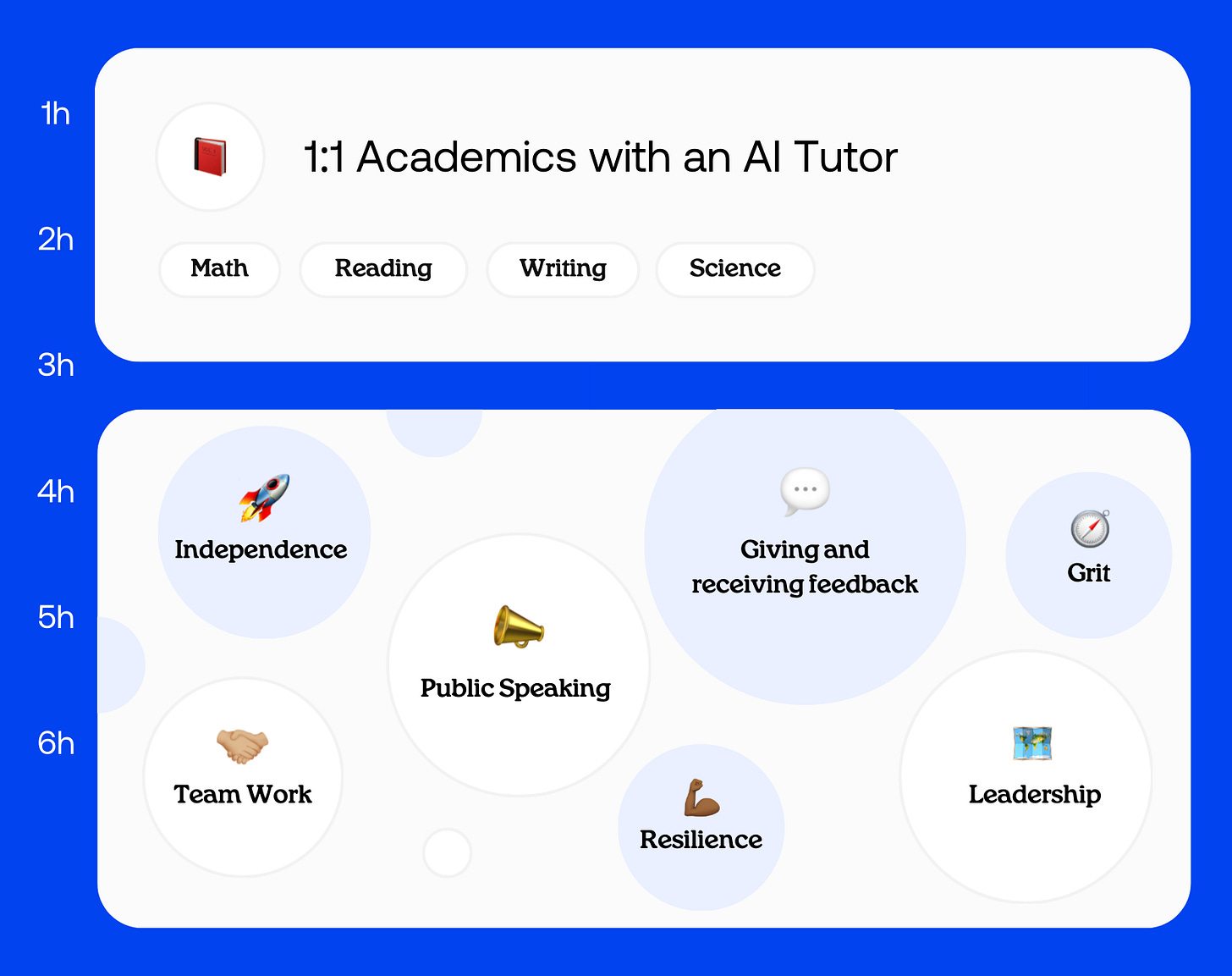
Some schools, like the Alpha School in the U.S., are taking this idea even further. They’ve introduced what they call a “2-Hour Learning Model,” where students finish their core academics (Math, Reading, Writing, and Science) in just two hours using 1:1 support from AI tutors. The rest of the day is then freed up for students to explore and build skills such as teamwork, leadership, and public speaking on their own terms. A unique approach to giving time back to the learner.
Even in India, several alternative schools are moving towards self-directed learning that allows more flexible time for learning.
Experiments like these (and their success) give us hope that it is in fact possible to design time for learning instead of the other way around. It gives us a glimpse not just into how much time learners need, but what kind of time helps them thrive.
Perhaps the role of education is not to teach learners to manage time, but to protect their capacity to dwell in it.
What does it look like when we treat time itself as a pedagogy?
Note: This post is Part I of a reflective series. It began as a bit of a rant pulled from our own memories, frustrations, and the questions that kept surfacing in conversations with others. We’re slowly working our way through this paradigm shift: from systems that optimise for time, to systems that honour learning.
In the next part, we’ll try to move beyond the critique. We’re taking some time to study this more deeply – looking at models, examples, and possibilities that treat time itself as pedagogy. If you’ve come across ideas, resources, or practices that speak to this, we’d love to hear from you.
Drop us a comment or message – your thoughts will help shape where we go next.
We’ll be back soon with Part II.



 )
)