



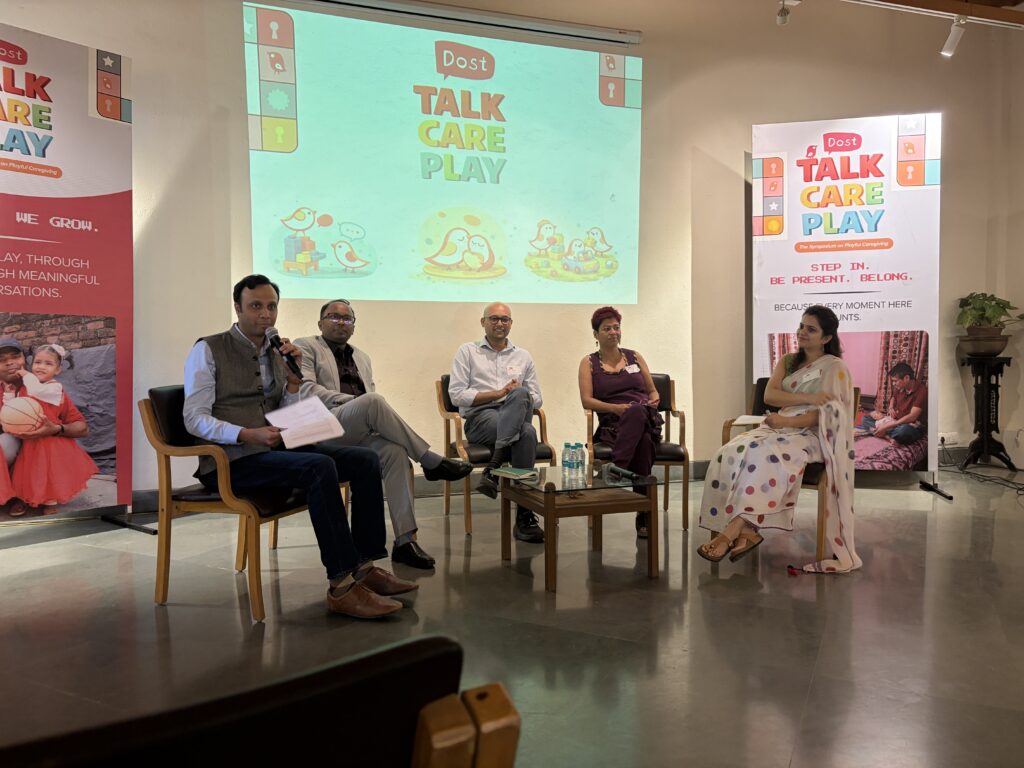
Earlier this week I had the opportunity to participate in a panel at the Talk, Care, Play Symposium titled
“Designing for Fathers: Gender, Identity and the Role of Technology in Shared Care.”
The panel brought together perspectives from psychology, technology, early childhood programme design, and media. I was joined by Nanki Oberoi (Child & Family Psychologist and Psychotherapist), Sukhna Sawhney (Head of ECCE at Rocket Learning), and the conversation was thoughtfully moderated by Richa Shukla (CEO, Dost Education).
What I appreciated most about the session was that it wasn’t framed as a technical discussion about programmes or platforms. Instead, it became a reflective conversation about something much deeper: why fathers still sit outside the circle of caregiving, and what it might take to bring them in.
Why do programmes still treat fathers as peripheral?
The discussion opened with a question that stayed with me long after the session ended:
If fathers’ engagement is so important for children’s development, why do most early childhood programmes still treat fathers as peripheral participants rather than central caregivers?
In many ways, the answer feels both structural and cultural.
Most early childhood systems, from Anganwadi services to parenting programmes, have historically been designed around mothers. Workers engage mothers, messaging reaches mothers, and spaces where caregiving conversations happen are often seen as women’s spaces.
But that doesn’t mean fathers are absent from families. Often, it simply means they are absent from caregiving spaces.
Fathers care deeply, but express care differently
Research and conversations with fathers of young children suggest that care is rarely the missing piece.
Many fathers speak about wanting their children to have better opportunities than they themselves had. They often see their role primarily as providers, working hard to secure their children’s futures.
But when it comes to everyday caregiving, many do not automatically see themselves as part of that space.
Interestingly, however, one interaction consistently emerges in these conversations: play.
Across contexts, fathers often describe playing with their children, whether for five minutes after a long day of work or during small everyday moments.
What many fathers don’t always recognise is that play is also learning.
And that they themselves are powerful facilitators of that learning.
An insight from our work at Bachpan Manao
One insight from our own work through Bachpan Manao reinforces this.
When we speak to parents about childhood, we have spoken about eight simple but powerful ingredients that make childhood meaningful, things like play, stories, creativity, social bonding, time in nature, quiet moments, and everyday learning.
What becomes clear very quickly is that many of these moments already exist in families.
Fathers may not always see themselves as caregivers in the traditional sense, but they often show up in these spaces naturally: taking a child to the market, inventing games, joking around, playing rough-and-tumble games, or sharing small everyday adventures.
When we begin to frame these moments as meaningful parts of childhood, something shifts. It becomes apparent that fathers are already participating in their child’s development.
It’s not about asking fathers to do something entirely new, it may be about helping them see the value of what they are already doing.
The role of narratives and visibility
Another theme that came up during the panel was the role of representation.
One reason fathers may hesitate to engage in nurturing activities is simply because they rarely saw it growing up.
Caregiving by men has not been widely modelled.
Media and public narratives have historically centred the mother–child relationship. The cultural imagination of caregiving is still overwhelmingly maternal.
But when we begin to show fathers in these roles — reading to children, inventing songs, playing on the floor, sharing quiet moments — people begin to see that this version of fatherhood is possible.
Identity matters more than instruction
An idea that surfaced repeatedly in the discussion was that behaviour change cannot simply be about telling fathers what to do.
The deeper shift is identity.
Fathers need to feel that caregiving is not an extra responsibility or something they are “helping” with.
It needs to feel like their role.
That shift cannot happen through a single programme or a short intervention. It happens gradually through many small nudges, policy changes, peer examples, media narratives, family dynamics, and everyday visibility of involved fathers.
Technology: powerful, but not sufficient
Technology naturally came up as part of the conversation.
It has undeniable strengths like reach, scale, and the ability to place messages into millions of homes.
But technology alone cannot shift deeply embedded social norms.
At best, it can act as an enabler of human connection.
Technology can amplify stories, build communities of parents, and reinforce messages, but meaningful change and moments that move you still occur through real connections, relationships, conversations, and lived experiences.
Moving forward
Designing for fathers may not be about simply adding them into existing programmes or creating new sets of instructions. It may require noticing where caregiving is already happening, questioning who caregiving spaces feel open to, and paying attention to how fatherhood is imagined in everyday life.
If small, ordinary moments already hold the possibility of care, what would it take for systems, narratives, and design to recognise them as such?





 )
)