


This piece begins from the question ‘What happens when we start to treat time itself as pedagogy?’. In the last couple of essays we laid out our critique of how educational systems in India and elsewhere systematically disrupt how we learn naturally and shape our relationship with time and learning.
In this post, we explore the learning systems, cultures, products, and technologies that push back against the mainstream towards establishing a healthier, learner-focused alternative to time for learning.
We ask: What designs, spaces, or systems are letting learning take its time?
Traditional skill-based communities
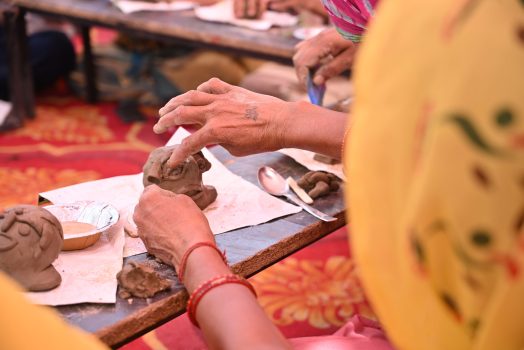
The idea that learning takes time, therefore, isn’t a new one. The idea is especially not new to communities that have been primarily skill-based – agricultural, artisanal or crafts focused. In such communities, learning happens gradually over long periods of time. Here, children observe their elders at work throughout their lives, engaging in apprenticeships when they come of age. Gradually they develop a situated and embodied understanding of the land and material involved. They engage through immersion, imitation and repetition. Over time, learners learn to act from intuition. Tools of the trade, if any, become an extension of the learner’s own body through seasons of use.
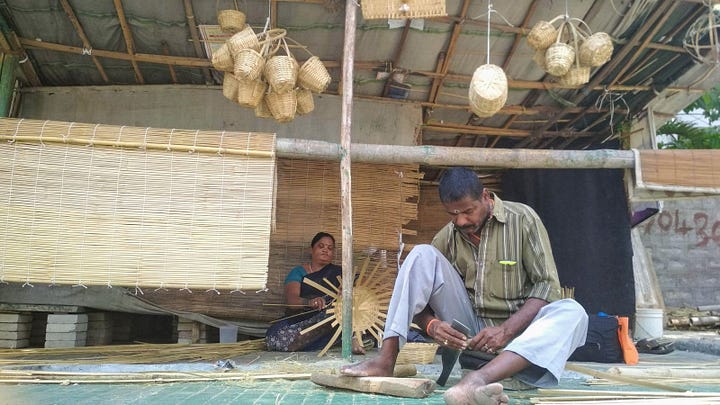
Let’s take the act of basket weaving as an example.
 .
. 
 .
. 
These snippets captures the process of basektweaving. It begins with splitting bamboo into even strips, then crossing them to form a steady base. Gradually, the spokes are bent upward and the weave continues round by round, until the basket begins to rise and hold its shape.
Observing this, one can’t help but wonder: how does a novice learn from an expert?
This work takes years to master. The hand learns how tight to pull, when to dampen the strip, how to keep the weave even.In order for this kind of learning to happen, all members of the community, learners and teachers, must develop a shared ethos. Here, one doesn’t question if learning will happen, they focus alternately on making learning happen. In other words, learning is seen as an inevitable outcome of the right conditions – time being an essential one.
Modern-day Communities of Practice (CoP)’s
We have seen how time for learning is held in traditional skill-based communities but the same shape appears in modern, industrial contexts too.
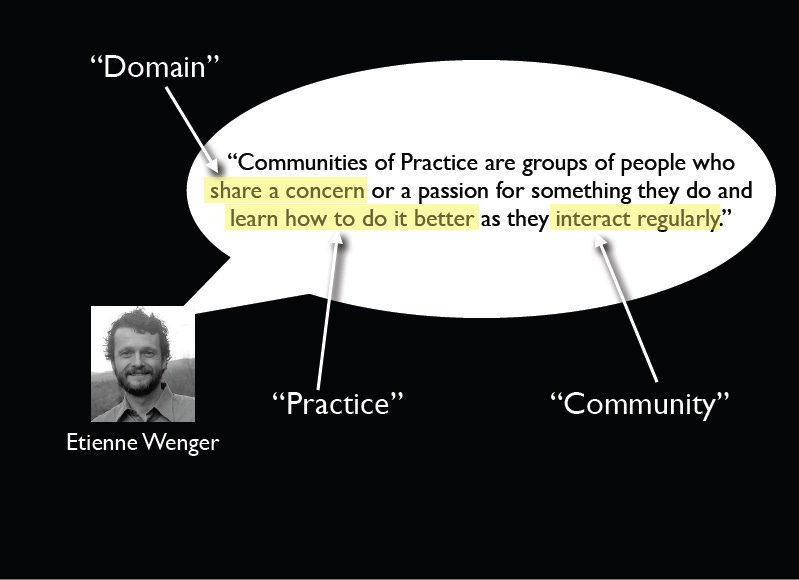
Jean Lave & Etienne Wenger’s seminal work on legitimate peripheral participation shows us that in Communities of Practice, newcomers first observe, then gradually participate more fully in the community’s shared craft, learning organically over time.

Time is an innate aspect of the learning design of CoP’s. Despite their lack of speedy processes, communities of practice are strongly valued across sectors that are tech, design and R&D heavy. Many large organizations (e.g. Shell, IBM, World Bank, NASA) have formally invested in them since they allow for tacit knowledge transfer, collaborative problem-solving, and fostering innovation.
Becoming a doctor takes more than a decade of study and apprenticeship. The question each student faces is whether they can give themselves over to those years of learning. The years cannot be shortened because medical training is rooted in hospitals and clinics, where interns, residents, and senior doctors work side by side, and much of the knowledge is passed on tacitly, almost invisibly, through shared practice. In fact, as Lave and Wenger noted in Situated Learning (1991), medical training has often been studied as a classic case of how novices move from the periphery toward full participation. In this setting time is not just passing – it is the medium of growth.
While traditional skill-based communities and modern day CoP’s are excellent reminders of how time itself can function as a material of learning, we’d now like to bring back the attention to the idea of schooling. In our last post, we critiqued mainstream schooling for its standardized, compartmentalized, 6-hours a day approach that rushes through subject areas. Inevitably, however, within the school system too there are exceptions to the norm.
As educators, we often get asked by young parents about the ideal school for their child. While some parents come with a clear sense of what they want or don’t want, most are just overwhelmed by the plethora of options now available to them. This, however, has never been an easy question to answer for either of us since there are a myriad of factors to be considered – the curriculum, frequency and rigour of exams, quality of teachers, facilities at the school, etc.
We now see that time for learning is an important (perhaps the most important) factor to be considered. This brings us to alternative schooling.
Alternative Schooling
The concept of alternative schools arose in the late 19th and early 20th centuries as a response to industrial-style education that treated students like units on an assembly line. Thinkers like John Dewey, Maria Montessori, and Rudolf Steiner believed that education should nurture curiosity, creativity, and deep understanding rather than rote memorisation and standardised pacing.
These schools reimagined time, not as a rigid schedule of 40-minute periods, but as a flexible framework. Montessori classrooms offer long, uninterrupted work periods (about 2-3 hours) where children choose their own activities and repeat them as often as they wish. Waldorf schools on the other hand design long ‘main lesson blocks’ i.e. 2-3 hours each morning on a single subject for several weeks. This lets students dwell in the specifics of a subject area. Meanwhile, Dewey emphasized experiential learning, where projects could stretch as long as needed to spark insight.
As remembered by Vibha
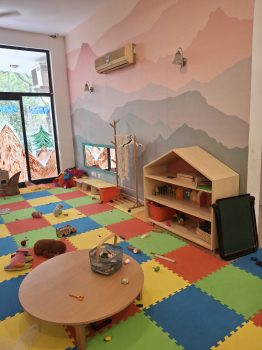
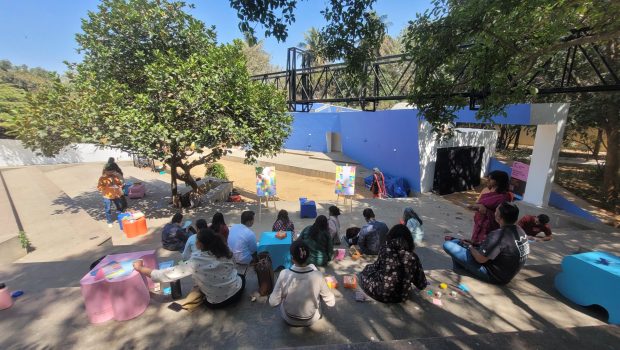
As I reflect on my own experiences teaching at an alternative learning center in the outskirts of Bangalore, I recall a few interesting details about the design of time.
- “Time commitment”: Time was committed either daily or weekly to certain universal aspects of being human in society – for cleaning, cooking, physical activity, eating, nature, reflection, dialogue.
- Time and space: Time at school and time at home were not differentiated from a learning perspective. Investigations that one begins at school, can carry into the home and other spaces. The reverse was also encouraged.
- The nature of time: As humans our experience of time is naturally affected by the rhythm of the day, seasons and all they bring. Instead of resisting it, the space leaned into it and allowed learning to emerge from or blend with nature’s rhythms.
- Slow but steady: Doing something slowly, doesn’t have to be lazy. Is there a way to be serious but not hurried?


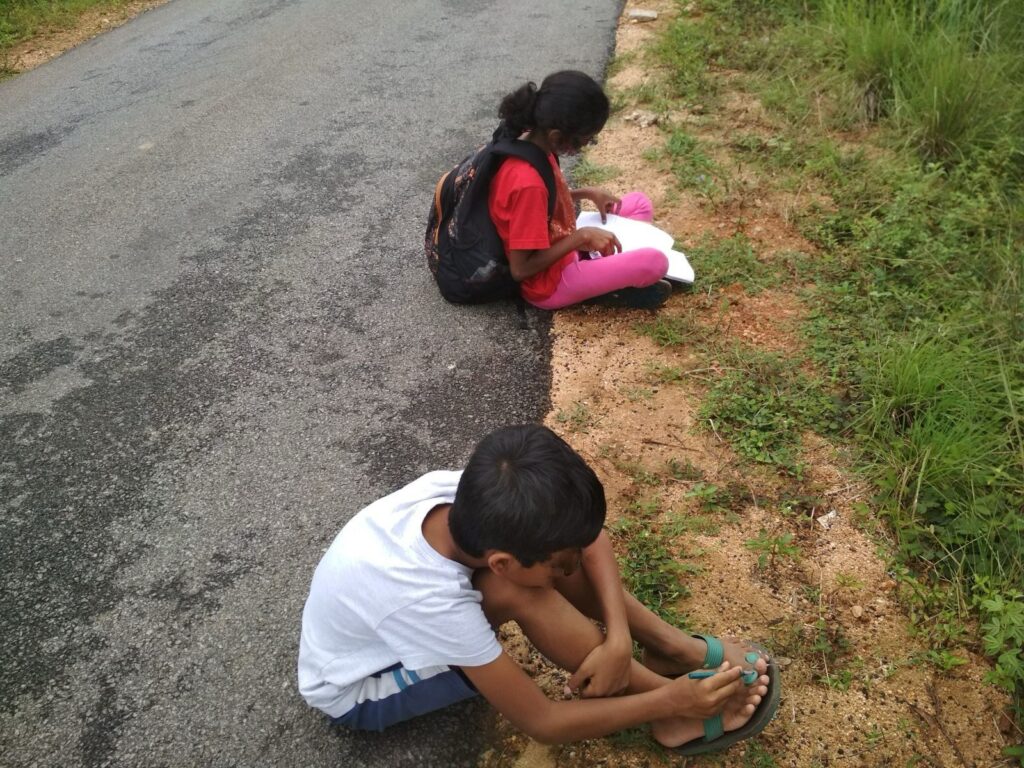
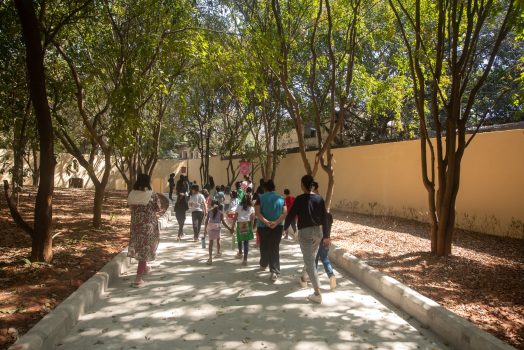
A new school campus is under development and the plan is to move the entire school there soon. In preparation, the children (as seen in the photos) have decided to spend their weekly ‘nature walk’ days for an entire term cycling from the old campus to the new campus all while preparing a route map. It’s an uphill terrain and different children have different levels of physical stamina for the task. Some stop earlier along the way, pull out their journals and start working on their maps. They discuss eagerly with each other trying to be as detailed as possible “Wait, was that a Banyan tree?” “What was the colour of the temple we passed?” “Did we take two rights and one left or one right and two lefts?”
Each week they manage to cycle a little further, and each week they discover newer details for their maps often making corrections to the previous draft. By week 3 they realise that the better way to track distance is to count it using M’s footsteps alone, instead of taking turns, since each of their steps measure distance differently based on their heights. This realization causes much frustration because the counting might need to be done again. But they learned something that will stay forever.
Alternative schools, by their very definition, step outside the mainstream to rethink almost everything – what is taught, how it’s taught, and the pace a day should keep. They’re small by design and serve fewer learners, but they, too, show us what’s possible when time is treated as the material of learning.
Most children, however, will remain in mainstream systems. In the next section therefore we explore experiments within mainstream schooling that make space for learning to take its own time, without rebuilding the whole school.
4. Flipped classrooms
Some experiments within mainstream schooling try to loosen the grip of the timetable without overhauling the whole system. One such move is the flipped classroom. Instead of spending class time on lectures and sending practice home, it reverses the flow: students first meet the idea through a short reading or video, and the shared period is freed for dialogue, application, and feedback.
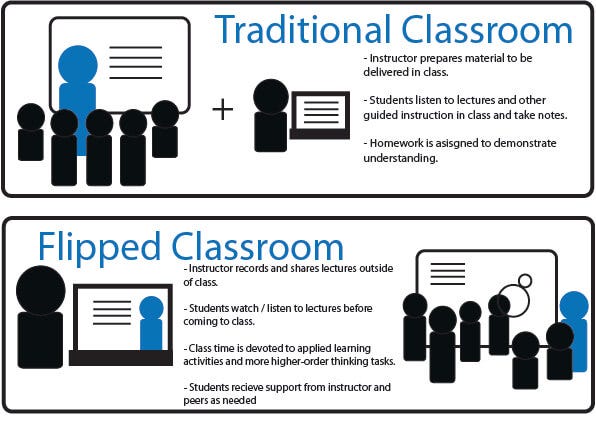
The roots of this model go back to Soviet classrooms in the 1980s, where overcrowding and limited teacher time led educators to push lectures out of class and reserve class time for collective inquiry. Later, teachers like Jonathan Bergmann and Aaron Sams (2007, Colorado) popularized the model in the U.S. What began as a practical solution revealed something deeper: when class is not consumed by instruction, it becomes a space for peer-to-peer learning and shared problem-solving.
Let’s pause for a moment and ask: How did it even become possible to move the lecture outside the classroom?
There was a time when the teacher was the only source of knowledge. If you missed a lesson, it was gone. Learning existed only in the room, at that hour, with that teacher. The arrival of print changed this fundamentally: books and worksheets made lessons portable and repeatable. Students could now revisit an idea, linger on it, and return as often as they needed. Home became a second site of learning, not just for homework but for getting in touch with the content before class even began. This shift in where learning could happen created space for models like the flipped classroom, where class time is reclaimed for discussion, practice, and application.
Each new medium since – from the printing press to the YouTube tutorial – has stretched the boundaries of when and where learning can happen. Today, that boundary is thinner than ever. A student can learn at 11 p.m. in a village in Gujarat or on a morning bus ride in Bengaluru. An app can pause, repeat, wait, or adapt; it is always available in ways the school bell is not. In a world still tied to fixed schedules, technology offers hope that learning doesn’t have to be bound by one teacher, one hour, one way.
That brings us to technology. What role does it play in stretching time, in bending space, in making learning possible beyond the bell? In our next piece, we’ll explore more deeply how technology expands and sometimes distorts – the time of learning.
So, coming back to our question – what designs, spaces, or systems are letting learning take its time?
From traditional crafts to modern communities of practice, from alternative schools to flipped classrooms, the answer is clear: wherever time is treated as the medium of growth, learning takes root.
First, learning will happen if time and attention are committed to it. This may sound obvious, but it runs against the grain of how most schools are designed. The fear that learning won’t happen on its own leads to constant measurement, control, and hurry. Yet what we see in weaving, in medicine, in alternative schools, is the opposite: with steady time and presence, learning is inevitable.
Second, the time required is set by the subject itself, not the clock. A gooseberry tree ripens on its own schedule, medicine takes a decade, a story may need one afternoon or many weeks. Each subject, each learner, has its own tempo. To pretend that all learning can fit into identical slots is to miss what the material itself demands.
These insights may seem simple, yet they answer the question we began with: time is not just a container for learning – it is the very material out of which learning is made.

 )
)