


As remembered by Vibha
Once while chatting with Nachi (10) about his English/Art project I asked him about his love for bird watching. “How did you develop an interest in bird watching Nachu? What do you like most about it?” He thought about it and responded.
“I don’t really like bird watching .. I like watching birds.”
Birding communities can often be competitive, the thrill of spotting and identifying birds before anyone else does can often become a motivation in itself. One that takes over to a point where the subject, i.e. the ‘watching of birds’ becomes irrelevant, replaced very quickly with something more shallow and surface-level – an act of classification. Nachi’s response therefore felt like a resistance to all that. He didn’t want to be known as an ‘expert bird-watcher’ and allow for specific expectations to be placed on himself. He simply wanted the space and freedom to watch birds with attention and to learn more about them.

Such moments remind us that children aren’t just ‘receivers of learning’, they are capable of far more than we as adults can visualize for them. They are, in a sense, experts at learning; not in the narrow formal sense of scoring marks or mastering content, but in the purest forms of learning i.e. with the kind of curiosity, presence, patience and diligence that most researchers, scientists and experts in their domains aspire to.

Teaching v/s Learning
The more we observe children, the more we start to separate the act of learning from the act of teaching. We, as educators, have spent years learning how to teach. But children especially in their youngest years need no such instruction to learn. They pick up language, understand relationships, notice patterns in the world, all without formal lessons. Their learning is raw, alive, and often invisible to our frameworks. We don’t need to schedule learning for toddlers. They’re already engaged in a constant form of inquiry – turning, testing, tasting, watching.
As a community of educators, we often say we want learning to be “child-centric”. But if we really mean that, we should probably begin not by asking what or how to teach, but by asking: How do children learn? And what exists in their toolkit of learning? The tools of learning then start to become visible: questions.. curiosity.. unhurried time.. lack of fear.. lack of bias.. community and care..What else?
Although it sounds good in theory, in many ways we, as adults might find it difficult to position children as the ‘experts in learning’. The shift in paradigm throws up challenges from the very start.. But stay with us, we’ll unpack this in our next few posts as a way of seeing.
For this post, we want to zoom into children’s ability to find abundance in time.
Abundance in Time
Time that isn’t scheduled.
Time that isn’t measured.
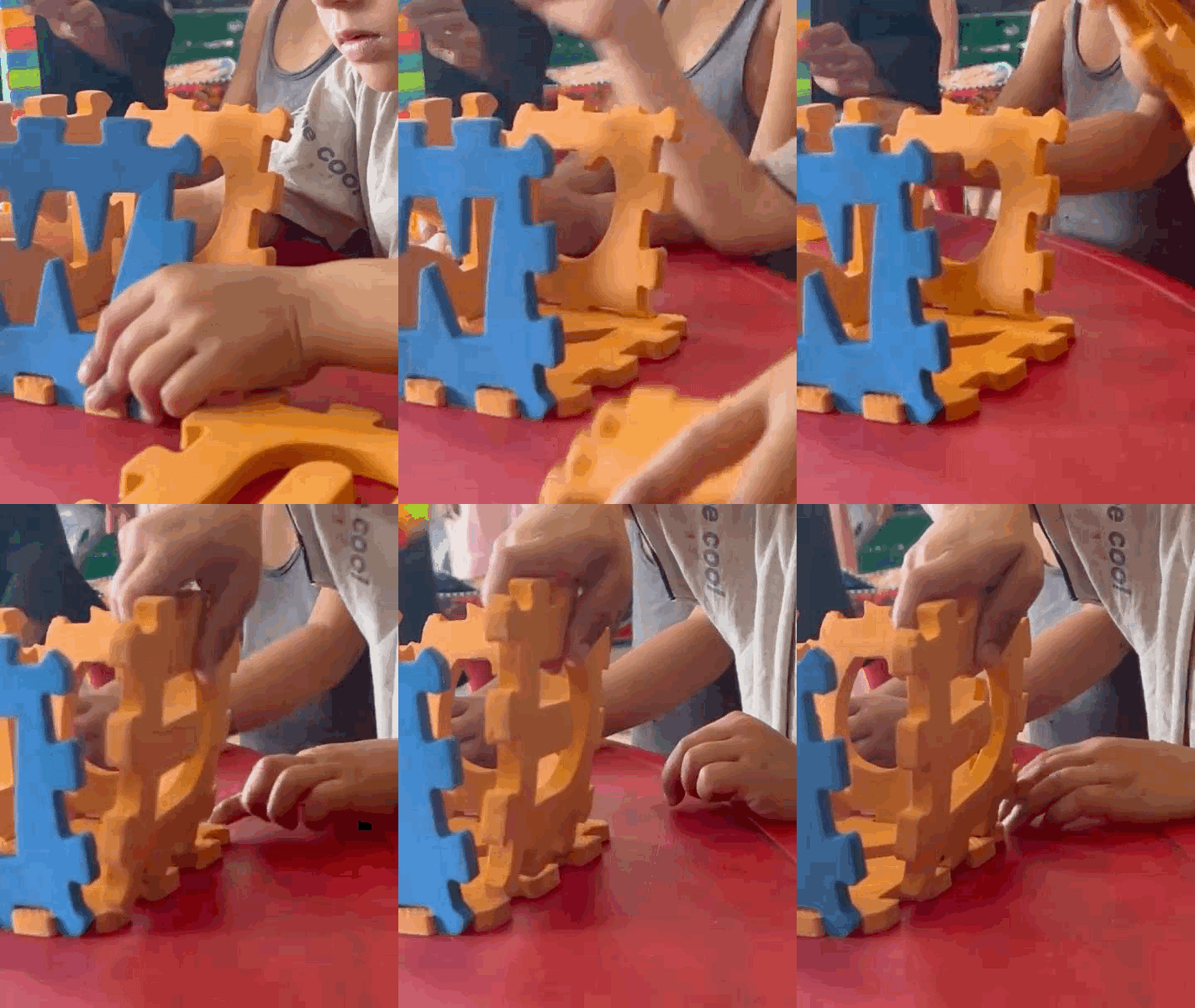
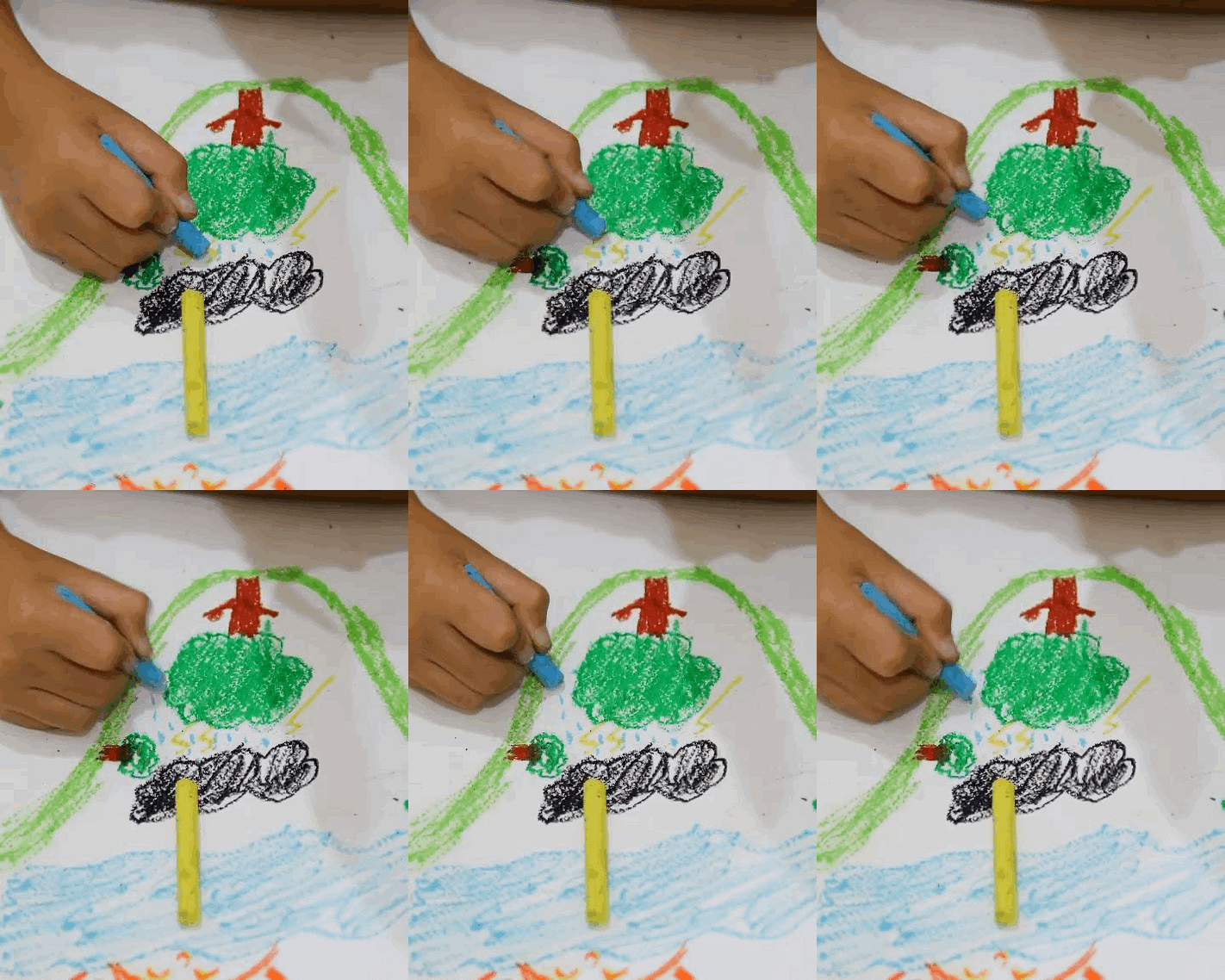
Time that moves at the pace of the child’s attention.
 .
.  .
. 
This kind of time allows children to follow a thought all the way through. To return to something again and again. To become absorbed in the texture of an idea, a task, or a tiny detail.
When learners engage in a task completely, and enter the ‘flow’ state, they often experience a distorted sense of time, where hours may feel like minutes or vice versa. Psychologist Mihaly Csikszentmihalyi, who coined this term suggests that it is in this state that people are the most creative, sharpening their cognitive abilities along the way. As adults we constantly aspire for this flow state at our work and other creative pursuits – a state of attention that we have to fight for and cultivate with intent and practice.
Flow is “a state in which people are so involved in an activity that nothing else seems to matter; the experience is so enjoyable that people will continue to do it even at great cost, for the sheer sake of doing it.”
~ Mihaly Csikszentmihalyi
However, for children, especially in the earliest years of their lives, it is easier to enter this timeless state. In fact, research suggests that under eight years of age childrens’ sensitivity to time intervals is less refined, leading to less accurate judgements about the passage of time, therein perhaps allowing them to experience it with abandon.
If you interact with children regularly, you must have experienced the tugs and tensions of getting children to move on from a task before they are completely done with it. Let’s say as a parent that has to ask your child to come for a meal multiple times before they finally come, or as a teacher that has to make the switch from language to math class. This tug comes when our adult understanding and experience of time contrasts with the child’s experience of time.
A mother describing her ‘laid-back, carefree, stop-and-smell-the roses type of child’
When I needed to be somewhere five minutes ago, she insisted on buckling her stuffed animal into a car seat. When I needed to grab a quick lunch at Subway, she’d stop to speak to the elderly woman who looked like her grandma.
An Excerpt from: “The Day I Stopped Saying ‘Hurry Up” by Rachel Macy Stafford
Does it not seem, therefore, that these youngest learners already possess one of the most critical tools for learning – the ability to experience an abundance in time.
Let’s pause for a few moments and observe this abundance in time:
How time shifts for them – when children grow
During the first 2 years of a child’s life, we hold time with softness. We wait patiently for them to respond to us with a smile, to walk, to speak. We don’t rush them. If anything, we slow down for them and make ourselves available to protect them. At 3 or 4, we still linger. We let them form sentences slowly and find their stumbles adorable. We aren’t yet measuring how fast they respond, because in many ways we’re in awe to see them learn it. Up until now we see children having abundant time, they have daily routines but there is ample time to play..
But as they near 5 or 6, something changes. We expect them to “get ready” on time for school, to tie their shoelaces fast, to ‘hurry up’, to recite numbers quickly.. Suddenly, time feels scarce and children are expected to keep up. We push them from moment to moment, often without realizing what we’re taking away.
Note: We aren’t saying these things aren’t important, for now we’re simply contrasting and highlighting the difference between when time feels scarce and time feels abundant
What happens when time is abundant vs. when it is scarce?
Let’s lay them side by side.
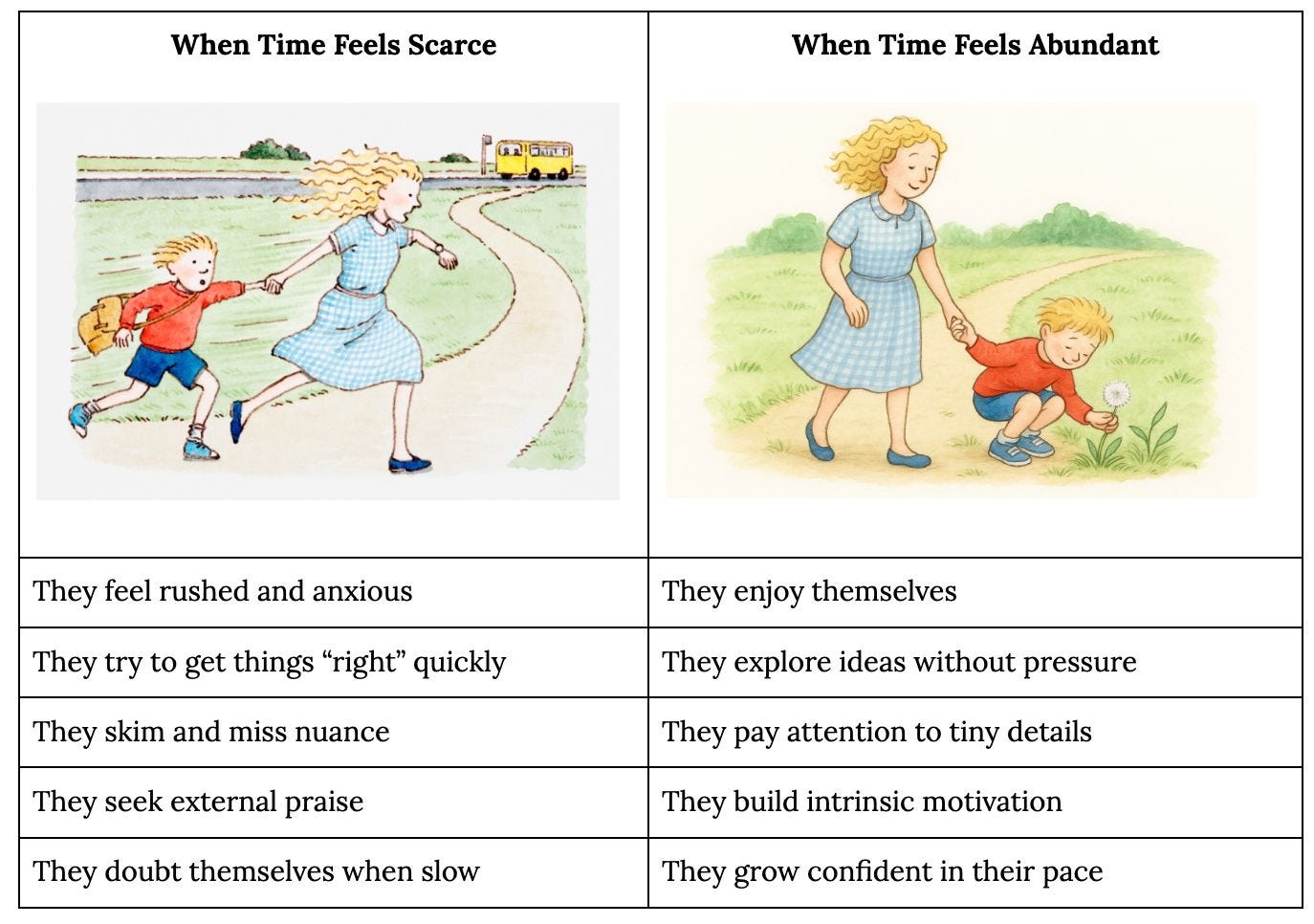
This isn’t just about childhood. Aastha’s first response to the videos of children at the park on a summery Monday morning was “I want such unhurried time”. Why is it that even as adults, we feel like we have increasingly less autonomy over our time? Most of us speed past our days hurriedly completing ‘tasks’ and striking things off our checklist only to spend what little free time we have in a blur of screentime. We relinquish the simple joys of walking to the store to carefully select veggies for dinner (perhaps we run into a friend or a cute dog on the way!), instead outsourcing this to an app or service and spending our hard-earned free-time gouging our way through easy-to-digest and bite-sized content.
We’ve been conditioned to solve quickly, to produce answers on time but in doing so, we often miss the beauty of taking abundant time to understand
Although at this point, we might all agree that we don’t want our learners to feel rushed or anxious, and neither do we don’t want them to skim and miss nuance. Still, there is tension between this seeing and the so-called “reality” of the world. There is content to be mastered, skills to be developed, exams to be aced and goals to be achieved. There’s so much to do and so little time. However, as champions of learning, and guardians of childhood, we could perhaps ask ourselves : What happens when we optimise for time instead of deep and lasting learning?
“It is the time you have wasted for your rose that makes your rose so important”
– Antoine de Saint-Exupéry, The Little Prince.
P.S. We promised ourselves we’d post every week but this time, we took our own time to dwell in the writing and give it the abundance it deserved. We took an extra week – without the guilt and it felt right. We hope you enjoyed reading it as much as we enjoyed writing it, slowly!
Read more: While reflecting on this, we stumbled upon a few lovely reflections from parents that resonated deeply with our theme of unhurried time and presence:
- Evoking the State of Flow by Laura Grace Weldon
- The Day I Stopped Saying “Hurry Up” by Rachel Macy Stafford



 )
)