

Over the past few weeks, we have been exploring the relationship between learning and time. This will be our last post in that series (for now). While reflecting on different models of learning led us to fundamental insights about time and learning, we have taken our time to unpack time in the context of digital technologies. This, in fact, might be the most important factor to consider in current times where technology shapes and dictates practically our entire lives. And in doing so it transforms our relationship with time far beyond the context of learning. But before we come to technology, we want you to consider a few structural shifts.
Learning in the age of scarcity
As Peter Gray outlines in A Brief History of Education, the modern school system was shaped by the logistical constraints of a time when access to knowledge was limited. Before the printing press, before digital archives, formal knowledge really did feel limited. Perhaps this was a social or political innovation, a false scarcity but it came to be that this formal knowledge, essential for humanity’s progress, was considered to be held by the few: the priest, the guru, the teacher. And in order for this formal knowledge to be passed on, people had to be gathered together in schools and classrooms where the knowing teacher could transfer this knowledge to the unknowing masses. Schools soon came to be considered the place where learning happens, offering access to these limited sources of knowledge.
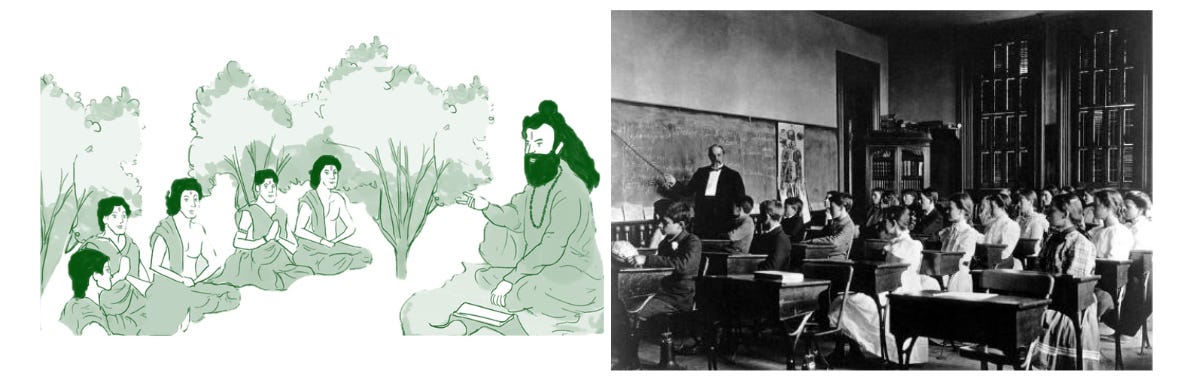
A key principle in these schools and classrooms was that the ceiling for knowledge was defined by the all-knowing teacher. What the teacher did not know, rarely ever entered the classroom and a student, wanting to know more or learn more had access to little beyond this boundary. This is often the case even in today’s classrooms. However, the advent of technology, beginning with the printing press has gradually allowed this to change.
As remembered by Aastha
My father was studying in a CBSE school in semi-urban Gujarat in the 1970s. Until Grade 10 he mostly studied what was taught in class. In 10th grade he got serious: he read the textbooks closely and spent long hours in the library with reference books, filling the gaps in his understanding and working through doubts. In his board exams that year, apparently the physics paper was notoriously tough. Out of four major questions, he solved three. (So tough that his teacher had managed to solve only two) – When his teacher asked how he did it, his answer: Perhaps the time I spent in the library, where I saw a similar problem in a reference book.
With books came libraries, and libraries allowed the learner to push past this false ceiling and access knowledge and information far beyond what the teacher brought in, just like Aastha’s father did. Print became a political tool in itself, an instrument of revolution and transformation. It resisted the control and one-dimensionality of knowledge and ideas that schools brought. Over time, schools and institutions co-opted print, incorporating them to serve their uniform agendas and standardized curriculums.
Yet again, technology advanced. Digital technologies – text messages, audio, video, the internet, they all created pockets of resistance. Alternatives to standardised, time-bound learning. Although school schedules and formal pedagogy look largely the same even today. What does learning really look like today for most people, we wondered.
Learning in the age of abundance
If we look around, today a learner is no longer limited by scarcity. There is an abundance of sources of knowledge. Print technology enabled access through books, but now, knowledge is also available in far more dynamic formats such as videos on YouTube, podcasts, learning apps like Duolingo and Khan Academy, community forums and countless others. Alongside these, technology has also opened asynchronous access points to teachers and experts. A learner can join a Zoom class, or send a question into a forum and receive a response hours later. What once required being in the same room at the same time can now happen across distance and time.
This abundance automatically expands the “time for learning” by dissolving the old six-hour boundaries of learning space. i.e. A person can learn early in the morning or late at night, on a bus, in a kitchen, or while walking through a park.
Researchers describe this as ubiquitous learning – an environment where knowledge is accessible anytime and anywhere through mobile devices and networks. Learning has almost woven into our everyday lives and appears the moment we seek it. The teacher is no longer the only source of knowledge. Their role has shifted to that of a facilitator and enabler, guiding learners to navigate, curate, and make sense of this abundance. So, the classroom has become only one among many possible places where learning takes place.
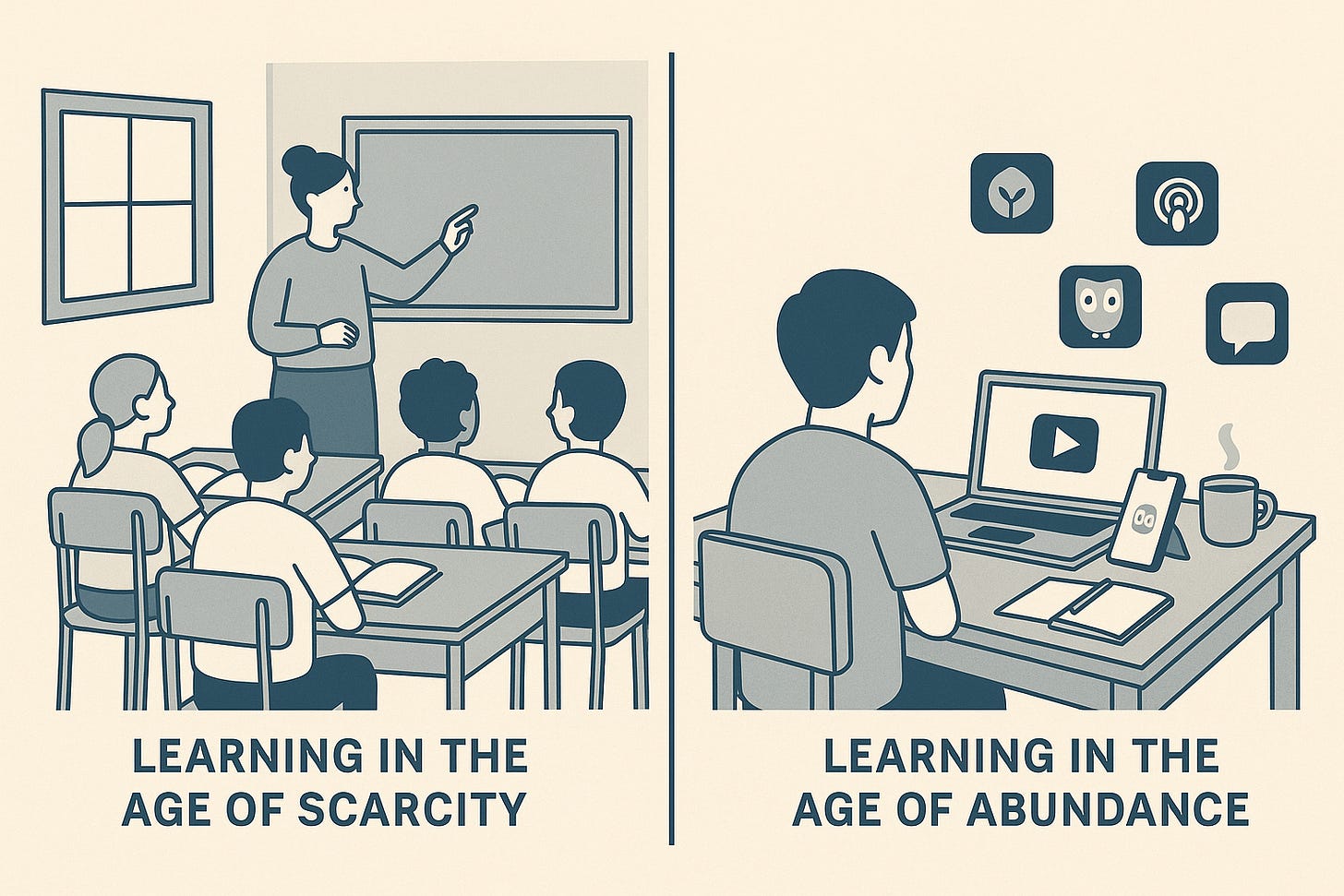
What does learning in the age of abundance look like?
Let’s look at some examples of the new-age learner in this age of abundance. Each of these portraits is inspired by real people we’ve come across.
Nikhil, 28: A schoolteacher preparing for UPSC

Nikhil teaches at a government school, but is simultaneously preparing for the UPSC exam (a popular, govt job entrance exam in India). Post-work on his bus ride home, he listens to the daily current affairs videos on YouTube often by Khan-Sir or other youtube-educators. Later, he follows a self-made timetable, and joins some scheduled live sessions hosted by the same youtuber or he searches for topic-wise videos, solves past year papers, and saves PDFs from Telegram. He’s part of a Discord group where aspirants share notes, updates, and questions.
Ron, 10: A homeschooled learner
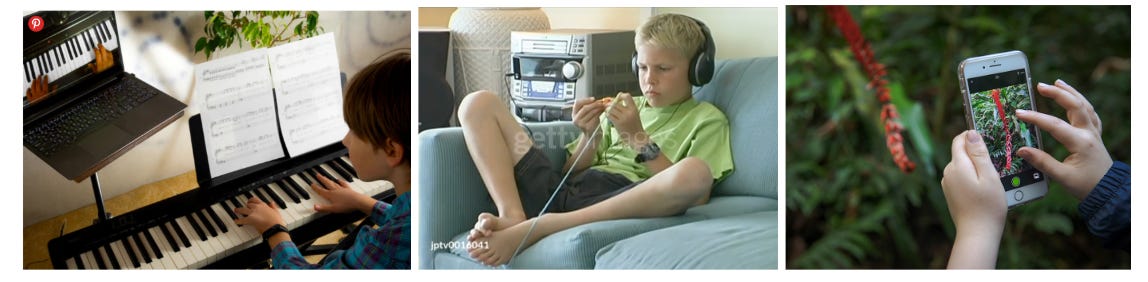
Ron is homeschooled by his parents. On a weekly basis the parents plan activities (both online and offline) and curate a list of resources. His mornings often begin with a short math practice on an app, followed by time to read, draw, or work on a personal project. He practices typing by writing short stories or letters on the computer. He follows drawing tutorials, watches how-to videos, or joins live sessions for art or science activities. He also loves to crochet (a skill he learned online), and listens to audiobooks while he crochets. On nature walks, he uses the Seek app to identify insects, plants, and leaves he comes across.
(Inspired by routines described in this Treehouse Schoolhouse post on using technology in homeschool)
Riya, 24: A self-taught coder
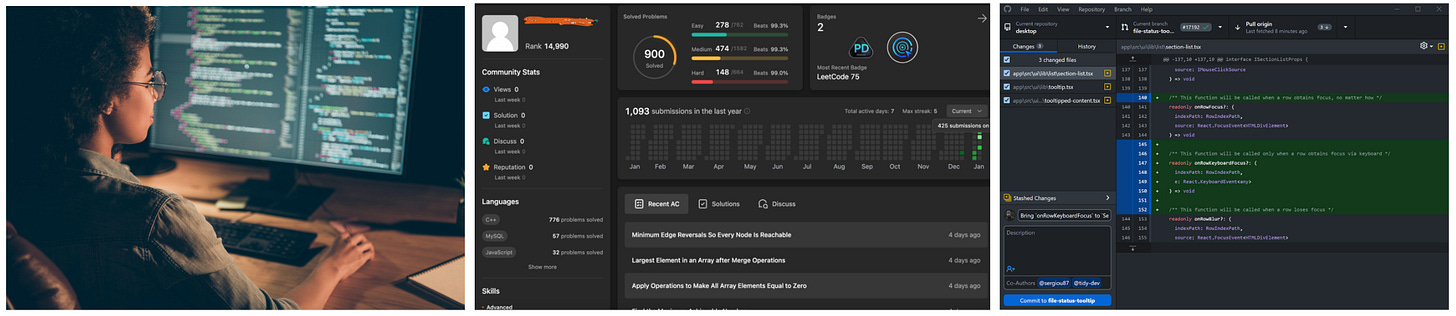
Riya is studying mechanical engineering, but over the past few months, she’s been preparing to move into tech. She practices coding on LeetCode, follows Python tutorials on YouTube, and uses GitHub to track her progress and explore others’ solutions. She’s part of a few Women in STEM communities where she attends online meetups and study groups every weekend. When stuck, she searches forums, rewatches a section of a tutorial, or joins a live debugging session on Discord. Her tabs are usually split between code, documentation, and a video walkthrough.
Neelam, 52: A lifelong learner
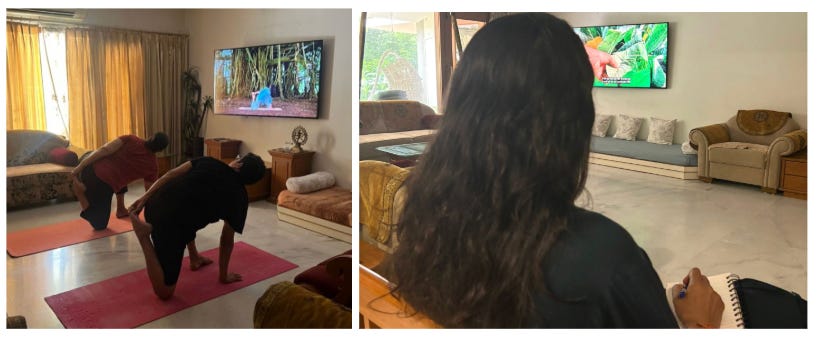
Neelam is a homemaker. Her mornings begin with yoga sessions on YouTube and tending to her growing kitchen garden. In the afternoons, she listens to Hindi podcasts and watches documentaries – often pausing to jot down ideas or questions in a notebook. She’s also learning French on Duolingo, a little every day. She enjoys the thrill of accessing all the knowledge of the world through the comfort of her home.
Across ages and backgrounds, the pattern of learning is striking. Each learner is piecing together their own paths, following their curiosity or their target learning objective, and using time in ways that classrooms never allowed. The learner, or in some cases the caregivers, curate the journey and take their own time to learn without being ‘rushed’ or being told how long to spend.
The New Age Learner
Learners in the age of abundance have the possibility to be immersed, curious, and in the driving seat of their own learning. We’re calling this possibility – the “new-age learner.”
And when we look at these learners, what they remind us of most is the expert learner, i.e., a young child. For a child, everything is learning. They notice, explore, and repeat simply because something calls their attention. They might follow a trail of ants or throw the same petal into the wind again and again. For them, this is the task – they are absorbed, determined to follow their curiosity, and they take their own time. Time bends to their attention.
The new-age learner isn’t so different. They might replay a segment of a video until the idea settles. They pause to make a note, search for a word they did not understand, or rewatch a tutorial to catch a detail they missed. They move from listening to reading to creating, without anyone needing to tell them that all of it counts as learning.. Just like the child, they carry with them an openness to learn from whatever is around them.
This is the shift we are noticing. The learner today is no longer just a student inside a classroom, bound by the timetable or syllabus. They are closer to the child in the park – curious, self-directed, unbounded. What was once natural only to the child is now possible for all of us, supported by the abundance of resources that technology has opened up.
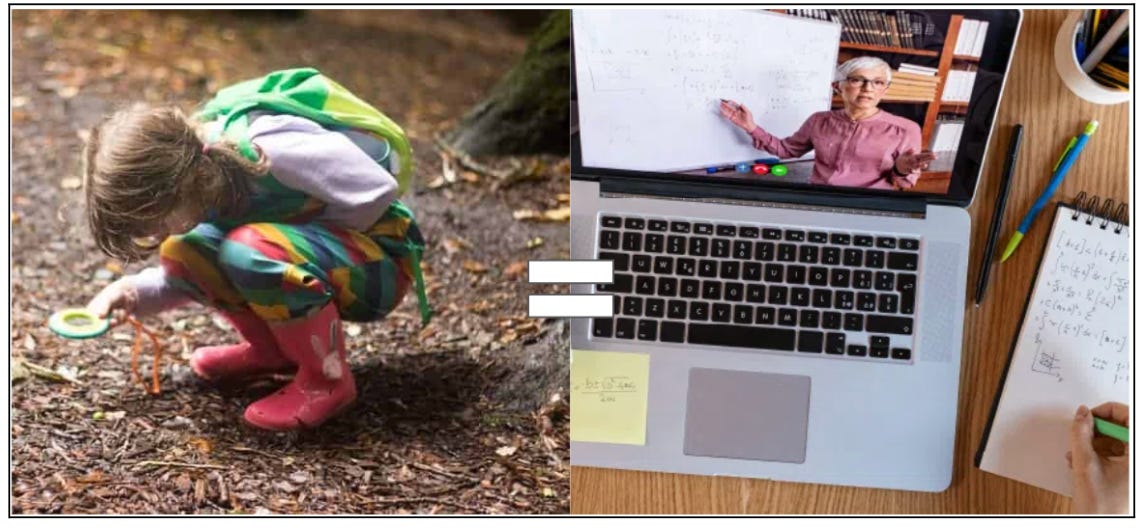
But abundance comes with a cost. It’s time to address the elephant in the room. The very platforms that expanded learning have also mastered the art of capturing our time. While technology promises greater control, big tech has also turned that very promise against us. Platforms are deliberately designed to be addictive, to keep us scrolling, watching, or buying for as long as possible. Hooked, a book that is aimed at helping readers learn ‘how to build habit forming products and increase customer engagement through strategic product design’ became quite popular a few years back. Even ed-tech organisations adapted principles outlined in the book to create a more ‘engaging’ product. We wonder however, if ‘habit forming’ is merely a benign-sounding way of saying addictive?
Think of the everyday examples: infinite scroll, autoplay, notification loops, rewards and gamification, personalized ad targeting. All of these tiny ‘strategies’ are carefully crafted to capture our time, not free it.
Importance of Intention & self-regulation
This brings us to the most important aspect of time and learning in the digital age. Today, our time and attention are our greatest resource. Although there is an abundance of resources and platforms for learning, there is also an abundance of distraction. A phone buzzes, Instagram beckons, autoplay carries us to the next video.
The key, we believe, is intention and self-regulation. To learn requires not just access, but the intention to use that access with focus. Imagine, if instead of letting the algorithm decide, we were to guide technology toward our questions. What if before we opened our YouTube app, we asked ourselves what it is we were seeking. The intent has been set, and it brings with it rigour. We bring along a note book, or a notes app and we pause to record and make sense of what we are consuming. Are we getting the information we wanted, we ask ourselves? If not, we switch to another resource.
Intention, as we see in this and previous examples, can turn passive consumption into active learning. It is the same kind of intent that once brought Aastha’s father to commit hours in a library, away from distraction, to linger with a physics problem until it made sense.
Although distractions are just a click away, this kind of intent also allows us to innovate and devise strategies that protect our focus: setting limits to app use, deleting certain apps, downloading focus tools, switching on flight mode. Learners need to pull in products that expand time for learning and push away the ones that steal it.
This is why we’ve been calling the “new-age learner” a possibility rather than a given. The conditions are here, but it is intention and self-regulation that turn the possibility into a reality. With them, learners can hold their time open, resist the pull of distraction, and keep learning at the center. We believe this kind of intention is what converts the possibility of the new-age learner into a reality. In the absence of such intention and self-regulation the learner is likely to merely wander aimlessly amidst the abundant resources.
This brings us full circle
Watching children closely has helped us see learning differently. They reminded us that learning takes time, that curiosity can guide attention, and that everything around us can become material for learning. Along the way we have also seen how schools and systems shape our relationship with time and learning, how some models of learning protect it while others restrict it, and how technology creates both abundance and risk.
The “new-age learner” is the possibility that emerges from this – someone who carries the openness of the child, but also brings intention and self-regulation. With the right intent, technology can support this state, making time feel open again and allowing learning to take its own shape.
We hope this series has allowed you to consider time a little differently, the way it led us to.. To see the relationship between simple mindsets and practices and how they enable time as a material for learning.
- Learning takes time, learning experts know it
- Schooling and workplaces often create scarcity, alienating us from time.
- Learning happens if time and attention are committed to it
- Time for learning emerges from the subject at hand, not the other way around
- In the digital age, the age of abundance, intention and self-regulation are what will win us back control over our time and attention.

 )
)