



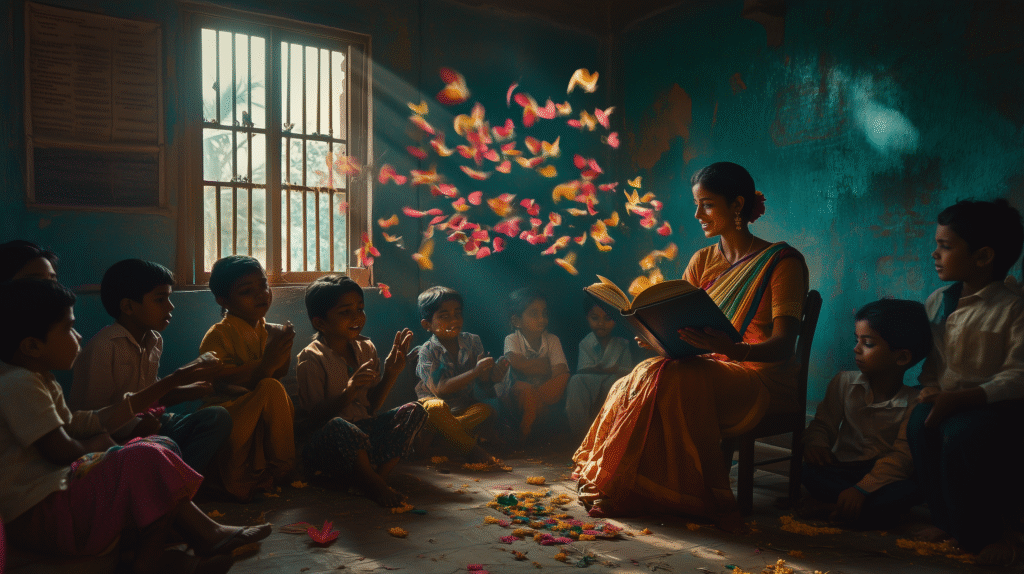
This edition of the Slate Scribbles captures Hema’s visits to a few Balwadi’s in Pollachi with the intent to understand what thriving childhood looks like in Pollachi. While I can witness diverse locations, Balwadi was one among them.
I visited the first Balwadi around 11.30 am. There were about 10 children playing. Two mothers were sitting along with the Anganwadi worker. The helper was on leave, so the mothers were there to help her.
Two children caught my attention. One was a two-year-old girl who was constantly crying for her mother. She has been coming to the anganwadi for only a few days, and ever since then she cries asking for her mother. The AWW said she is better now compared to earlier, but still, once in a while when she remembers her mother, she starts crying again. The other was a three-year-old girl who has been coming for almost 2–3 weeks. She was sitting on a side bench holding her bag close to her chest, asking again and again, “When will my mother come?” I went and sat next to her and started talking. She told me, “My mom has gone to work, she will come and pick me up. While coming she will get me chocolate and biscuits.”
Soon it was lunch time. The menu follows a six-day cycle, repeated every week. Children sat on the floor and started having their food. The two mothers were helping, feeding their own children. The two girls did not eat. The one sitting on the bench had her lunch in the bag, but she said, “I will go home and have lunch.” She kept looking at the door, saying her mother, father, or granny would come to pick her up.
While lunch was happening, the two-year-old’s parents came and took her home. After lunch, children went one by one to pass urine. There is no toilet facility, so they use the nearby open sakadai.
Then they were made to sleep on a broken jute mat. One boy, who has been coming for the second year, fell asleep. The rest lay down chattering. One mother sat with a scale in her hand, telling them to close their eyes and sleep. But 2–3 children were playing. One boy was riding on a teddy bear donated by a neighbour. Two or three children joined him, crawling, sitting, laughing. The AWW also joined in, playing and smiling. Then one boy pulled out a fidget spinner from his pocket and showed it to the AWW. The others ran to see it. She teased him, saying, “From morning you kept it in your pocket, and now you take it out!” Then they went back to the teddy bear, crawling and playing. A few children were playing separately, crawling, doing yoga.
The AWW mentioned that there was a power shutdown that day, which is a regular practice in Tamil Nadu. Otherwise, she said, the TV would be playing all day, and some children would sit and watch it. This TV was donated by a neighbour. I noticed they keep a chart of small requirements like the monthly cable connection bill, a wall cloth, even a god’s photo, because for parents here with low incomes, even these small items are a big contribution.
She also shared that the children come from different locations, not just the neighbourhood. Some mothers who work nearby in bakeries, shops, or as domestic help leave their children here. Some children come without having breakfast, so they are given snacks like sathu kolakattai by the government, and lunch at 12 pm.
Children usually arrive by 9 am. Some leave after lunch, while others stay until 3.30 or 4 pm, when parents come to pick them up after work
Visiting the 2nd Balwadi
The first day I went there, it was an ammavasa day. Very few children had come, and they finished lunch early by 12 and went home to go to the temple. It was raining heavily, so I stayed for some time while my son played on the slide and swing. The Balwadi was right next to a public toilet, and the school had an unfinished toilet at the back. The children simply sat outside to pee. Rainwater drizzled in through the long windows, and there seemed to be nobody to fix it.
I went back to the school the next day around 11 am. The children were playing. A six-year-old girl was there, and the AWW told me her mother works as a house help. She has three children who do not go to school, and this girl, the youngest, comes here to hang around, have lunch, and go back.
During the lunch hour, three or four mothers came to feed their children. One mother had already been there for a few days since her two-year-old started coming to the Balwadi. Another came with a bowl to take lunch home. Some children played and ate while their mothers fed them, and a few ate by themselves.
A 6–7-year-old boy came just to play around. The teacher asked him why he had not gone to school. When his father came, she asked him the same thing. The father said the boy was not interested in school.
One grandmother brought her 1.5-year-old granddaughter to feed her. The teacher told me there are quite a few children in the neighbourhood who are enrolled in low-budget private schools or government schools but stay at home instead. Parents don’t seem to care much about sending them. Even after repeated reminders, nothing changes.
Then came a more unusual moment. A grandmother arrived at the anganwadi carrying her three-month-old grandchild and asked the AWW if there was any medicine for the baby’s cold. The AWW said no and asked where the child’s mother was. The grandmother, holding the baby, said the mother had gone to work in an office in Coimbatore, about 60 km away. There was no breastfeeding during the day, only cow’s milk. She added that the parents had taken the child to the GH in the morning, and the doctor had given syrup, but the child was still unwell. She also told me their house is poorly sanitised because it is right next to the public toilet, with water leakage and a constant stench, and that they are suffering with the baby’s condition. I had no words to respond.
By the end of the day, the children going back home took the sathu kolakattai with them and left. The AWW also mentioned the helper was on long leave, so she was cooking and taking care of the children all by herself. And still, play was everywhere. Where there is a child, there is play, laughter, and happiness.
Visiting the 3rd Balwadi
I went to the Balwadi around 10.30 am. A few children were playing with building blocks while the helper was taking care of them. The AWW was sitting at her desk, finishing her report. Her left hand had a fracture, so she was slowly working through it.
Since this month’s theme is flowers, the helper was talking about flowers. The Tamil Nadu government’s ICDS has given textbooks for each month with a theme. There are 11 books like that. Each one has stories, poems, and activities around that theme, along with a timetable.
The helper gathered the children in a circle, engaging them with poems and activities, and then asked them to recite a poem to me. I just sat and observed them playing and chattering.
Then, an 8–9-year-old boy showed up. His younger sister comes here. The AWW told me he does not go to school. His single mother, who works as a house help, does not care much about sending him to school. He also has an elder sister who is at home helping the mother. Both do not go to school. He comes along with his younger sister, sits for some time, and then leaves.
During lunch hour, the boy was helping by giving plates and taking the children to wash their hands. There was no toilet facility here either. It was still under construction, and there was no water connection. A mother came with a bowl to take food home. While all this was happening, I left the space.


 )
)