


Bangalore | 23 May 2025
At its heart, this was a space to think about childhood as it really is: messy, magical, and rooted in what we often overlook.
It was about the everyday kind. The kind built on nap-time negotiations, lunchtime giggles, scraped knees, mango-stained fingers, and endless, urgent questions. The kind of childhood that’s held together not by institutions alone, but by people, parents, teachers, neighbours, siblings, Anganwadi workers, who show up again and again with small acts of care.
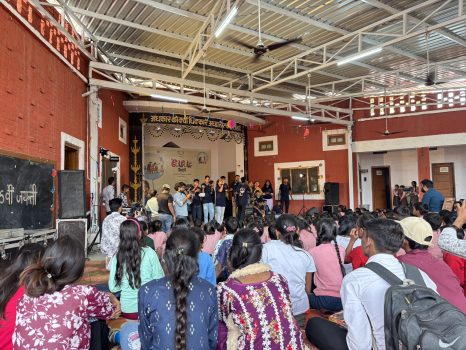
Over 150 participants came together, spanning more than 80 organisations, from grassroots educators and Anganwadi workers to journalists, designers, policymakers, artists, and caregivers. There were people from different parts of India, working in urban classrooms, rural play corners, health systems, prisons, and learning collectives. The Sabha welcomed a range of roles and voices, not just those at the front of the room, but also those often at the margins. Inclusivity was woven into the day’s design: ISL interpreters ensured accessibility, children were co-participants, and open invitations encouraged wide participation beyond formal networks.
Bachpan Manao Sabha was created as a space to pause and ask:
What does it really take, in today’s India, for a child to feel safe, loved, and free to wonder?
And equally:
What holds them back? What are we missing?
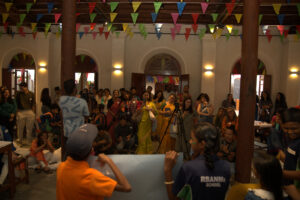
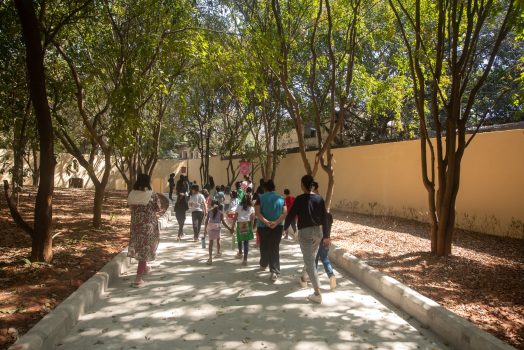
Held in a 160-year-old restored school building in Bengaluru, the Sabha brought together over 150 people from across India, educators, caregivers, artists, policy thinkers, children, fieldworkers, creators, to reflect, reimagine, and reconnect.
But it wasn’t a conference. It was a shared village of story, memory, and meaning. Workshops. Play-based circles. Immersive exhibits. 8-minute talks. Conversations over chai. It was designed to be felt before it was analysed.
The day didn’t try to solve childhood. It tried to see it, in all its complexity, contradictions, and quiet abundance.
The Morning: Questions Before Answers
The day began not with a keynote, but with a question: What does a thriving childhood feel like, to a child, to a parent, to a policymaker, to a teacher?
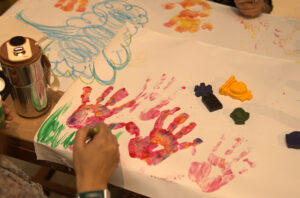
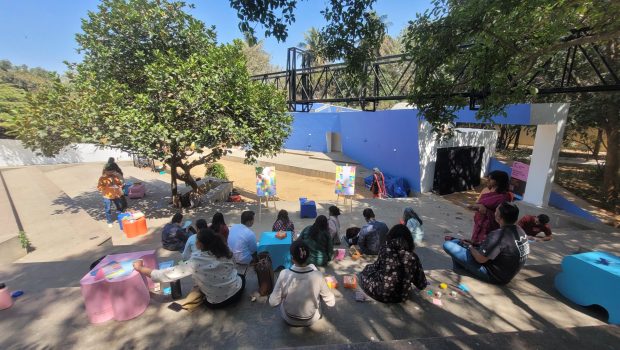
In two parallel spaces, one for adults, one for children, participants were invited to leave their roles at the door and reflect on their own lived childhoods. No designations. No jargon. Just stories, memories, sketchbooks, and silence.
Ashish Shrivastava, founder of Shiksharth, led the first session with a simple provocation: We often say we’re “designing for children.” But are we really listening to what they’re already saying?
As adults mapped childhood in words and drawings, children in another room did the same, their outputs would be brought together later, revealing where our perspectives overlapped, and where they didn’t.
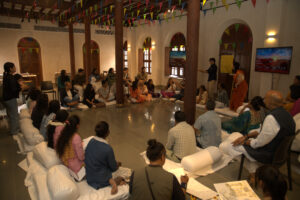
Later that morning, Dream a Dream invited us to shift from reflection to play. Through a creative, sensory session led by Tania and Ansar, participants explored emotions through movement, colour, and shared vulnerability. It wasn’t about technique. It was about noticing. Noticing what moved, what stuck, what softened, within ourselves and with each other.
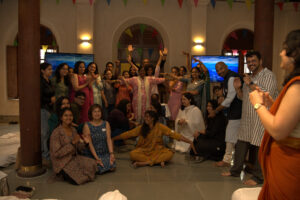
These morning workshops weren’t content delivery sessions. They were reorienting moments, asking each of us to move from assumption to attention.
BM8 Talks —Championing Childhood, 8 Minutes at a Time
BM8 Talks featured six powerful ideas, each shared in under eight minutes. A small window, but a deliberate one. Because if the first eight years of life shape the foundation of childhood, then perhaps eight minutes can hold a story that shifts how we see it.
But this wasn’t a race against time. It was an offering, each speaker bringing a story, a question, a memory worth holding.
 Rachna Narwekar told the story of a child in a prison crèche who asked, “What is a fish?” That question changed how she saw learning, and led her to build joyful learning spaces in carceral environments.
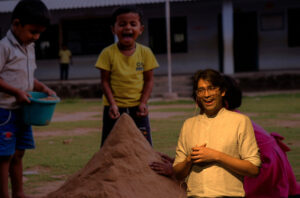
- Mangal Pandey watched a group of five-year-olds build a mountain out of sand and remembered what undistracted focus feels like. Their teamwork, joy, and presence reminded him of everything adults forget.
- Aastha Patel and Vibha Iyer shared a quiet moment where a child used plastic toys to act out hunger and rest. That scene, elephants “eating” letters, then lying down to sleep, sparked their ongoing inquiry into how children learn without being taught.
- Ashish Shrivastava reflected on how systems often fail children, and how trust, not technology, is the foundation for learning in conflict zones.
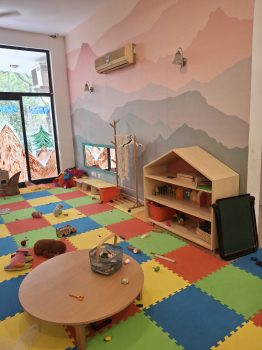
- Tinni Sawhney spoke about Khel Konas, play corners co-created with families in rural UP and Bihar, reminding us that joy, too, can be locally sourced and deeply rooted.
- Sanjana Samraj recounted the day she watched children play in ankle-deep monsoon mud and realised that they were not “messy”, they were architects of a magical world, solving problems with sticks, mud, and story.
 Rachna Narwekar told the story of a child in a prison crèche who asked, “What is a fish?” That question changed how she saw learning, and led her to build joyful learning spaces in carceral environments.
These were stories to carry. Each one asked something simple yet profound: Are we really seeing children for who they are, or only for who we think they need to become?
Katha Utsav: Stories That Stay
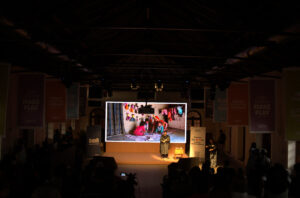
The afternoon opened into Katha Utsav, a celebration of the first-ever FactorDaily–Bachpan Manao Storytelling Fellowship. These were not professional journalists, but ten educators, fieldworkers, and caregivers who had spent months listening deeply to children’s lives in places we rarely hear from.
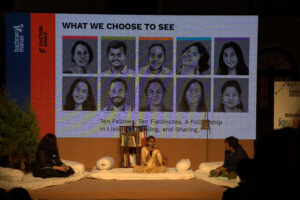
We began with a conversation between journalist Pankaj Mishra, Muskaan Sajjad, and Ragnee, a 17-year-old from Pakela, Chhattisgarh, the heart of Muskaan’s story. Together, they spoke about menstrual health, community silence, and what it means to speak up when no one else does.
Pankaj then invited six of the fellows present (Varsha, Subrato, Muskaan, Swetha, Mani and Mansi) to share what this journey had meant, the unexpected turns in the field, the emotional weight of writing, and the breakthroughs they witnessed.
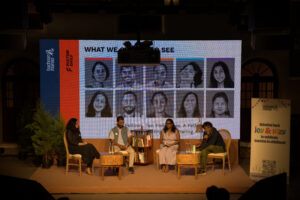 The stories celebrated shared held a remarkable range. One took us into a prison crèche, where a child asked a question that redefined learning (Rachna Narwekar). Another followed the trail of an imaginary houseguest who gently transformed how a family saw education (Mansi Kumbharjuvekar). There was the scent of jaggery in an Anganwadi kitchen (Varsha Vijayakumar), the stillness of a classroom broken by a single raised hand (Subrato Mukherjee), and a child’s quiet rebellion to protect a pangolin (Priyanka Chatterjee). We heard of grief that became action, a father mourning his daughter who turned that loss into a fight for dignity for women waste workers (Dr. S. Manikandan). In another corner, joy under a mango tree became a classroom (Swetha Guhan), and in a garage once thick with fear, healing began (Megha Suhas).
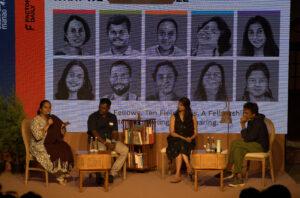
These weren’t just stories. They were mirrors, windows, and sometimes, gentle demands. Reminding us that childhood doesn’t need rescuing. It needs witnessing.
The evening closed with a Fireside Conversation between Pankaj Mishra and Anish Chandy on what it takes for grassroots stories to grow into culture, not just reports. Books. Films. Podcasts. And beyond. Anish spoke about the slow, committed act of following a story, sitting with it, reshaping it, and sometimes returning to it dozens of times until it lands. Sharing it over and over, until it sticks. It was a gentle reminder that storytelling isn’t just about what’s told, but how patiently we stay with it, and how much we believe it’s worth telling.
Beyond the Day — What the Space Held
All day long, the space itself was in conversation with us. Every corner held something to notice, reflect on, or carry home.
- Threads of Care Wall
A public good created together, this tactile grid of strings slowly filled with over 100 handwritten notes, each marking an act of care. Some were offered (“I lent my umbrella to a stranger”), some received (“She tied my shoelace without a word”). Together, it became a map of connection, showing how care, when noticed, becomes visible. - Noticing Childhood Exhibit
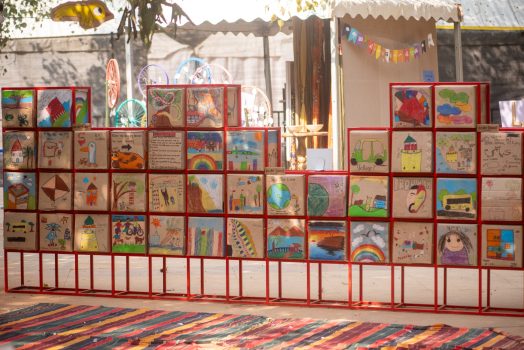
A polaroid-style wall filled with everyday moments, muddy feet, held hands, paper crowns, accompanied by handwritten captions. Each image captured a small act of care, independence, or wonder. Alongside this, participants received the BM Slate, a soft grey notebook designed for quiet observation and slow noticing. It wasn’t a worksheet. It was an invitation. Paired with gentle prompts and cue cards, the Slate became a space to jot down what often goes unseen: a conversation overheard, a drawing left behind, a question that lingered. By the end of the day, nearly every copy had been taken home, a reminder that noticing is not just something we do in the room, but something we carry with us.
- First Songs Listening Station
A life-size installation where participants could sit, listen, and hum along to lullabies from across India. These weren’t just songs, they were sounds of safety, memory, and belonging, sung by caregivers and passed from generation to generation. - Bringing the Podcast to Life
A gallery of snapshot boards based on The Educators’ Commune podcast. Each board featured an image, a quote or infographic from a real educator or caregiver, and a QR code to hear the full conversation. It was a reminder that deep knowledge often sits in lived experience, not just in reports or toolkits. - Newsletter Wall
A walkable, physical version of the Bachpan Manao newsletter. Rich with visuals and one-line insights, it brought field stories and ecosystem thinking into eye-level dialogue. - Masterclass – A Living Playlist of Practice
The Bachpan Manao Masterclasses are one-hour online sessions where people closest to the field: educators, caregivers, programme leads, and designers share what’s working on the ground. These aren’t abstract theories or case studies polished for panels. Each session offers a practical approach, a resource that can be reused, or a small shift that made a real difference. At the Sabha, we brought these sessions into the room through a curated wall: a living playlist of snapshots, QR codes, and audience reflections. It reminded us that deep knowledge often travels through conversations, not just toolkits. And that sometimes, what works best is what’s quietly been working all along. - Visible and Invisible Work
This two-sided panel installation showed two halves of the same scene. On one side: children laughing in a courtyard. On the other: an anganwadi worker preparing meals, wiping noses, keeping count. It gently asked, what work is seen, and what gets overlooked? - The Tea Conversations
And then, there were the soft, unplanned exhibits, the ones with no signage. A quiet story shared over chai. A drawing left behind on a bench. A page in someone’s notebook, underlined twice.

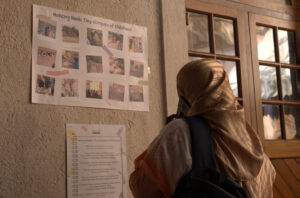
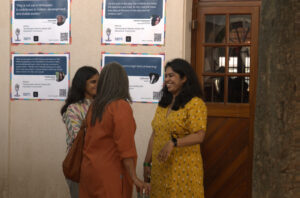
Together, these installations did not explain childhood. They did something better, they let you feel it. They reminded us that play, care, and learning don’t always need to be taught. They just need to be seen.
What We Heard from Children
Throughout the day, children weren’t just watching, they were shaping the space. They drew, wrote, played, and responded to a simple prompt:
What makes you feel safe, seen, and excited to learn?
Their answers were unvarnished:
“When I can go on school trips with my friends”
“When my dad gives me pocket money”
“When RCB wins a match”
Not elaborate demands. Just small certainties, friendship, freedom, fun, that made them feel held.
And maybe that’s the truth we need to carry forward:
Children are not complicated. They’re already paying attention, already full of wonder. It’s we who need to unlearn, to look closer, listen better, and let go of the urge to fix what simply needs to be felt.
What’s Next
The Bachpan Manao Sabha was never meant to be a one-day event. It was a pause in a much longer journey, part of a growing movement to centre childhood with clarity, care, and collective imagination.
In the coming weeks, we will be sharing:
- Stories that stayed with us, from children, caregivers, and collabactors
- BM8 Talks, so these ideas can travel further
- Public goods like toolkits, postcards, and playlists, made to be shared, used, and reimagined by many
But more importantly, the conversations won’t stop here. They’ll ripple outward, into classrooms, anganwadis, libraries, panchayat offices, living rooms, and tea stalls.
They’ll show up in small shifts: how a teacher listens. How a father reads. How a policymaker pauses. Because every act of noticing is a beginning. And every beginning counts.
Thank you for being part of this one.
There’s much more to come. Watch this space, or better yet, step into it.
Whether you want to hold a masterclass, share a BM8 story, or co-create a space for childhood to be seen and felt, there’s room for you in this growing circle. Join the fray, bring your questions, your chaos, your care, and let’s build what comes next, together.

 )
)