



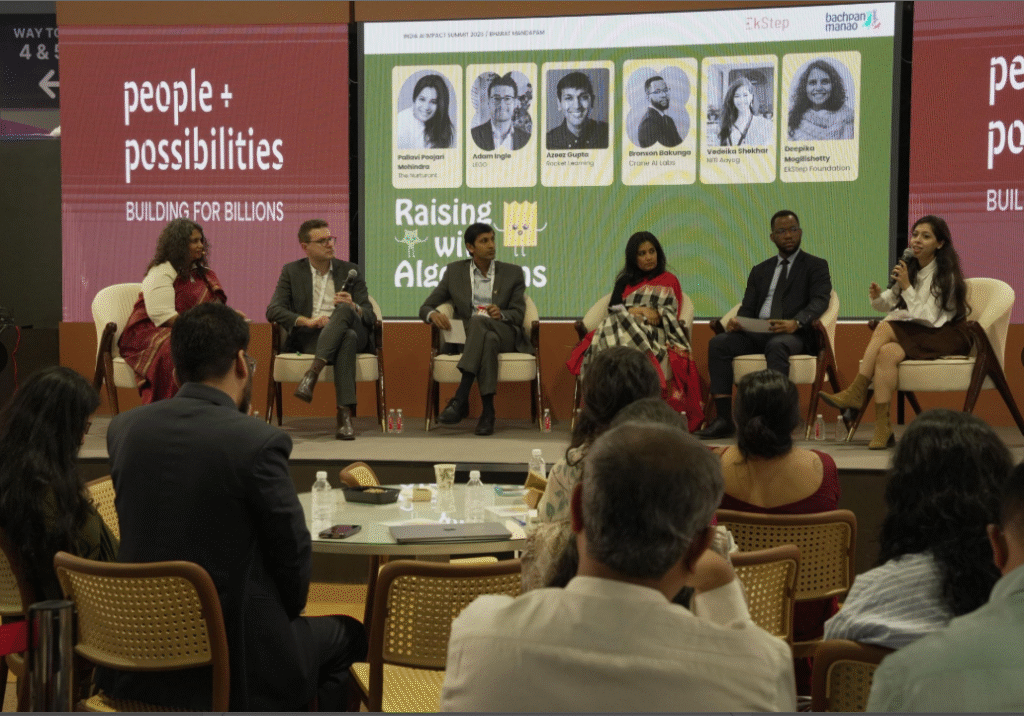
This post is a round up of all our discussions that have grown out of a conversation held at the India AI Impact Summit, where educators, technologists, policy practitioners, and learning designers came together to talk about children and intelligent systems. The session was titled Raising with Algorithms – Who Shapes the World the Next Generation Grows Into.
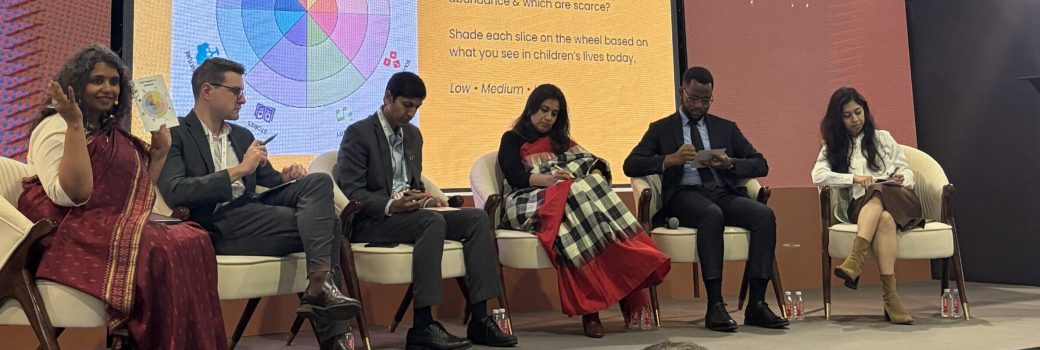
The room brought together people who do not usually occupy the same space for very long: Adam Ingle from the LEGO Group, working on digital safety and policy; Azeez Gupta of Rocket Learning, focused on early childhood systems across India; Bronson Bakunga of Crane AI Labs, building language technologies for communities often left out of mainstream AI; Pallavi Poojari Mohindra from The Nurturant, rooted in early childhood practice and attachment; and Vedeika Shekhar from NITI Aayog, approaching these questions from a public policy lens. It was an unusual mix of vantage points in one space. The conversation was moderated by Deepika Mogilishetty from EkStep Foundation, who moved it along without letting it drift too far from the lived realities being described. What became clear fairly quickly was that although everyone came from different systems, sectors, and pressures, the conversation kept circling back to the same centre of gravity: childhood itself, and what it actually takes for it to remain whole.
____________________________________________________________________________________________________________________
Over the past few weeks, Bachpan Manao’s conversations from the AI Summit travelled across a number of spaces. Pieces appeared on the Playground website, reflections went up on LinkedIn, stories circulated on Dailyhunt, and smaller fragments moved through social media.
Across all of these, the starting question remained the same.
What is happening to childhood as intelligent systems become part of everyday life?
At the Summit we brought together voices from childhood research, policy, education, caregiving, and technology. The discussion did not stay at the level of tools or features. It kept returning to a more fundamental point.
Children grow through relationships with adults who are attentive, available, and emotionally present.
Across the articles and posts that followed, we tried to unpack different parts of childhood that deserve attention as technology becomes more embedded in children’s environments.

Play came up early in the discussion. When children play together they negotiate rules, invent games, solve small conflicts, and discover how other minds work. It is messy, interactive, and physical. Those qualities are precisely what allow children to experiment and learn.
Social bonding came up as another core element. Reflective thinking develops slowly through human interaction. Children learn how to read expressions, interpret pauses, and respond to other people’s feelings. These capacities grow through repeated exchanges with adults and other children.
All-round skills such as resilience, problem solving, social awareness, and emotional confidence were also emphasised. These abilities sustain people across their lives, yet they rarely appear in datasets or performance dashboards.
Several speakers spoke about the loss of unstructured time in childhood. Many children now move from one structured activity to another with little space to sit with their own thoughts or curiosity.
Nature also surfaced repeatedly. When children step outside, something shifts. Weather, textures, insects, plants, and uneven ground introduce forms of learning that do not exist inside controlled environments.

The conversation also moved through small stories that revealed the limits of data systems.
One speaker shared a story from an anganwadi. A child refused to participate in painting because they disliked the feeling of stickiness on their hands. The dataset would simply record that the child did not complete the activity. The actual reason would disappear.
Another moment came from a story about two nieces who spent nearly thirty minutes naming their goldfish. The conversation wandered through possibilities before they settled on a name. They could have asked Gemini in seconds. Instead they lingered with the question.
We also spoke about the emotional climate around children. Several speakers raised concern that adults themselves are becoming cognitively distracted. Phones, notifications, and constant information streams are changing how adults listen, pause, and respond.
One comment during the session stayed with many of us. If a child reaches for a system for guidance before reaching for a parent, caregiver, or trusted adult, something important has shifted.
For Bachpan Manao, these reflections matter because conversations about AI and childhood often begin with product design or policy frameworks. Those discussions are important, yet they must remain connected to a deeper understanding of childhood itself.
Childhood involves relationship, patience, curiosity, frustration, imagination, and care. These are the environments within which children grow.
Through the pieces we shared across platforms, we tried to keep asking a few ongoing questions:
- What parts of childhood do we want to protect?
- What aspects of human development remain invisible to data systems?
- What questions about childhood remain unresolved as AI systems expand?
- What principles should guide adults raising children in a world shaped by algorithms?
One point surfaced across every conversation.
Children need adults who are present in their lives.
The work ahead is not only about building responsible technology. It is also about protecting the conditions in which children grow through attention, relationships, and shared time.
Read the full series
On Our Playground
- Designing for Childhood in Intelligent Systems
- Eight Bits of Childhood and What They Mean for Intelligent Systems
On Our LinkedIn
- The Bachpan Manao panel at the India AI Impact Summit – “Raising with Algorithms – Who Shapes the World the Next Generation Grows Into?”
- Eight Words on a Wheel
- At the Raising with Algorithms panel at the India AI Impact Summit 2026, the room was full of people who build things that, in some way, reach children. And the conversation kept raising questions that none of them could answer. Maybe that’s exactly where we need to start.
- Varun from the Bachpan Manao team ponders, “How would all this play out for children and their childhoods?”
- Deepika from the Bachpan Manao team writes about the most important moments that did not happen on the panel, and what this means as we design for intelligent systems.
- What is the impact of AI on children, and what do adults need to do about it?
- Children don’t meet technology as tools, they meet it as environments
- Five people came from their separate worlds to share a stage, because childhood needed to be in the room.
- A huge shoutout to our CollabActors who made it to the panel conversations
- Who’s really making decisions about your child?
- A poll on What makes an AI tool truly fit a local community?
- A poll on When you think about AI in children’s lives, how do you feel?
- When asked what responsibility looks like in a world being shaped by intelligent systems, Deepika Mogilishetty started with values, and what it means to protect the humanity of a child.
- The next generation might be smart, but will they be reflective? What is the future of connection? Hear from Pallavi Poojari Mohindra on this and on whether parents are present as a child watches. AI can give caregiving adults the right answer, the language and even the reassurance, at the right time. But the child isn’t looking at the screen. They’re looking at you. How do we remember to trust our judgement as parents and teachers?
- Bronson Bakunga shares that curiosity isn’t something you can schedule into a curriculum. But can you design for it? And is optimisation the way to create ideal learning environments or should there be space for feedback and error?
- Adam Ingle speaks about what happens when children are presented with a screen and a crayon, what do they choose? He also shared a concern around who bears the consequences when an AI product designed for children causes harm?
- Azeez Gupta shares on connection and what social bonding means in the age of AI and how can technological progress deepen relationships, and not replace it.
- Learning about the role of nature in childhood today, from Vedeika Shekhar along with what happens if as parents the first instinct becomes to ask AI, and then think? And as we rely on AI systems to share metrics, does data truly present the entire picture?
On Instagram
Reflections post session





 )
)