

Much of what we’ve learned about learning has come from observing children in the context of our work as educators, researchers and designers. These contexts allowed us time to engage with young children and to learn about learning. However, in each of these situations, our goals as learning designers inevitably took precedence. Observations or insights that didn’t enable us to achieve these goals, were set aside to focus on the specific output or challenge at hand. Sharing these stories among ourselves laid the foundation for the Observation Project, where we intentionally stepped away from these goals, carved out time for creative thinking. That allowed us to see how much of childhood and learning lay in the peripherals of our guided vision.
On a recent joint exploration, we set aside a few days to simply walk around town and observe together. It’s remarkable what you start to see, once you allow yourself to. We walked past little shops, street sides, in and around apartment buildings and more.
The first child we stumbled upon on this sunny summer day was a little boy in a sandy play area all set up with slides and swings. It was still morning hours and the child in question, around 2 years of age, was someone familiar. His grandmother watched over him as he played leisurely with his brightly coloured toys – a bucket filled with water, a few plastic objects – a turtle, a cucumber, a brinjal, a strawberry, a ball. The child picked up these objects in a somewhat distracted manner and explored them with his little fingers. Occasionally his grandmother would look our way and explain to us what he was doing.
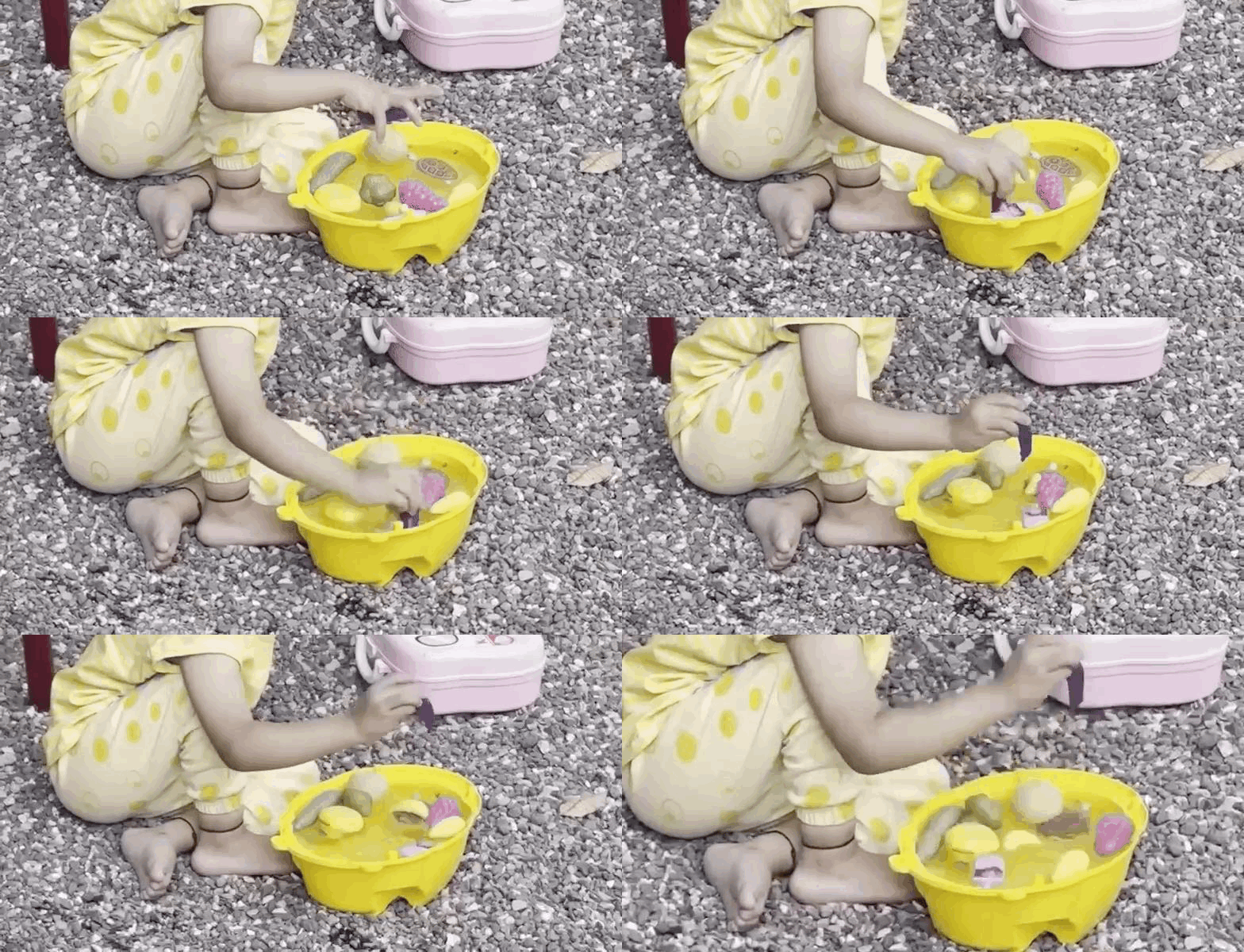
There were several devices of learning present; an intentionally designed play area, toys that had been created and purchased with a child in mind, a grandparent to care and protect.
Not wanting to disrupt the child or his morning play, we decided to move further and keep walking. A few minutes later we noticed a group of children huddled on a ragged mat laid out on some construction sand. Of the five or so children present, three of them were absorbed in what felt like a video on a phone while a fourth one, much younger than the rest, was sliding down slowly on a mound of sand.
 .
. 
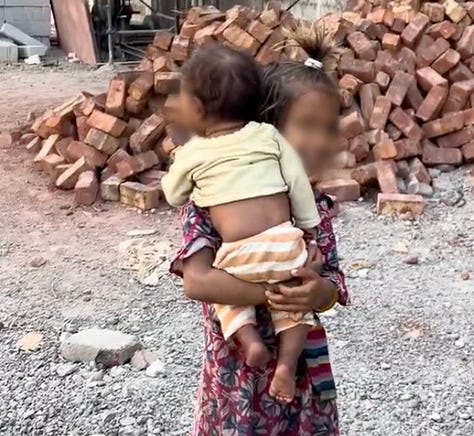
We looked around us slowly, and registered that this was a construction site. Looking further, we recognised that there was hardly an adult present in the immediate vicinity. About 100 meters away, across the road, we spotted young men and women, most likely the parents of these children engaged in construction work on a building. Occasionally they would look in our direction, the direction of the children, and look to see what was happening.
The kids, for the most part, were hardly bothered about our presence. As they occupied themselves with various little things, their bodies seemed to gradually move from a sleepy, slumber-like state to an almost intense alertness. One little girl began filling little bottles with sand and pouring them out, another had filled a curved metal plate with sand and was carrying it on her head, much like the young men and women on the other side of the road. It was one of those visuals that always cracks adults up, watching small children imitate adult tasks with tremendous care, pride and focus. But contrary to children in homes like ours, there was no one around to laugh at them, cheer them on or document them (apart from us today). This, it seemed to us, lent a very distinct mood or flavour to the children’s activities. We are yet to articulate what exactly this was, but for now reader, we hope you allow yourself to experience this with us and perhaps figure it out for yourself.
 .
.  .
. 
Unprompted by any adult, an older sister, perhaps of 6 or 7 years, began performing small acts of care for the little ones. They took off or changed their soiled underwear, straightened out and dusted their clothes, and combed the toddlers hair with their own little fingers before resuming their own play; running and chasing each other. There’s so much beauty in how effortlessly children from six months to maybe twelve play and care for one another, older children folding younger ones into their games – modeling what to do, participating in the little one’s play, care-giving and taking the space of the missing adult.
 .
. 

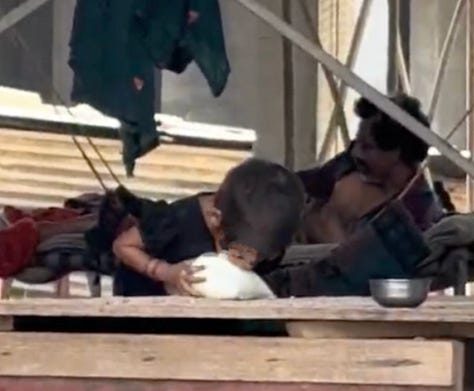
As we lingered, we noticed a very young child of less than three years holding a small milk packet handed out by someone from the affluent neighbourhood. She studied it with her hands before bringing it to her mouth, trying to drink from a corner that had no opening. After a few patient attempts, a tiny puncture appeared, and she pressed the packet, delighted by the thin stream that arced out. As the stream slowed; she pinched the packet again, attempting to release a stronger flow. The packet ripped slightly and finally spilled. Through all of this, she remained completely absorbed; adjusting pressure, changing angles, mastering her pincer grip all while nursing an unworded question. Watching the milk spill and waste yet not interfering demanded tremendous restraint from us.
 .
. 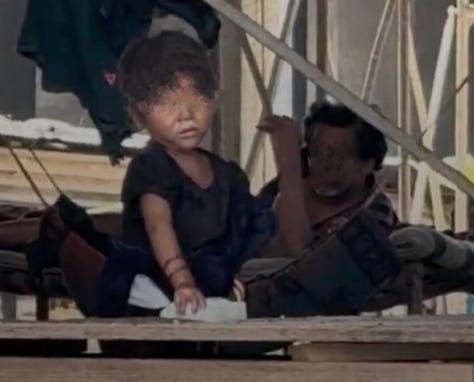

This was one of the first construction sites we observed. Ever since, we have both accidentally and intentionally been observing construction sites. Almost always there are children, and almost always we get a taste of that flavour we mentioned earlier; serious, deliberate.
“Play is often talked about as if it were a relief from serious learning. But for children, play is serious learning.”
– Fred Rogers (Mister Rogers)
On another morning visit to a construction site, two kids, probably about five years of age, caught our attention. They were fidgeting with a long wooden plank, approaching it from different angles. They moved it around multiple times until finally they had managed together to lift it. A third child joined their exercise in excitement. With a seriousness that felt older than their years, the three children now lifted the plank and wedged it between two slightly levelled patches of ground, resting it at a slant. They threw some sand down and poured water from the top. Before we understood what was happening the first child sat feet forward and slid down. In that instant, the makeshift intention of their invention finally became visible to us. Using the material offered to them by the site, they had built themselves a slide.
“In play, a child always behaves beyond his average age, above his daily behavior. In play it is as though he were a head taller than himself.”
– Lev Vygotsky
 .
.  .
. 
On a few of our other visits, we saw a similar wooden board become a slide once again. It then became a seesaw of sorts as the older children hopped on one end allowing the smaller ones at the other end to catch a gentle lift. Although no one had named it or explained it to them, the ideas of balance, force and counterforce lived inside their bodies as a feeling first.
 .
.  .
. 
Reflections: What is it that we can learn from these observations?
As we write this we are extremely conscious of our own tendency to romanticise. It is important therefore that we don’t miss out on describing the very real physical dangers that we witnessed. The ‘play area’ that we have come to be fascinated by is a construction site. This means that there are all kinds of exposed beams, and hard construction material lying around. There are half constructed stairs that lead up to largely unsecured higher floors. Most children have no footwear, no underwear, and little protection from sharp edges or infection.
Despite this awareness, as learning enthusiasts, we can’t help but feel drawn to the flavour of learning characteristic to these construction sites. There is a sense of completeness in the children’s play – serious, self-chosen, absorbed.
Aastha on the ‘completeness’ of play
I live only two minutes from a construction site and I stop and observe almost every morning. As an educator, I keep thinking of bringing them toys, or books for learning the basics (literacy/numeracy), crayons, and blocks. Or even spend some time every week teaching something. But somehow, that just doesn’t feel right when I picture these children all sitting at one place or playing with the ‘toys’. The little ones are already inside their own imaginative world – absorbed, inventive, complete. If I arrive with “things (toys),” I’ll only interrupt. They don’t need me to add anything; I would only interrupt a world of play that’s working.
The scenario is definitely different for the older children (eight and up). I can see how books, tutoring and guidance might open new doors for them. But even as I notice what’s missing, I’m struck by what’s already there. Despite the scarcity, there is an abundance of play and learning.
Much like the children at formal learning centers (pre-schools, schools, anganwadis) these children too learn through play. Yet, in contrast, there is a quality of seriousness that we have often found to be lacking in formal learning centers. In fact, this seriousness has for us begun to feel like a marker of play and learning. Seriousness, the way we see it, doesn’t point to the lack of joy or fun, instead it points to a state of absorption, where the child’s actions appear to be guided not merely by adult instruction but by an invisible line of inquiry that demands their complete attention. It reminds us of the statement by Jean Piaget ‘Play is the work of childhood’.
“Play is the work of childhood” – Jean Piaget
What we’re witnessing at construction sites feels exactly like that – play that carries the seriousness of work. And over time, we’ve started to wonder: What creates this particular flavour of learning? What are the ingredients that make this play feel so complete, so self-driven, so serious
Although we don’t have a checklist or a perfect list of insights, here’s what seems to show up again and again:
- Freedom and complete ownership over their own play
Children at construction sites are largely in control of their own time and learning. They construct their own activities, inspired by what they see and the limited materials available to them. Rarely are there adults present to shape their activities or to direct their learning.

We have also noticed that in this kind of self-directed learning the activity, the material, the pace and the outcome (context) are all closely interlinked. For instance, if there had been no plank of wood, the children may not have considered building a slide. Had they not collectively devised and performed the activity of moving the plank of wood (already present in the environment) and placing it in a slant position, there would be no slide to play on. If the plank had not been moved once again and balanced upon a central object, there would be no seesaw. If the milk packet had not been ripped, the milk could not have been accessed. The learning outcomes of sensory play, fine-motor/ gross-motor skills, exploring force and balance were incidental but also fundamental. This interconnectedness imbues their play with meaning, allowing them to play with the seriousness of work.
In contrast, let’s think of a pre-school or aanganwadi center where the teacher sets up the task for the day. What comes first during the planning stage, is the ‘age-appropriate’ learning outcome. From this is born the task or activity, which then dictates the material to be used. When this experience is handed to the child, the starting point is often the introduction of the task and the material. Occasionally, skilled teachers are able to drape the activity in the garb of ‘meaningful context’. Making a bracelet with a wire and pasta tubes is introduced as a fun activity. An experienced teacher might add “Since today is friendship’s day, let’s make a bracelet with pasta tubes for our friends”. Now, as a child, I might embrace this ‘context’ and get excited about it or perhaps the material is context enough for me. We wonder, however, if this leads to some fundamental loss of agency – is it really possible for a teacher to implant their own line of inquiry into the child’s mind therein shaping their play?
At the construction site, we see something different. These children are directing their own learning. They are the designers of their play. And unlike us – learning designers working backward from outcomes – they design forward: from what’s around them, from what they need, from what they feel like doing next.
- Mixed-age group as scaffold
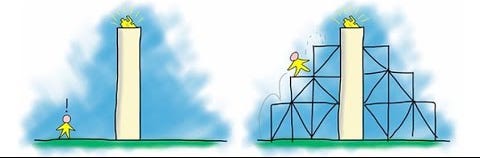
There are, almost always, children of different ages growing up together at the construction site. Older children, unlike teachers, are just a few steps ahead of the younger learners; close enough to model, guide, and support. Unlike adults, they don’t position themselves as all-knowing. Their ‘help’ comes from knowing just a little bit more and is typically weaned off as the younger one becomes capable of performing the task on their own. This evolving relationship prevents the creation of a false ceiling, a threat we often identify with adult-led learning spaces (read previous article to understand this better). The mixed age group learning environment itself becomes a scaffold – where learning flows sideways and not just top-down.
- The materials invite and enable play
At construction sites we have often seen children play with sand, planks of wood, bottles, and old containers; things that are just lying around. These materials aren’t designed as toys, and perhaps that’s exactly why they invite and nurture serious play. They have the power to become anything that the learning mind needs them to be. A plank of wood becomes a slide or a seesaw. Sand becomes pretend food or cement. An empty bottle becomes a scooping device.
 .
. 
In contrast, the brightly coloured plastic vegetables we encountered at the beginning of our observations, seem rather dull in comparison now. They seemed, in fact, to limit the child’s play as he picked them up, tapped them, appearing to lose interest. The toy had already decided what it was.
Conclusion: What might we borrow from here?
Once again, we want to reiterate that we recognise that construction sites are far from perfect learning environments. We believe deeply that the children there deserve safety, security and exposure to educational opportunities beyond what their current environments offer. They deserve to be supported in assimilating their experiences, articulating their knowledge with rich vocabulary, and transferring them across domains, especially as they grow older. However, our time at these sites made us wonder.. What would emerge if we were to observe and build portfolios of learning for children at construction sites? How would they compare to formal early years classrooms? What might we learn about learning through this kind of deliberate and careful observation of their ‘free play’? As we wrote in our first post as Leaves in Pocket, the key is to notice what’s already there and to build on it for all learners.. instead of throwing out the baby with the bathwater.
Before we end, we’d like to share a moment that really moved us.







 )
)