


Under the Rain Tree: Songs, Stories, and Care in Rajasthan’s Balwadis
This edition of the Slate Sribbles is a glimpse of the field visit to sites where Jatan Sansthan implements work related to Early Childhood. Jatan Sansthan is an non-governmental organisation based in Udaipur, Rajasthan where they work on programs related to children, young people and women in the areas of health and education.
The field visit by the team at Bachpan Manao, was to understand how Jatan establishes and runs a Balwadi and the capacity with which they work in Anganwadis and with Anganwadi workers in the regions Amet and Devgarh.
August 7th, 2025:
On an overcast day, Dr. Usha, and Surbhi from Jatan Sansthan, and I set out for a field visit to the Anganwadis and Balwadis that Jatan work with. We were to visit 2 Anganwadis and 1 Balwadi in the blocks of Amet, and Devgarh and finally end our visit at the Jatan office in Rajsamand.
We left around 8 am and stopped on the way for breakfast to have some yummy poha and masala buttermilk. When we reached the first space, the Balwadi in Devgarh, it was around 9 am.
The Balwadi:
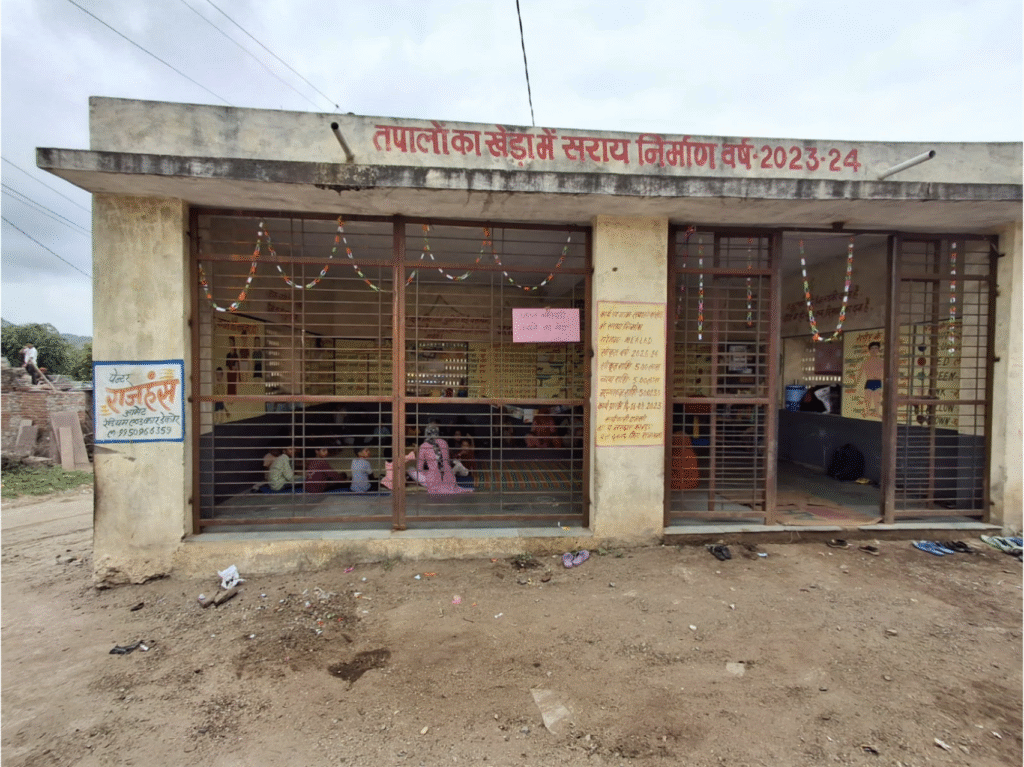
The Balwadi was situated right at the centre of the village with a big rain tree looking over it as if it was placed there specifically for the purpose of shielding it from the rain and sun. As we got out of the car, the men who had gathered around the Balwadi came to greet us. They were extremely welcoming and grateful to Usha, Surbhi, and the work that Jatan had done. The Program officers of the region introduced us to the Up-Pradhan and a few of the other men. As I wondered where the women were, I noticed almost immediately that they were seated inside a space where there were a few kids huddled in a circle with a lady leading some activity.
That space turned out to be the Balwadi. It wasn’t anything remarkable. Far from it, in fact. What surprised me was the fact that it looked like it could have been a large bus shelter. Or a grocery store. Or a small meeting space. It was just a roof with 3 walls and one side completely open and facing the large father tree. They had recently added metal grates to ensure that the kids wouldn’t just run out. I felt it would’ve been nicer without that though. Classrooms with less walls are a nicer option, in my opinion.
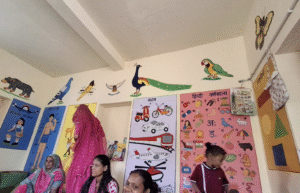
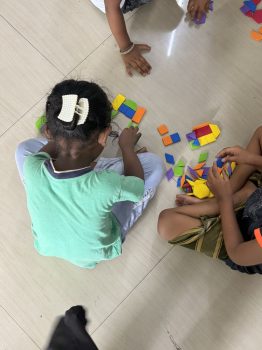
We went inside and met the mothers who had gathered there. As we sat down to begin our discussion, I wondered if we would be disturbing the kids and the teacher. So, I asked Usha about this. We then decided we’d go out and have the discussion. But right then the Balwadi teacher said that she would take the kids out to play and we got the space to ourselves.
Usha began the discussion by giving them some context about why I was there. I then continued by giving them context about Bachpan Manao and the projects we run i.e. First Songs, Stories of Transformation, etc and told them that I was curious to know about their caregiving practices.
We first spoke about their daily routines of which a lot was centered around work and cooking. The women woke early, cooked breakfast, and went to work in the fields or sometimes were involved with NREGA work. The men ate and went to work as labourers, or in the fields, or were involved with NREGA work. The kids were left in the care of the grandparents or at the Balwadi till the afternoon. When the mothers returned in the evening, they would cook dinner and then go to sleep. The fathers usually returned only at night when they would have dinner and then go to sleep. Both the parents didn’t spend too much time with their children but when they did it was usually the mothers that played with the children.
So, I asked them about what they used to play when they were younger and what they played with their children. They used to play ‘Sitoliya’ (Lagori) and ‘the throw-the-pebble-in-the-air-gather-the-others-and-catch-the-pebble-without-dropping-any game, and also ‘Dhollak’ whose video I have attached below. Then I asked if they would make puppets or toys and or sing to the kids.
And then they did ALL of that. They sang so many songs, made a puppet right in front of me, and a toy with thorns, a stick, and goat droppings (Dhollak)
You can see the puppet here along with a song they sang: Puppet and song.mp4 and the goat dung toy here: Stick and goat dung toy.mp4. Here’s the kid playing with that toy: Kid playing with goat dung toy.mp4
They also sang a song about the rain: Rain Song.mp4 and the Up-Pradhan gave the meaning of it as well: Explanation about rain song.mp4
It was lovely to hear and watch all this. There seemed to be so much richness with what they knew and it was all passed down from mother to daughter/daughter-in-law. What was unsurprising though was that the fathers didn’t really involve themselves much with the caregiving aspect of things. They only played the role of the provider for the family.
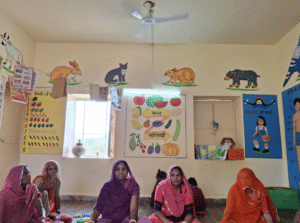
They also spoke about how when they were younger the girls and boys would play together but as they reached their teens, they would play in segregated spaces. The girls would play much lesser though.
After this enriching conversation, we had some yummy lime juice that one of the mothers brought us and then left to an Anganwadi.
The first Anganwadi (Nandgarh)
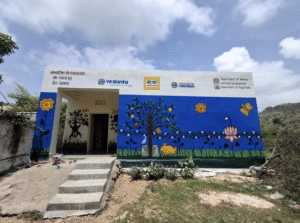
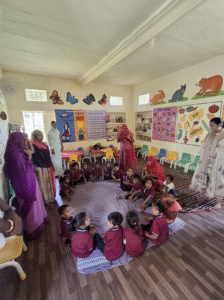
After our time at the Balwadi, we went to see an Anganwadi in Devgarh. The Anganwadi was called a Nandgarh and was funded by Vedanta as a part of their CSR initiative because they have mining operations in the area. The Anganwadi was made to be like a model anganwadi with bright paintings outside and inside. There was also a smart TV inside which the AWW used to show videos or pre-installed activities for the kids.
As in the Balwadi, there were 3 mothers waiting inside the Anganwadi along with the AWW and helper. The program officer of the area was there too. The kids, dressed neatly in their uniforms, were having their class while we started having a similar discussion that we had previously. And they too said the same things. Here though, the AWH was a grandmother and her daughter was there too with her child. I asked if she knew any stories from her culture and she then regaled us a story in Mewari, of which I really didn’t understand much at all. But there seemed to be something about a king and marriage and a woman saying that she would only marry someone with golden hair. The others who understood what she was saying also didn’t quite get the point of the story. But she was really invested in telling us the story and that moment was nice.
Then, as we began talking about lullabies and songs within the community, the Program officer said she knew many lullabies and she sang us one: Song 3.mp4
We also spoke about mothers using their phones and they said that they do give their phones to the kids for 30 – 60 mins but not more than that. When asked about whether they do activities at home with their children, they said that they did but it didn’t sound convincing.
As we were leaving the Anganwadi, the only father that was there, very proudly said that his mother was the AWH and that he had only cleared the area in front of the Anganwadi of rocks, stones, and bushes and said that he was happy to help out in the Anganwadi at all times. “Well, this guy deserves a lot of recognition”, I thought to myself.
The second Anganwadi (also a Nandgarh)
The second Anganwadi we visited, which was in Amet, was a very interesting encounter. Here too, the mothers were seated inside and there were three men that had come. Two were very elderly and one was young (seemed like he was in his mid to late twenties). What was interesting here was that when we began our discussion, there was one lady who was older than everyone else, who spoke the most. She was quite the firebrand. Here she is talking about one of the ways to put the child to sleep: One of the ways to put the kid to sleep.mp4
We had a very similar discussion like in the previous places. But what was interesting here was how passionately the older woman spoke of her disdain towards mothers giving their phones to children because their children were on it all the time. She added that it was just ruining them and they weren’t engaging with the outside world at all and not learning anything! She spoke of how when she was younger she would always learn from what was around her even when she was playing. And she added that that’s how children learn! It just seemed like she had observed so much and knew what children needed. There was something there that the rest of us adults could learn from: to observe more.
Gratitude:
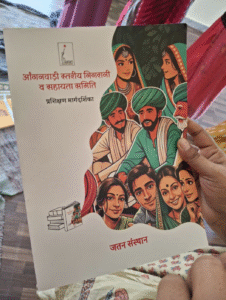
I’d like to conclude by showing my utmost gratitude to all of the staff at Jatan who not only showed me around but patiently explained all of the details of their program and arranged all of the interactions with the beneficiaries that they work with. Special thanks to Dr. Kailash Brijwasi, Dr. Surbhi Yadav, and Dr. Usha Chaudhary for making all of this possible and for hosting me with much care.


 )
)