


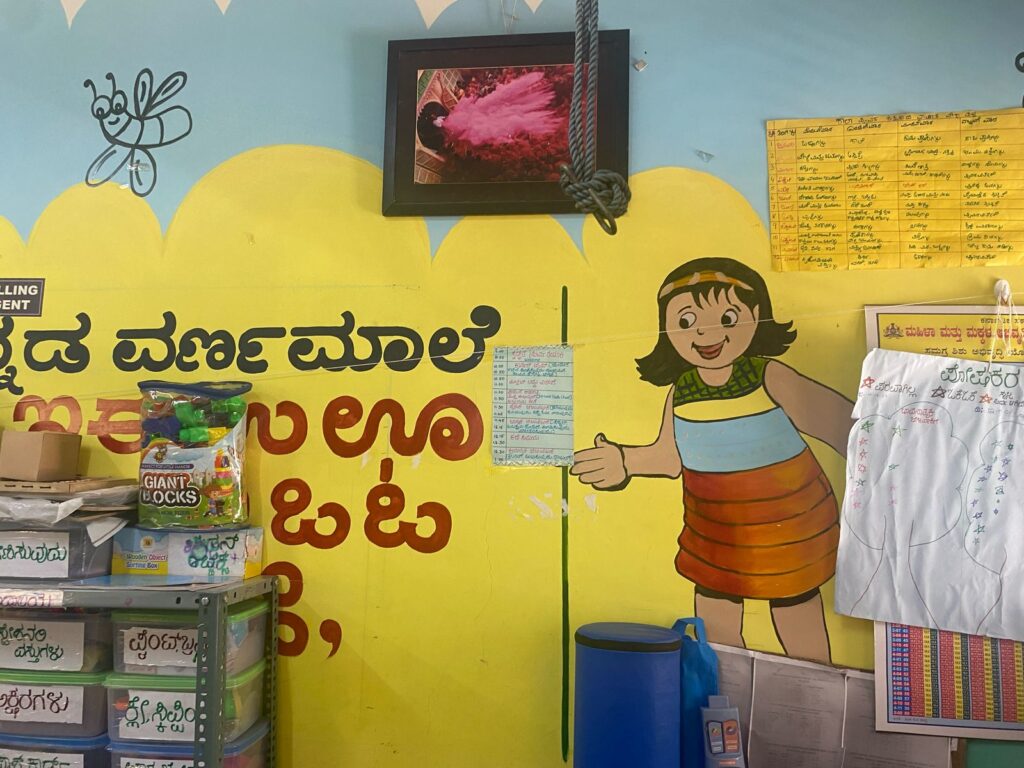
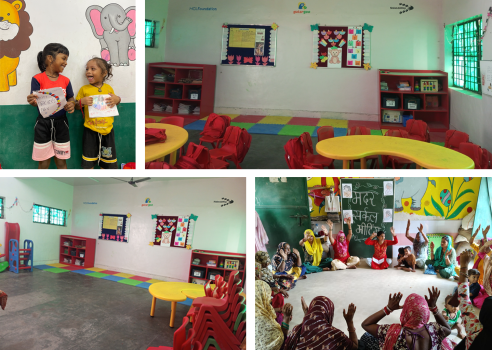
Inside a government school building in Anepalya, Bengaluru — tucked into a room off a corridor — sits a quietly functioning Anganwadi centre. The hum is immediate. Not noise. Not silence. A soft, balanced rhythm.
Children are spread across four learning corners — life skills, block play, cognitive games, role play. In one corner, children are handling toy kitchen sets. Someone offers watermelon juice. Another calls out biryani. A doctor’s set is in use nearby — children putting on stethoscopes, injecting plastic syringes. In another group, towers are being built with blocks. It is clear this isn’t performance. It is daily life.
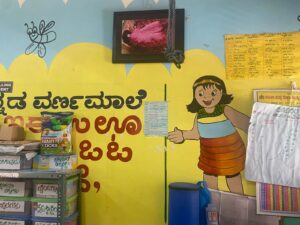
“This is how it is every day,” says Amrutha, Deputy Director at Makkala Jagriti, quietly. “Not because you’re here. You can tell. The engagement is natural. The energy — it’s not tense, and it’s not still. It’s just right.”
In the middle of it all is Ghousia Sultana. She doesn’t command the room. But she’s the one everything flows through. She has been running the Anganwadi for ten years.
She walks slowly from group to group, crouching or leaning in — never towering over. “What is this?” she asks. “What sweet have you made?” She doesn’t fill in the blanks. She waits. The children know how to respond.
The centre has 40 enrolled children. Most of them are Muslim. 60% come from migrant families — Assam, Bihar, Bengal. Many of them speak multiple languages — including Nepali and Kannada. Children often translate for each other.
There is a rhythm to how the space functions. Children identify their own name tags and wear them. There’s circle time, where they sing with actions. There’s a toy library — families borrow toys for about a week. “The very poor hesitate,” Ghousia says. “They’re afraid of breaking the toys.”
Parents now message her if their child is going to miss class. If she forgets to post a photo or update in the parents’ WhatsApp group — which she created — they check in. “They’ve become invested,” she says. “They notice now.”
Zayn is one of the children who has changed over time. “He wouldn’t speak or mingle with others,” recalls Akshita, the field worker. “His parents were very strict. Now, he plays. He talks.”
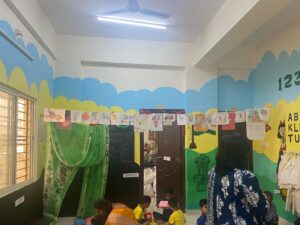
Shaurya plays by himself in the corner, arranging animal toys. Occasionally, another child approaches him to say something. He responds. Then returns to his world. “He isn’t officially enrolled,” Ghousia explains. “If he was, we’d have to show learning outcomes. But his parents were keen. The doctor said it’s good for him to be here.” She adds, “He’s only about ten percent behind. He’s started speaking. He recognises letters. He’s very good with puzzles.”
What sustains all of this is not just the programming. It’s Ghousia.
She puts it simply: “I always wanted to teach children. But I didn’t know how. Makkala Jagriti showed me the way. And helped me understand how important these years are. I didn’t know that before.”
Zameen Taj, the Anganwadi helper, has been here even longer — sixteen years. “I was the one who started this,” she says. “There was nothing here then. Now it has grown.”
Still, the fact that the Anganwadi shares a school campus has not meant equal access. “Actually, the opposite,” says Amrutha. “When an Anganwadi visitor used the school washroom, people asked why. During a school function, when biscuits were distributed, these children were left out. When the school building was upgraded, this room was ignored.”
There is no direct coordination between departments. And yet the Anganwadi runs — and thrives.
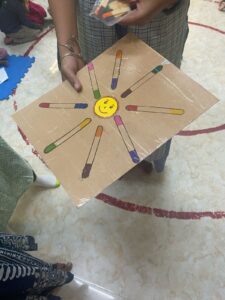
What makes a model Anganwadi? “It’s the worker,” Amrutha says plainly. “Her motivation. That can’t always come from outside. It has to come from within.”
Of the 49 Anganwadis in the area, 20 are now considered model centres. “We started with ten,” she adds. “We’re having long-term conversations with workers — around purpose, mastery, autonomy. About what sustains motivation.”
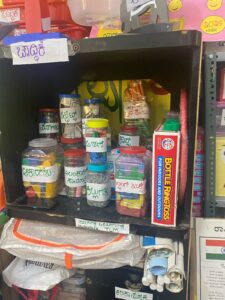
There are systems in place — learning templates, teaching-learning materials created by volunteers, a parent activity book, a child assessment card issued by WCD. But the relationship work sits beyond all this.
During parent meetings — ten have been held in the past year — Ghousia walks families through why play matters. She leads
them in simple exercises — like joining dots on a brain diagram to explain development. She shares stories of how different environments shape children. “That’s when the ‘aha’ moments happen,” says Amrutha. “They get it.”
On ECCE Day, the centre had a photo booth. On Graduation Day, parents attended. Photos are shared on the group. Some parents send videos back. Others put them up as their WhatsApp status.
Ghousia doesn’t speak in frameworks. But her daily practice is full of intent.
This isn’t a shiny space. But it is a steady one. What you see here isn’t a single programme working well — it is a long, consistent act of care. One that has made the centre not just functional, but trusted.
And the person at the centre of that? She doesn’t stand at the front of the room. She moves through it.
—–
This story is part of Voices of Care—an ongoing inquiry into the caregiving systems that shape childhood in India. By understanding what enables care to thrive, we uncover what allows children to flourish.
Slate Scribbles—a series of on-ground reflections from our visits, documenting the people and practices that quietly hold up a child’s world.
A heartfelt thank you to the team at Makkala Jagriti for opening up their space to us. A space shaped gently by trust, consistency, and the belief that small gestures, repeated daily, can build something lasting. This note is drawn from what we saw, heard, and quietly understood: that even in systems with constraints, it is people who make the centre hold.







 )
)